
Catalogue Search | MBRL


Are you sure you want to remove the book from the shelf?

{{itemTitle}}
178
result(s) for
"Pyramids Egypt."
Sort by:

Mysteries of the Egyptian pyramids
Introduces readers to the myths, science, and technology surrounding the creation and exploration of the Egyptian pyramids.
Book

On the Origins of the Cartouche and Encircling Symbolism in Old Kingdom Pyramids
This study suggests the development of the cartouche was closely related to the monumental encircling symbolism incorporated into the architectural designs of the Old Kingdom pyramids. By employing a new architectural style and a new iconographic symbol, the pharaoh sought to elevate his status above that of the members of his powerful court.
eBook
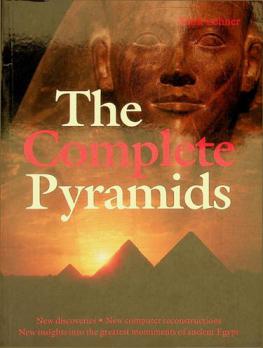
The complete pyramids
Discusses the origin and development of the Egyptian pyramids, describes their role in Egyptian religion and culture, profiles pyramid explorers, and explains how they were built.
Book

The Pyramid Builders of Ancient Egypt
In Rosalie David's hands, the Egyptian builders of the pyramids are revealed as simple people, leading ordinary lives while they are engaged on building the great tomb for a Pharoah. This is an engrossing detective story, bringing to the general reader a fascinating picture of a special community that lived in Egypt and built one of the pyramids, some four thousand years ago.
eBook

Egyptian pyramids
\"Describes the pyramids of ancient Egypt, one of the ancient wonders of the world, including how and why they were built, the pharaohs who were buried inside, and what the ruins are like today\"--Provided by publisher.
Book

Building the Great Pyramid in One Year
Work smarter, not harder? Most archaeologists feel that 25,000 workers spent 20 years building the Great Pyramid in Egypt over 4000 years ago. However, by closely examining the clues and artifacts left behind, and by assuming that the Egyptians were clever and intelligent, it is found that 10,000 workers could have built the Great Pyramid in about 385 days. This book, for high school readers and up, shows how, even at a more realistic, relaxed building schedule, the project could have been completed easily within four to six years by just 4000 workers. Gerard Fonte presents the construction of the Great Pyramid as a wonder indeed, while challenging our cherished notions of the arduous labor and extreme human costs required for the project. Starting with his knowledge of project management, the properties of basic materials, and common sense, and giving the Egyptians credit as a sophisticated and well-run society, he shows step by step how they may have built great edifices and enhanced social cohesion at the same time. He posits that some of the implements found at archeological sites were clever labor-saving devices, and using experiments, models and tests he illustrates some ingenious techniques that were well within the scope of Egyptians' technical knowledge. Photographs and diagrams support his theory. This research covers all major aspects of pyramid building: quarrying, moving, placing, lifting, fitting the blocks, finishing the outer casing blocks, placing the top-most blocks, tool specifications, wood requirements and machine design. It examines Egyptian pyramids in general, general pyramid geometry, common pyramid fallacies, available worker population, social effects of large works and scale factors in engineering. It is important to emphasize that everything is based on archaeological remains, forensic evidence, engineering
principles, common sense and creativity. Additionally, it presumes that the Egyptian builders were intelligent and innovative and would use the best available techniques. In particular, two mysterious tools that have been found at the pyramid site are examined and found to instrumental for moving and lifting the blocks. The first is the wooden quarter circle or rocker which is made from imported cedar. The author built replicas of these tools and was able to move a 4200 pound concrete pyramid block 15 feet in less than 10 seconds by himself and from a stationary starting position. (The author was 52 years old and weighed 135 pounds at the time.) A forensic examination of the second tool, a proto-pulley , reveals that the Egyptians used a particular type of lever to lift the blocks. A time-motion examination showed that three men could lift a block a full course in just three minutes with this lever. The conventional approaches of using ramps to lift blocks and sledges to move blocks are examined are shown to be flawed. The consequences of employing these methods lead to untenable situations, like a quarry that must supply twice as much rock than it can possibly hold.
eBook

Pyramids of Egypt
\"Carefully leveled text and vibrant photographs introduce early readers to the science and engineering behind the Pyramids of Egypt. Includes infographics, an activity, glossary, and index\"-- Provided by publisher.
Book

Saving the pyramids : twenty-first century engineering and Egypt's ancient monuments
\"Having worked on projects around the world, strengthening and restoring historically significant structures from Windsor Castle to the parliament building in Canada, Peter James brings insight to the structural engineering of ancient Egypt. After fourteen years working on the historic buildings and temples of Egypt, and most recently on the world's oldest pyramid, he now presents some of the more common theories surrounding the 'collapsing' pyramid -- along with new and innovative projections on the construction of the pyramids and the restoration of some of Cairo's most monumental structures from the brink of ruin. The decoding of historic construction from a builder's perspective is examined and explained -- at times against many existing theories -- and the book provides a new outlook on long-held assumptions, to embrace theories in a bid to preserve the past.\"-- Back cover.
Book