
Catalogue Search | MBRL


Are you sure you want to remove the book from the shelf?

{{itemTitle}}
485
result(s) for
"Pythagorean theorem."
Sort by:

What's your angle, Pythagoras? : a math adventure
In ancient Greece, young Pythagoras discovers a special number pattern (the Pythagorean theorem) and uses it to solve problems involving right triangles.
Book

Geometry of q-Exponential Family of Probability Distributions
The Gibbs distribution of statistical physics is an exponential family of probability distributions, which has a mathematical basis of duality in the form of the Legendre transformation. Recent studies of complex systems have found lots of distributions obeying the power law rather than the standard Gibbs type distributions. The Tsallis q-entropy is a typical example capturing such phenomena. We treat the q-Gibbs distribution or the q-exponential family by generalizing the exponential function to the q-family of power functions, which is useful for studying various complex or non-standard physical phenomena. We give a new mathematical structure to the q-exponential family different from those previously given. It has a dually flat geometrical structure derived from the Legendre transformation and the conformal geometry is useful for understanding it. The q-version of the maximum entropy theorem is naturally induced from the q-Pythagorean theorem. We also show that the maximizer of the q-escort distribution is a Bayesian MAP (Maximum A posteriori Probability) estimator.
Journal Article

The Pythagorean theorem : a 4,000-year history
The author presents a complex history of the Pythagorean Theorem, examining the earliest evidence of knowledge of the theorem to Einstein's theory of relativity.
Book

Examining tenth-grade students’ errors in applying Polya’s problem-solving approach to Pythagorean theorem
This study uses Polya’s problem-solving strategy to explore student errors and causal factors in Pythagorean theorem problem-solving. The sample was drawn from tenth-grade students at Al Hosn Secondary School in Abu Dhabi, United Arab Emirates in the academic year 2023/2024. Data were collected using two methods: written examinations, as outlined in Polya’s strategy, and interviews with students who committed errors. The research test instrument consists of 3 trigonometric problem-solving. From 30 students of Al Hosn Secondary School, there were 48.9% of data errors, 50% of concept errors, 57.8% of strategy errors, 47.8% of calculation errors, and 14.4% of careless errors. The errors made by the students originated from their inability to comprehend the geometric interpretation of the Pythagorean theorem, difficulties in applying algebraic operations, and challenges in modelling the data provided in the problems.
Journal Article

Pythagoras and the ratios
An ancient Greek boy, Pythagoras, helps his cousins produce pleasant music when he adjusts the mathematical ratios between the part of their pipes and lyres, knowledge he would later use to become a famous philosopher.
Book

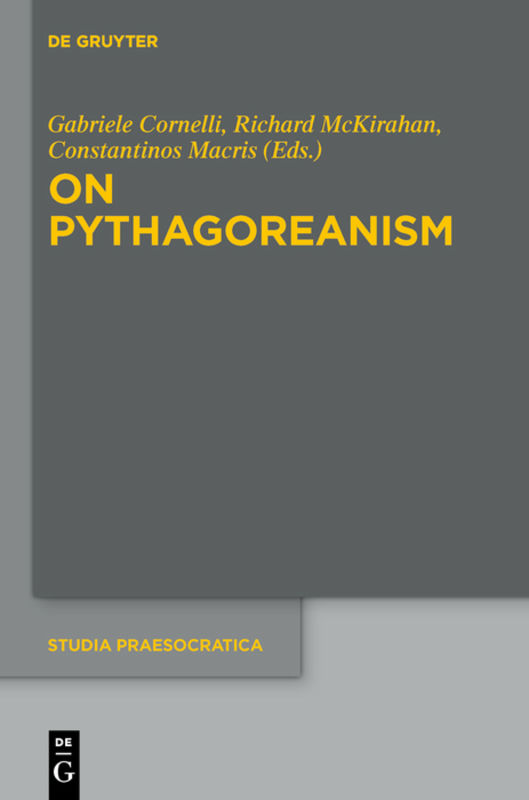
On Pythagoreanism
The purpose of the conference \"On Pythagoreanism\", held in Brasilia in 2011, was to bring together leading scholars from all over the world to define the status quaestionis for the ever-increasing interest and research on Pythagoreanism in the 21st century. The papers included in this volume exemplify the variety of topics and approaches now being used to understand the polyhedral image of one of the most fascinating and long-lasting intellectual phenomena in Western history. Cornelli's paper opens the volume by charting the course of Pythagorean studies over the past two centuries. The remaining contributions range chronologically from Pythagoras and the early Pythagoreans of the archaic period (6th-5th centuries BCE) through the classical, hellenistic and late antique periods, to the eighteenth century. Thematically they treat the connections of Pythagoreanism with Orphism and religion, with mathematics, metaphysics and epistemology and with politics and the Pythagorean way of life.
eBook


ANA: Ant Nesting Algorithm for Optimizing Real-World Problems
In this paper, a novel swarm intelligent algorithm is proposed called ant nesting algorithm (ANA). The algorithm is inspired by Leptothorax ants and mimics the behavior of ants searching for positions to deposit grains while building a new nest. Although the algorithm is inspired by the swarming behavior of ants, it does not have any algorithmic similarity with the ant colony optimization (ACO) algorithm. It is worth mentioning that ANA is considered a continuous algorithm that updates the search agent position by adding the rate of change (e.g., step or velocity). ANA computes the rate of change differently as it uses previous, current solutions, fitness values during the optimization process to generate weights by utilizing the Pythagorean theorem. These weights drive the search agents during the exploration and exploitation phases. The ANA algorithm is benchmarked on 26 well-known test functions, and the results are verified by a comparative study with genetic algorithm (GA), particle swarm optimization (PSO), dragonfly algorithm (DA), five modified versions of PSO, whale optimization algorithm (WOA), salp swarm algorithm (SSA), and fitness dependent optimizer (FDO). ANA outperformances these prominent metaheuristic algorithms on several test cases and provides quite competitive results. Finally, the algorithm is employed for optimizing two well-known real-world engineering problems: antenna array design and frequency-modulated synthesis. The results on the engineering case studies demonstrate the proposed algorithm’s capability in optimizing real-world problems.
Journal Article

The Schur-Horn Theorem for operators with finite spectrum
We characterize the set of diagonals of the unitary orbit of a self-adjoint operator with a finite spectrum. Our result extends the Schur-Horn theorem from a finite dimensional setting to an infinite dimensional Hilbert space, analogous to Kadison’s theorem for orthogonal projections, and the second author’s result for operators with three point spectrum.
Journal Article