
Catalogue Search | MBRL


Are you sure you want to remove the book from the shelf?

{{itemTitle}}
1,244
result(s) for
"Qiu"
Sort by:

Dong Zhongshu, a 'Confucian' Heritage and the Chunqiu fanlu
The assumption that a system described as 'Confucianism' formulated by Dong Zhongshu became accepted as the norm during the Western Han dynasty (202 BCE - 9 CE) is challenged and his supposed authorship of the Chunqiu fanlu examined.
eBook


Diagnosing the development of seasonal stratification using the potential energy anomaly in the North Pacific
Upper-ocean seasonal stratification (seasonal pycnocline and/or transition layer) is a ubiquitous feature and its vertical structure has large spatial variability. The density stratification regulates the stability of the upper ocean and thus can affect the oceanic response to atmospheric forcing and biogeochemical processes by modulating vertical mixing. In this study, we described the development of the seasonal stratification in terms of the stability of the water column, using the potential energy anomaly (PEA) as a metric based on Argo profiles. PEA budget analysis reveals that over most of the North Pacific, seasonal stratification develops under a vertical one-dimensional energy balance between an increase in PEA (i.e., a strengthening of the stratification) driven by atmospheric buoyancy forcing and a decrease in PEA associated with vertical mixing within the water column. Horizontal advection of PEA plays a significant role in the seasonal development of the stratification only in the regions of the western boundary current and equatorial current system south of 10°N. We find that, in addition to the total magnitude of the oceanic buoyancy gain, the balance between compositions of the atmospheric forcing (non-penetrating surface buoyancy forcing and penetrating radiative heating) is also important in explaining regional differences in the development of the seasonal stratification. The vertical diffusivity in the seasonal stratification estimated from the residual of the PEA budget is in the range from 5 × 10
−5
m
2
s
−1
to 5 × 10
−4
m
2
s
−1
and shows spatial and seasonal variability associated with local wind forcing.
Journal Article
Xenotropism and the Awakening of Literary Expatriatism through Writing Memoirs
Although there have been many discussions about challenges faced by individuals going through East to West migrations, there are few literary accounts about such migrations. Yet these migrations are becoming more frequent now due to advances in technology and the fact that a writer's work can now involve an increasingly global audience. One way of expressing these challenges is through writing memoirs. Xenotropism and the Awakening of Literary Expatriatism through Writing Memoirs about China exemplifies the craft of memoirs written while living in a foreign country and explains how this is different from writing from home. The book is a theoretical analysis of xenotropism based on the work of three prominent writers in China's history: Emily Hahn, Nien Cheng and Qiu Xiaolong. The author explores the relationship between xenotropism (turning towards foreign ideals and practices), its complexities and challenges, and the writing of a memoir and its impact on mental health. This discourse will contribute to new knowledge in the field of creative writing and Asian studies by illustrating how xenotropism or 'turning towards foreign ideals and practices' results in both personal and artistic development and builds an understanding and acceptance of different cultures within an individual. These processes of change and understanding, in turn, facilitate the writing of a memoir, which is a cathartic process having a positive effect on one's mental state. Readers interested in creative writing or Asian literary studies will be able to understand the creative process behind writing memoirs from a combination of personal, research-based, literary and theoretical perspectives.
eBook

The Influence of Qiu Jun on Jesuit Missionaries and Chinese Christian Texts in Ming–Qing China
This study explores the previously overlooked influence of Qiu Jun, a renowned mid-Ming dynasty scholar, on Jesuit missionaries and Chinese Catholic believers. Although Qiu’s impact on Confucian scholars of the mid-to-late Ming period is well established, his role in shaping formalized Chinese ritual systems and Chinese Catholicism has received little attention. A closer examination of Jesuit missionaries’ translation of Confucian classics and Chinese Catholic texts from the late Ming and early Qing periods reveals that Qiu’s works were frequently cited, particularly in relation to the abolition of divine titles, the worship of Confucius, and the establishment of the City-god system. Qiu’s responses to these issues, informed by Emperor Zhu Yuanzhang’s efforts to centralize power and establish authority in both secular and religious spheres, served as key references for mid-Ming reforms. Moreover, Jesuit fathers and Chinese Catholic adherents drew on Qiu’s perspectives in their writings to address various issues during the Chinese Rites Controversy. This research uncovers the profound impact of Qiu Jun’s ideas on the cultural exchange between China and the West in the 17th–18th centuries.
Journal Article

Beyond the Tribute of Yu: Sinitic Poetry's First Encounters with the Heartland of the Mongols
This article investigates the increased presence of Inner Asian landscapes in Sinographic poetry during the Mongol era and thus challenges traditionally postulated boundaries between sedentary and nomadic societies. Examining two sets of poems by Qiu Chuji 丘處機 (1148–1227) and Yelü Chucai 耶律楚 材 (1190–1244) that document their journeys through the Mongol heartland in the Eurasian Steppes of the early thirteenth century, this study highlights their pioneering efforts in adapting Sinographic poetics to represent this newly accessed landmass. While Qiu Chuji utilized early Daoist discourse about the far north to create a new framework that incorporated Mongol territories into the world of Sinographic literature, Yelü Chucai sought to connect the Mongol enterprise with the foundational periods of earlier powerful dynasties. This research contributes to the understanding of cross-cultural exchanges during the Mongol era and the role of travel in shaping Sinographic writers' imaginations of the emerging Mongol empire.
Journal Article

The Zuo Tradition / Zuozhuan Reader
Essential passages from a classic Chinese history, organized topically, introduced, and annotatedZuo Tradition, China’s first great work of history, was completed by about 300 BCE and recounts events during a period of disunity from 722 to 468 BCE. The text, which plays a foundational role in Chinese culture, has been newly translated into English by Stephen Durrant, Wai-yee Li, and David Schaberg in an unabridged, bilingual, three-volume set. This reader arranges key passages from that set according to topic, as a guide to the study of early Chinese culture and thought. Chapter subjects include succession struggles; women; warfare; ritual propriety; governance; law and punishment; famous statesmen; diplomacy; Confucius and his disciples; dreams and anomalies; and cultural others. An introduction explains the nature and significance of Zuozhuan and discusses how to read the text. Section introductions and judicious footnoting provide contextual information and explain the historical significance and meaning of particular events. The Zuo Tradition / Zuozhuan Reader will appeal to readers interested in Chinese and world history, claiming a place on library and personal bookshelves alongside other narratives from the ancient world.
eBook

Effect of Neiyi Prescription of QIU on autophagy and angiogenic ability of endometriosis via the PPARγ/NF-κB signaling pathway
ObjectivesNeiyi Prescription of QIU (NYPQ) is a traditional Chinese medicine prescription for the treatment of endometriosis (EMS). Here, we aimed to examine the effects and mechanisms of NYPQ on angiogenic ability in EMS.Study designEMS rats were established with estradiol valerate and autologous transplantation. EMS rats were intraperitoneally injected with chloroquine (CQ, 40 mg/kg), rapamycin (RAPA, 1 mg/kg), and monoclonal antibody VEGF (anti-VEGF, 3 mg/g/d) or administered 5, 10, 20 mg/g/d NYPQ decoction through oral gavage for 4 weeks, respectively. By the before and end of the treatment period, the volume of the endometriotic lesions was measured. The pathological morphology, angiogenesis, and the number of autophagosomes of the endometriotic lesion were observed by hematoxylin and eosin staining, immunohistochemistry, and transmission electron microscope, respectively. The cell viability, apoptosis, and angiogenesis of HUVECs were detected by MTT, flow cytometry, and lumen formation experiment, respectively. The expression levels of VEGF, autophagy-/apoptosis-/PPARγ/NF-κB- pathway-related proteins in endometrium tissues or HUVECs were detected by western blot assays.ResultsThe autophagy agonist rapamycin reduced the lesion size, the microvessel density, and VEGF expression, and promoted the production of autophagosomes and the expression of autophagy-related proteins, while the autophagy inhibitor chloroquine had the opposite effects. In vivo, NYPQ could dose-dependently reduce lesion volume and microvessel density, ameliorate histopathological features and promote autophagosome production of ectopic endometrium. Moreover, serum-containing NYPQ could significantly inhibit the cell viability and tube formation of HUVECs and elevate HUVECs apoptosis. Besides, NYPQ significantly reduced VEGF and promoted autophagy-/apoptosis-related protein expressions. Also, NYPQ might promote autophagy and inhibit angiogenesis by activating the PPARγ/NF-κB pathway.ConclusionsCollectively, these findings indicate that NYPQ has therapeutic potential in experimentally induced peritoneal endometriosis, and its mechanism may be related to the activation of the PPARγ/NF-κB signaling pathway.
Journal Article

Erratum to “Therapeutic Effectiveness and Safety of Mesotherapy in Patients with Osteoarthritis of the Knee”
In the article titled “Therapeutic Effectiveness and Safety of Mesotherapy in Patients with Osteoarthritis of the Knee” [1], Dr. Bo Qiu should be listed as a corresponding author along with Xianglei Wu.
Journal Article
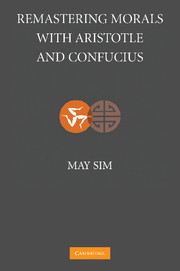
Remastering Morals with Aristotle and Confucius
Aristotle and Confucius are pivotal figures in world history; nevertheless, Western and Eastern cultures have in modern times largely abandoned the insights of these masters. Remastering Morals, published in 2007, provides a book-length scholarly comparison of the ethics of Aristotle and Confucius. May Sim's comparisons offer fresh interpretations of the central teachings of both men. More than a catalog of similarities and differences, her study brings two great traditions into dialog so that each is able to learn from the other. This is essential reading for anyone interested in virtue-oriented ethics.
eBook