
Catalogue Search | MBRL


Are you sure you want to remove the book from the shelf?

{{itemTitle}}
9,039
result(s) for
"Queens History."
Sort by:

Scholars and Poets Talk About Queens
\"Scholars and Poets Talk About Queens is a lively and erudite collection, unusual in an especially appealing way: not only are there essays about a range of queens and how they were represented in the Middle Ages and Renaissance through primary accounts, chronicles, and literary representations, but the book also contains modern poetry and short plays about these same queens, allowing readers to understand and appreciate them both intellectually and emotionally. Queens include such famous and fascinating women as Hecuba, Cleopatra, the Empress Matilda, Margaret of Anjou, Catherine of Aragon, Mary Stuart, and Queen Elizabeth I, and Grace O'Malley, a pirate queen. One can find, for example, an essay on Mary Stuart's responses to her widowhoods paired with Mary's lamentation from the afterlife. After reading the analysis of the Empress Matilda's efforts to gain the throne of England, one can also see the character of the much older Matilda playing chess with her daughter-in-law Eleanor of Aquitaine\"-- Provided by publisher.
Book
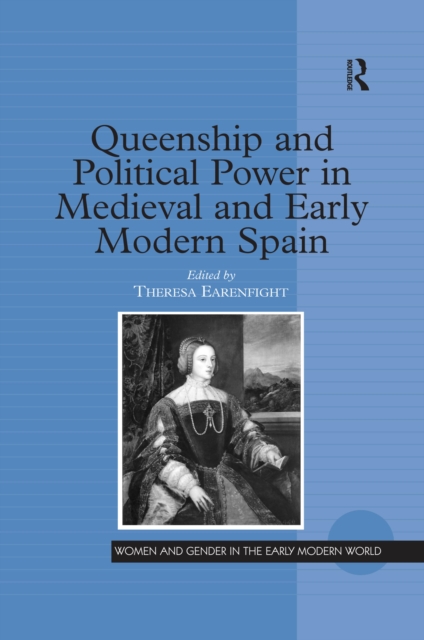
Queenship and Political Power in Medieval and Early Modern Spain
Unlike empresses in Germany and queens in England and France, the lives and political careers of most Iberian queens remain largely unknown to non-specialists. In this collection, Theresa Earenfight brings together new research on medieval and early modern Spanish queens that highlights the distinctive political culture that resulted in forms of queenship similar to, yet also substantially different from, that of northern Europe. The essays consider three aspects of queenship and politics: the institutional foundations and practice of politics, the politics of religion and religious devotion, and the literary and artistic representations of queenship and power. Late medieval queens, because they often occupied prominent and powerful offices such as the regency in Castile and Portugal and the Lieutenancy in the Crown of Aragon, exemplify a unique form of queenship that can best be described as a political partnership. Habsburg queens and empresses, often excluded from such official political roles, were less publicly visible but their power as partner to the king, although shrouded, remains potent. Their political careers were the result of two forces: first, military circumstances brought about by territorial expansion, conquest, and second, a political culture that did not explicitly prohibit queens from active participation in the governance of the realm. The essays in this collection-by both newer and well established scholars-demonstrate the range and depth of current research on Iberian queenship, and prompt a re-examination of long-held assumptions about women and the exercise of power in pre-modern Spain.
Contents: Preface: Part I The Practical Limits of Partnership: Unwilling partners: conflict and ambition in the marriage of Peter II of Aragon and Marie de Montpellier, Elizabeth Haluska-Rausch; The many roles of the medieval queen: some examples from Castile, Joseph F. O'Callaghan; Absent kings: queens as political partners in the medieval crown of Aragon, Theresa Earenfight. Part II Practising the Politics of Religion: Defending their Jewish subjects: Elionor of Sicily, Maria de Luna, and the Jews of Morvedre, Mark Meyerson; Spirit and force: politics, public and private in the reign of Maria de Luna (1396-1406), Núria Silleras-Fernández; The queen and the master: Catalina of Lancaster and the military orders, Ana Echevarria-Arsuaga. Part III Representing the Politics of Queenship: Royal portraits: representations of queenship in the 13th-century Catalan chronicles, Marta VanLandingham; Isabel of Castile (1451-1504), her self-representation and its context, Peggy Liss; Choices and consequences: the construction of Isabel de Portugal's image, Jorge Sebastián Lozano; Conspicuous in her absence: Mariana of Austria, Juan José of Austria, and the representation of her power, Eleanor Goodman. Bibliography; Index.
Theresa Earenfight is Associate Professor of History at Seattle University.
eBook

Forgotten queens in medieval and early modern Europe : political agency, myth-making, and patronage
\"Forgotten Queens in Medieval and Early Modern Europe examines queens dowager and queens consort who have disappeared from history or have been deeply misunderstood in modern historical treatment. Divided into eleven chapters, this book covers queenship from 1016 to 1800, demonstrating the influence of queens in different aspects of monarchy over eight centuries and furthering our knowledge of the roles and challenges that they faced. It is ideal for students and scholars of pre-modern queenship and of medieval and early modern history courses more generally.\"--Provided by publisher.
Book

The Routledge Companion to Women and Monarchy in the Ancient Mediterranean World
This volume offers the first comprehensive look at the role of women in the monarchies of the ancient Mediterranean. It consistently addresses certain issues across all dynasties: title; role in succession; the situation of mothers, wives, and daughters of kings; regnant and co-regnant women; and role in cult and in dynastic image, and examines a sampling of the careers of individual women while placing them within broader contexts. Written by an international group of experts, this collection is based on the assumption that women played a fundamental role in ancient monarchy, that they were part of, not apart from it, and that it is necessary to understand their role to understand ancient monarchies. This is a crucial resource for anyone interested in the role of women in antiquity.
eBook


Queens & power in medieval and early modern England
In Queens and Power in Medieval and Early Modern England , Carole Levin and Robert Bucholz provide a forum for the underexamined, anomalous reigns of queens in history. These regimes, primarily regarded as interruptions to the “normal” male monarchy, have been examined largely as isolated cases. This interdisciplinary study of queens throughout history examines their connections to one another, their constituents’ perceptions of them, and the fallacies of their historical reputations. The contributors consider historical queens as well as fictional, mythic, and biblical queens and how they were represented in medieval and early modern England. They also give modern readers a glimpse into the early modern worldview, particularly regarding order, hierarchy, rulership, property, biology, and the relationship between the sexes. Considering topics as diverse as how Queen Elizabeth’s unmarried status affected the perception of her as a just and merciful queen to a reevaluation of “good Queen Anne” as more than just an obese, conventional monarch, this volume encourages readers to reexamine previously held assumptions about the role of female monarchs in early modern history.
eBook

Regina : the queens who could have been
Our princesses have been mothers willing to risk anything for their children, wives who followed their husbands to the very ends of earth, and spinsters who demanded their intellectual and societal freedom. This book explores what it meant to be royal, how sons came to be valued higher than daughters, and just how England might have looked under a royal matriarchy. The politicians we lost, the masterminds we see negotiating nunneries not armies, the personalities shining brilliantly even hundreds of years later: the Queens who should have been. Let's meet them.
BOOK

Queens and Queenship
This work looks at queenship in a global, timeless sense—examining the role of queens, empresses, and other royal women from the ancient and classical period through to nearly the present day on every continent. By looking at queenship in this comparative, longue durée way, we can start to see connecting threads and continuity over time and space as well as the change and development and comparisons of how the queen's role differed in various cultural contexts. A wide variety of examples are given to explain and contextualize key themes in queenship: family and dynasty, rulership, and image crafting. The introduction provides a brief overview of the development of queenship studies and a discussion of the ideals that queens were expected to conform to. This book offers a radically new perspective on queenship studies which enables new insights into the queen's role as the preeminent woman in the realm.
eBook


Rochdale Village
From 1963 to 1965 roughly 6,000 families moved into Rochdale Village, at the time the world's largest housing cooperative, in southeastern Queens, New York. The moderate-income cooperative attracted families from a diverse background, white and black, to what was a predominantly black neighborhood. In its early years, Rochdale was widely hailed as one of the few successful large-scale efforts to create an integrated community in New York City or, for that matter, anywhere in the United States.
Rochdale was built by the United Housing Foundation. Its president, Abraham Kazan, had been the major builder of low-cost cooperative housing in New York City for decades. His partner in many of these ventures was Robert Moses. Their work together was a marriage of opposites: Kazan's utopian-anarchist strain of social idealism with its roots in the early twentieth century Jewish labor movement combined with Moses's hardheaded, no-nonsense pragmatism.
Peter Eisenstadt recounts the history of Rochdale Village's first years, from the controversies over its planning, to the civil rights demonstrations at its construction site in 1963, through the late 1970s, tracing the rise and fall of integration in the cooperative. (Today, although Rochdale is no longer integrated, it remains a successful and vibrant cooperative that is a testament to the ideals of its founders and the hard work of its residents.) Rochdale's problems were a microcosm of those of the city as a whole-troubled schools, rising levels of crime, fallout from the disastrous teachers' strike of 1968, and generally heightened racial tensions. By the end of the 1970s few white families remained.
Drawing on exhaustive archival research, extensive interviews with the planners and residents, and his own childhood experiences growing up in Rochdale Village, Eisenstadt offers an insightful and engaging look at what it was like to live in Rochdale and explores the community's place in the postwar history of America's cities and in the still unfinished quests for racial equality and affordable urban housing.
eBook