
Catalogue Search | MBRL


Are you sure you want to remove the book from the shelf?

{{itemTitle}}
872
result(s) for
"Question (Logic)"
Sort by:
Questions in discourse. Volume 2, pragmatics
The volume 'Questions in Discourse - Vol. 2 Pragmatics' collects original research on the role of questions in understanding text structure and discourse pragmatics. The in-depth studies discuss the effects of focus, questions and givenness in unalternative semantics, as well as the role of scalar particles, question-answer pairs and prosody from the perspective of Questions under Discussion. Two contributions compare the discourse-structuring potential of Questions under Discussion and rhetorical relations, whereas another adds a perspective from inquisitive semantics. Some contributions also look at understudied languages. Together, the contributions allow for a better understanding of question-related pragmatic and discourse-semantic phenomena, and they offer new perspectives on the structure of texts and discourses.
Book


The In-Class Questions of Science and Engineering Students: A Gender-Based Perspective
Research in Educational Sciences has suggested that a student’s participation in the classroom varies according to their gender. In STEM fields of higher education, male students tend to participate more in class than female students. However, with respect to the specific form of participation represented by students’ questioning, the conclusions of the existing studies are not yet perfectly overlapping in their findings. Considering that the posing of questions by students is one of the activities that reveal greater student participation and involvement in class, we aimed to investigate and characterize the questioning patterns of male and female students in chemistry classes and within the contexts of various teaching strategies designed to encourage their questioning. In an effort to contribute to a deeper understanding of student questioning in higher education, and with a particular focus on gender differences, this study also sought to identify the contexts and conditions that are more conducive to questioning by male and female students. This study was conducted in two first-year chemistry classes attended by sciences and engineering students at a Portuguese university, following a mixed methodology. Concerning the students’ questioning patterns, specifically in terms of their frequency and contextual occurrence, our findings showed that although in the first semester the female students asked fewer questions in class than the male students, in proportion to the representation of each gender in the class, this trend was reversed in the second semester. As the year developed and students became more acquainted with each other, female students asked more questions. The number of questions asked in each phase of the study leads us to conclude that, with respect to asking questions, female students benefit from strategies that foster familiarisation with the context. On the other hand, male students do not benefit from an increased familiarisation with the context.
Journal Article

When do parts form wholes? Integrated information as the restriction on mereological composition
Abstract
Under what conditions are material objects, such as particles, parts of a whole object? This is the composition question and is a longstanding open question in philosophy. Existing attempts to specify a non-trivial restriction on composition tend to be vague and face serious counterexamples. Consequently, two extreme answers have become mainstream: composition (the forming of a whole by its parts) happens under no or all conditions. In this paper, we provide a self-contained introduction to the integrated information theory (IIT) of consciousness. We show that IIT specifies a non-trivial restriction on composition: composition happens when integrated information is maximized. We compare the IIT restriction to existing proposals and argue that the IIT restriction has significant advantages, especially in response to the problems of vagueness and counterexamples. An appendix provides an introduction to calculating parts and wholes with a simple system.
Journal Article

The commitment of rhetorical questions
Rhetorical questions have received a detailed treatment in semantic studies that defined them in terms of common ground updating, assertion and lack of information seeking. How these semantic traits interact with the syntactic derivation of a rhetorical question has been less debated in the literature (with some notable exceptions). This paper adopts the findings of the semantic studies and considers them from a syntactic perspective: to what degree does syntax contribute to the interpretation of an interrogative clause as a rhetorical question? The paper focuses on data where the switch from a heuristic to a rhetorical reading of interrogatives is forced by the insertion of certain lexical items, and analyzes these items within a framework that maps conversational pragmatics to syntax. In particular, the proposal is that the interaction of the question clause typing feature with an evidential feature in the Commitment Phrase (i.e., the projection that relates speaker/addressee to the proposition) has the effect of an assertion that overrides the addressee-orientedness of the interrogative clause.
Journal Article

Uncovering students’ misconceptions by assessment of their written questions
Background
Misconceptions are ideas that are inconsistent with current scientific views. They are difficult to detect and refractory to change. Misconceptions can negatively influence how new concepts in science are learned, but are rarely measured in biomedical courses. Early identification of misconceptions is of critical relevance for effective teaching, but presents a difficult task for teachers as they tend to either over- or underestimate students’ prior knowledge. A systematic appreciation of the existing misconceptions is desirable. This explorative study was performed to determine whether written questions generated by students can be used to uncover their misconceptions.
Methods
During a small-group work (SGW) session on Tumour Pathology in a (bio)medical bachelor course on General Pathology, students were asked to write down a question about the topic. This concerned a deepening question on disease mechanisms and not mere factual knowledge. Three independent expert pathologists determined whether the content of the questions was compatible with a misconception. Consensus was reached in all cases. Study outcomes were to determine whether misconceptions can be identified in students’ written questions, and if so, to measure the frequency of misconceptions that can be encountered, and finally, to determine if the presence of such misconceptions is negatively associated with the students’ course formal examination score. A subgroup analysis was performed according to gender and discipline.
Results
A total of 242 students participated in the SGW sessions, of whom 221 (91 %) formulated a question. Thirty-six questions did not meet the inclusion criteria. Of the 185 questions rated, 11 % (
n
= 20) was compatible with a misconception. Misconceptions were only found in medical students’ questions, not in biomedical science students’ questions. Formal examination score on Tumour Pathology was 5.0 (SD 2.0) in the group with misconceptions and 6.7 (SD 2.4) in the group without misconceptions (
p
= 0.003).
Conclusions
This study demonstrates that misconceptions can be uncovered in students’ written questions. The occurrence of these misconceptions was negatively associated with the formal examination score. Identification of misconceptions creates an opportunity to repair them during the remaining course sessions, in advance of the formal examination.
Journal Article

Elements of Research Questions in Relation to Qualitative Inquiry
Research denotes the importance of quality research questions and their role in guiding methodology, data collection methods, and interpretation of results. Research questions, living at the base of methodology, play a key role in quality inquiry. This article addresses common themes of research questions in qualitative inquiry and the factors impacting question development. The importance of driving questions and the use of a question map are discussed as useful tools in developing probing, quality research that directs effective qualitative research.
Journal Article

Inquiry, reasoning and the normativity of logic
According to the traditional view in the philosophy of logic facts of logic bear normative authority regarding how one ought to reason. Usually this is to mean that the relation of logical consequence between statements has some special relevance for how one’s beliefs should cohere. However, as I will argue in this article, this is just one way in which logic is normative for reasoning. For one thing, belief is not the only kind of mental state involved in reasoning. Besides adopting and revising beliefs, rational agents pose and resolve questions. For another thing, the consequence relation of classical logic can be conservatively extended such that it includes logical relations between questions as well. Therefore, there is an argument to be made that not only the inference of new beliefs from extant beliefs but also the process of raising additional questions falls under the normative authority of logic. Accordingly, a nuanced account of the normativity of logic presents itself, which convincingly deals with problems such as clutter-avoidance and the paradox of the preface.
Journal Article
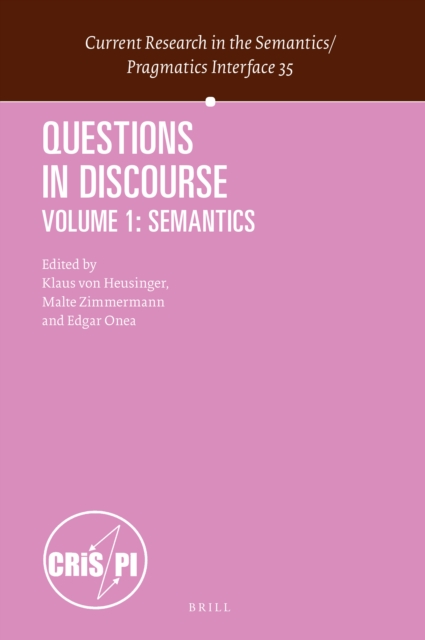
Questions in Discourse
The volume Questions in Discourse - Semantics contains an overview of the semantic analysis and discourse-structuring role of questions, together with in-depth contributions on individual aspects of question meanings and the function of implicit questions in discourse.
eBook