
Catalogue Search | MBRL


Are you sure you want to remove the book from the shelf?

{{itemTitle}}
197
result(s) for
"Qurʼan Relation to the Bible"
Sort by:

Adam and the names
This paper examines the naming episode in the Quran's Adam story, in which God teaches Adam “the names, all of them”, to counter the angels' objection to the creation of the human creature on the basis that he will “spread corruption … and will shed blood”. I try to show that the traditional understanding of this narrative in Western scholarship, which connects it ultimately to the Genesis 2 episode in which Adam names all the creatures of the land and sky, fails to do justice to a close reading of the quranic text itself. Instead, I argue for an alternative reading of the passage already suggested by early Muslim exegetes, in which God's teaching Adam the “names” refers to Adam being introduced to his future offspring. This, in turn, is central to the Quran's engagement with the problem of theodicy.
Journal Article
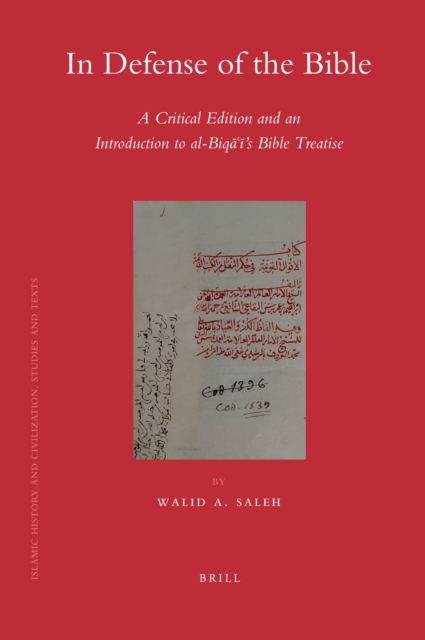
In Defense of the Bible
This is a critical edition of a very important document from the history of the Islamic interaction with the Bible. The edition is based on four copies of the document. The introduction places the document in its historical context and offers an analysis of its significance.
eBook

Noah's Lost Son in the Qurʾān
In Kor 11 (Hūd), 42-47 the Qurʾān has Noah address one of his sons and plead with him to enter the ark. Noah's son refuses to do so, explaining that he plans to seek refuge from the flood on a mountain. When the son is lost in the flood, Noah turns to God in order to ask that his son be forgiven. In the present article, I discuss the relationship of this Qurʾānic episode with larger themes in the Qurʾān-seen also in the material on Abraham and his father-regarding the believer's proper disposition towards unbelievers, and unbelieving family members in particular. After a study of earlier theories about this passage, I propose that the account of Noah's lost son (not found in the Bible) has a particular relationship to Ezekiel 14, a passage which speaks hypothetically of an unrighteous son of Noah. In conclusion, I argue that this passage is an important example of how the Qurʾān applies, and transforms, earlier traditions in order to advance its particular religious arguments.
Dans le verset coranique 11 (Hūd), 42-47, Noah s'adresse à l'un de ses fils et le prie d'entrer dans l'Arche. Le fils de Noé refuse de s'exécuter, arguant qu'il a l'intention de trouver refuge dans une montagne contre le Déluge. Quand son fils est perdu dans le Déluge, Noé se tourne vers Dieu afin de Lui demander de pardonner à son fils. Dans le présent article, nous examinerons la relation de cet épisode coranique avec des thèmes plus importants du Coran-que l'on peut également voir dans les récits sur Abraham et son père-concernant la disposition du croyant envers les incroyants et, plus particulièrement, les membres de la famille. Après une étude des théories antérieures à propos de ce passage, nous avancerons que le récit du fils perdu de Noé (qui ne se trouve pas dans la Bible) est particulièrement lié à Ezéchiel 14, un passage qui traite, en toute hypothèse, d'un fils indigne de Noé. En conclusion, nous soutenons que ce passage est un exemple important de la façon dont le Coran emploie et transforme des traditions antérieures afin d'avancer ses propres arguments religieux.
This article is in English.
Journal Article

A WOMAN’S ‘SELF-WRONGING
This article examines the encounter between Solomon and the fascinating, but intricate Queen of Sheba in the Qur’an (Q27:15-44). By taking a literary approach to the Qur’anic narrative itself (and not later interpretations as have been the focus of both the Muslim tradition and in the field of Qur’anic studies), I argue that the story not only presents a didactic Qur’anic conversion scene (from paganism to monotheism), but also that the story is permeated by gender related features. I show that two episodes in the story, the Queen’s entry into Solomon’s palace and her declaration of ‘self-wronging’ (zulm al-nafs; Q27:44) are essential for the story’s gender subtheme. On the one _ hand, the Qur’anic story depicts a woman’s submission to a patriarchal order, but, on the other, it also indicates what seems to be a relative gender equality for men and women before God.
Journal Article

A Muslim Scholar of the Bible: Prooftexts from Genesis and Matthew in the Qur'an Commentary of Ibn Barrajān of Seville (d. 536/1141)
The Andalusian mystic and Qur'an commentator Ibn Barrajān (d. 536/1141) was one of the earliest scholars of Islam to use the Arabic Bible extensively and non-polemically in his quest to understand the divine Word. This paper assesses his mode of engagement with the Bible and the different strategies he employed to resolve perceived incongruities between narratives of the Qur'an and the Bible. The Bible enjoys the same degree of interpretive authority in Ibn Barrajān's works as Prophetic reports (ḥadīth), and there is at least one instance where the Bible not only complements but also challenges his understanding of the Qur'an. Ibn Barrajān's openness to the Bible rests on his principle of ‘Qur'anic epistemological supremacy’—that is to say, his reasoning that since the Qur'an is God's untarnished divine revelation, it can serve as the ultimate litmus test against which all other scriptural passages, including the Bible, are to be judged. His far-reaching hermeneutical principle of Qur'anic hegemony was probably partly inspired by the scripturalist-literalist writings of the Ẓāhirī scholar Ibn Ḥazm (d. 456/1064). An exhaustive appendix and translation of the Biblical materials in Ibn Barrajān's works accompanies this paper, confirming beyond reasonable doubt that the Bible used by Ibn Barrajān was translated into Arabic directly from Jerome's Latin Vulgate.
Journal Article

On the Qurʾanic Accusation of Scriptural Falsification (taḥrīf) and Christian Anti-Jewish Polemic
[...] in scholarly treatments of the subject a comparison is sometimes made between tahrif al-nass, alteration of the text of scripture, and tahrif al-mac ani, misinterpretation of scripture. [...] I use the phrase \"textual alteration\" to describe the common accusation of medieval (and modern) Islamic literature that the Jews and Christians really erased (or destroyed) some or all of the true scripture and rewrote it (tahrif al-nass).
Journal Article

Solomon and Mythic Kingship in the Arab-Islamic Tradition: Qaṣīdah, Qurʾān and Qiṣaṣ al-anbiyāʾ
This article contrasts techniques from non-narrative, poetic and Qurʾānic texts with the narratives of Qiṣaṣ al-anbiyāʾ (the Stories of the Prophets) in order to interpret passages on Sulaymān/Solomon in pre- and early Arabic-Islamic texts. Beginning with the renowned non-narrative Sulaymān passage in the pre-Islamic poet al-Nābighah al-Dhubyānī's ode of apology to the Lakhmid king al-Nuʿmān ibn al-Mundhir and several Qurʾānic passages concerning Sulaymān, the article compares these to the eminently narrative prose renditions of Solomonic legend that appear in Qurʾānic commentary and the (related) popular Stories of the Prophets (Qiṣaṣ al-anbiyāʾ). I argue that verbal structures and rhetorical techniques characteristic of non-narrative forms such as poetry and the Qurʾān have the effect of preserving and stabilizing the essential panegyric (poetic) or salvific (Qurʾānic) message in a manner that the constantly mutating popular narrative forms neither strive for nor achieve.
Journal Article

Moses and the Holy Valley Ṭuwan: On the biblical and midrashic background of a qur’ānic scene
In the Hebrew Bible, Moses never enters the Holy Land, but when he arrives at the burning bush, near Mount Sinai, God nevertheless tells him that he is standing on holy ground. The Qur'an retells the story of the burning bush in versions that deserve some attention due to certain elements that are not found in the original biblical version of the scene. These versions contain several expanded descriptions of the holiness of the ground on which Moses stood. Here, Rubin talks about Moses in the Qur'anic scene.
Journal Article