
Catalogue Search | MBRL


Are you sure you want to remove the book from the shelf?

{{itemTitle}}
35,264
result(s) for
"Qurʼan."
Sort by:

Reading the Qur'an in Latin Christendom, 1140-1560
Selected byChoicemagazine as an Outstanding Academic Title Most of what we know about attitudes toward Islam in the medieval and early modern West has been based on polemical treatises against Islam written by Christian scholars preoccupied with defending their own faith and attacking the doctrines of others. Christian readings of the Qur'an have in consequence typically been depicted as tedious and one-dimensional exercises in anti-Islamic hostility. InReading the Qur'an in Latin Christendom, 1140-1560, Thomas E. Burman looks instead to a different set of sources: the Latin translations of the Qur'an made by European scholars and the manuscripts and early printed books in which these translations circulated. Using these largely unexplored materials, Burman argues that the reading of the Qur'an in Western Europe was much more complex. While their reading efforts were certainly often focused on attacking Islam, scholars of the period turned out to be equally interested in a whole range of grammatical, lexical, and interpretive problems presented by the text. Indeed, these two approaches were interconnected: attacking the Qur'an often required sophisticated explorations of difficult Arabic grammatical problems. Furthermore, while most readers explicitly denounced the Qur'an as a fraud, translations of the book are sometimes inserted into the standard manuscript format of Christian Bibles and other prestigious Latin texts (small, centered blocks of text surrounded by commentary) or in manuscripts embellished with beautiful decorated initials and elegant calligraphy for the pleasure of wealthy collectors. Addressing Christian-Muslim relations generally, as well as the histories of reading and the book, Burman offers a much fuller picture of how Europeans read the sacred text of Islam than we have previously had.
eBook
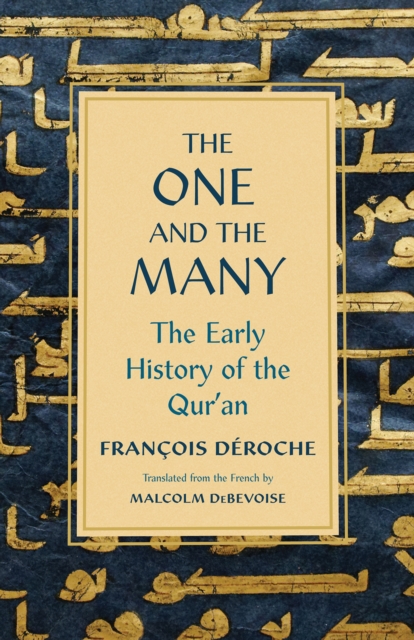
The One and the Many
A revelatory account of early Islam's great diversity by
the world's leading scholar of early Qur'anic manuscripts
\"There is no one better placed than François Déroche to
write the history-and tell the story-of how the Quran went from
words uttered by Muhammad to inviolable canonical scripture. This
is a meticulous, lucid, and fascinating book.\"-Shawkat Toorawa,
Yale University According to Muslim dogma, the recited and
written text of the Qur'an as we know it today scrupulously
reflects the divine word as it was originally sent down to
Muhammad. An examination of early Islamic sources, including
accounts of prophetic sayings, all of them compared with the oldest
Qur'anic manuscripts, reveal that plurality was in fact the
outstanding characteristic of the genesis and transmission of the
Qur'an, both textually and orally. By piecing together information
about alternative wordings eliminated from the canonical version
that gradually came to be imposed during the first centuries of
Islam, François Déroche shows that the Qur'an long remained open to
textual diversity. Not only did the faithful initially adopt a
flexible attitude toward the Qur'anic text, an attitude strikingly
at odds with the absolute literalism later enforced by Muslim
orthodoxy, but Muhammad himself turns out to have been more
concerned with the meaning than the letter of the divine message.
eBook


An oral-formulaic study of the Qur'an
The Qur’an makes extensive use of older religious material, stories, and traditions that predate the origins of Islam, and there has long been a fierce debate about how this material found its way into the Qur’an. This unique book argues that this debate has largely been characterized by a failure to fully appreciate the Qur’an as a predominately oral product. Using innovative computerized linguistic analysis, this study demonstrates that the Qur’an displays many of the signs of oral composition that have been found in other traditional literature. When one then combines these computerized results with other clues to the Qur’an’s origins (such as the demonstrably oral culture that both predated and preceded the Qur’an, as well as the “folk memory” in the Islamic tradition that Muhammad was an oral performer) these multiple lines of evidence converge and point to the conclusion that large portions of the Qur’an need to be understood as being constructed live, in oral performance. Combining historical, linguistic, and statistical analysis, much of it made possible for the first time due to new computerized tools developed specifically for this book, Bannister argues that the implications of orality have long been overlooked in studies of the Qur’an. By relocating the Islamic scripture firmly back into an oral context, one gains both a fresh appreciation of the Qur’an on its own terms, as well as a fresh understanding of how Muhammad used early religious traditions, retelling old tales afresh for a new audience.
eBook


The Impact of Interpreting the Holy Quran on the Interpreter's life
All praise is due to Allah. We praise Him, seek His help, and ask for His forgiveness. We seek refuge in Allah from the evils of our souls and the wickedness of our deeds. May blessings and peace be upon our Master Muhammad, whom Allah sent with guidance and the true religion, and to whom He revealed this Qur’an to warn those who disbelieve and as good tidings to the believers. Now then Serving the Qur’an is an honor beyond all honor, and a virtue that is unmatched and unparalleled. This is because the honor of knowledgeWith the honor of its subject, there is no doubt that the greatest and best service a Muslim can undertake is serving the Book of Allah, the Blessed and Exalted, as interpretation takes the place of the first science in the sciences of Islamic law. This is one of the evidences of the excellence of Quranic interpretation. The excellence of this science is that it explains the Holy Quran, which is the primary source of Islamic legislation. Interpretation brings people closer to the words of their Lord, the Highest, and increases their understanding of the Book of Allah. And He places them on the truth of meanings so that they do not fall into doubt and confusion that could harm their religion due to their lack of knowledge. God Almighty has honored the people of interpretation and raised their status and elevated their position by making them a reference for His servants in understanding His words and clarifying His intentions. This is sufficient virtue and honor. Therefore, we wanted to shed light on the impact of interpreting the Holy Quran on the life of the interpreter, through the following plan.
Journal Article
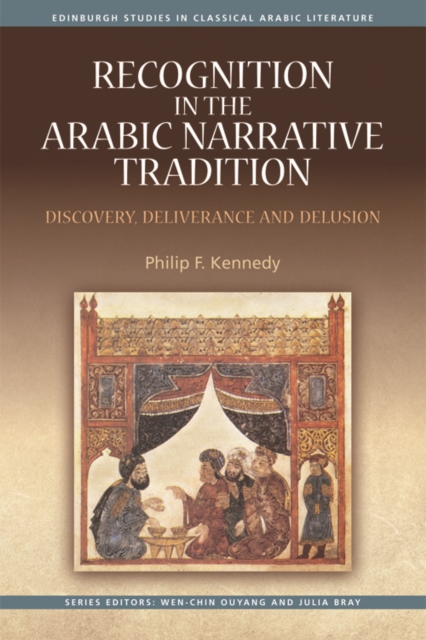
Recognition in the Arabic Narrative Tradition
According to Aristotle, a well-crafted recognition scene is one of the basic constituents of a successful narrative. It is the point when hidden facts and identities come to light-in the classic instance, a son discovers in horror that his wife is his mother and his children are his siblings. Aristotle coined the term 'anagnôrisis' for the concept. In this book Philip F. Kennedy shows how 'recognition' is key to an understanding of how one reads values and meaning into, or out of, a story. He analyses texts and motifs fundamental to the Arabic literary tradition in five case studies: the Qur'an; the biography of Muhammad; Joseph in classical and medieval re-tellings; the 'deliverance from adversity' genre and picaresque narratives.
eBook