Catalogue Search | MBRL


Are you sure you want to remove the book from the shelf?

{{itemTitle}}
3
result(s) for
"Qurna (Egypt) Antiquities."
Sort by:
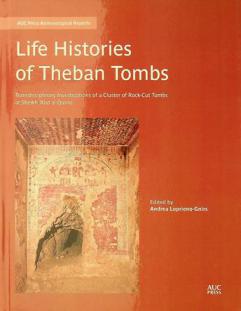
Life histories of Theban tombs : transdisciplinary investigations of a cluster of rock-cut tombs at Sheikh 'Abd el-Qurna
\"\"In recent years, archeological research has undergone major changes. The material turn in archaeology and related disciplines prompted the adoption of sophisticated scientific, digital, and technical approaches and methods often conducted on a micro level, enhancing our understanding of depositional processes and of the creation and life of an archeological object. This volume reflects seven seasons of transdisciplinary archaeological research at a cluster of rock-cut tombs in Sheikh Abd al-Qurna, an ancient Egyptian hillside cemetery and part of the much larger Theban Necropolis. Organized in twelve main chapters, Life Histories of Theban Tombs presents current investigations in landscape archaeology (including recent excavations at a large debris hill previously covering a tomb), geo- and bioarcheology, the archaeology of tomb construction, burial practices, and domestic uses as well as various epigraphical, visual, and material studies[should there be a serial. The last two sections provide additional insight into the applied recording, surveying, and visualization methods and techniques and the database system used for data recording and organization.
Book

Sandals, shoes and other leatherwork from the Coptic monastery Deir el-Bachit : analysis and catalogue
The Coptic monastery and cemetery Deir el-Bachit stands on the hilltop of Dra' Abu el-Naga, the well-known necropolis in Qurna (West Bank, Luxor). It is the largest Coptic monastery complex preserved in Western Thebes and the first monastery that has been systematically investigated. The excavation of the monastery was started as a DFG-Project des Ägyptologischen Instituts der Ludwig-Maximilians-Universität Muenchen in close collaboration with the Deutsches Archäologisches Institut Abteilung Kairo. Until the start of the investigations in 2001 with a survey, little research was done. After three seasons of preliminary research, full archaeological research was started in 2004. The leatherwork was studied in 2007, the present volume of which presents the results. The book consists of two parts: the analysis and a detailed catalogue, including colour images of all finds and, where necessary, line drawings. The finds are analysed within the framework of the excavation as well as within the frameworks of the Ancient Egyptian Leatherwork Project and the Ancient Egyptian Footwear Project (www.leatherandshoes.nl).
eBook