
Catalogue Search | MBRL


Are you sure you want to remove the book from the shelf?

{{itemTitle}}
12,792
result(s) for
"RELIGIOUS CONFLICT"
Sort by:


Antagonism on YouTube
Similar to many sites on the Internet, interaction on YouTube often features confrontational, antagonistic exchanges among users. YouTube comments threads in particular are known for their offensive, conflagratory content. This books looks at this form of discourse. The term 'drama' (or 'flame wars') appears often as a label for a phenomenon that is easily recognisable. In these cases, serious disagreements can become entangled with interpersonal relationships and users take positions for themselves in relation to others and social controversies.
The focus of this book is on the ways in which metaphor contributes to the development of Internet drama, particularly on YouTube. Although a growing body of research into YouTube social interaction continues to develop descriptions of user experience on YouTube, empirical studies of the YouTube video page are rare, as well as close discourse analysis of user interaction on the site. This research specifically focuses on the interaction of a group of users discussing issues of Christian theology and atheism on the site, analysing how discourse facilitates to antagonistic interaction among users.
Since YouTube drama occurs publicly, the book focuses on actual YouTube video pages rather than user reports of their actions and responses. It investigates how and why YouTube drama develops through a systematic description and analysis of user discourse activity. Through close analysis of video pages, this study contributes to a greater academic understanding of Internet antagonism and YouTube interaction by revealing the factors which contribute to the development of drama over time.
eBook


The Political Origins of Primary Education Systems: Ideology, Institutions, and Interdenominational Conflict in an Era of Nation-Building
This paper is concerned with the development of national primary education regimes in Europe, North America, Latin America, Oceania, and Japan between 1870 and 1939. We examine why school systems varied between countries and over time, concentrating on three institutional dimensions: centralization, secularization, and subsidization. There were two paths to centralization: through liberal and social democratic governments in democracies, or through fascist and conservative parties in autocracies. We find that the secularization of public school systems can be explained by path-dependent state-church relationships (countries with established national churches were less likely to have secularized education systems) but also by partisan politics. Finally, we find that the provision of public funding to private providers of education, especially to private religious schools, can be seen as a solution to religious conflict, since such institutions were most common in countries where Catholicism was a significant but not entirely dominant religion.
Journal Article


Hostile humor in Renaissance France
This book is also freely available online as an open access digital edition here: https://bibliopen.org/9781644531792 [https://bibliopen.org/9781644531792]. The open access edition is funded by the National Endowment for the Humanities. In sixteenth-century France, the level of jokes, irony, and ridicule found in pamphlets and plays became aggressively hostile. In Hostile Humor in Renaissance France, Bruce Hayes investigates this period leading up to the French Wars of Religion, when a deliberately harmful and destructive form of satire appeared. This study examines both pamphlets and plays to show how this new form of humor emerged that attacked religious practices and people in ways that forever changed the nature of satire and religious debate in France. Hayes explores this phenomenon in the context of the Catholic and Protestant conflict to reveal new insights about the society that both exploited and vilified this kind of satire.
eBook


The 'Us' and 'Them' Divide: Rethinking the Role of Young People in Religious Conflicts in Nigeria
As a value-based problem, religious conflicts are disruptive and protracted. Indeed, Nigeria has experienced a plethora of protracted religious conflicts since independence in I960. Constituting major actors in these conflicts are young people, who play critical roles in fomenting and escalating them. Although extant literature acknowledges this preponderant place of young people in these conflicts, it tends to negate the potential constructive roles they play in managing the conflicts. This paper explores the disruptive and potential constructive roles of the youths as principal actors in religious conflicts in Nigeria. It argues that if armed with the right education on peace and tolerance, young people can play critical preventive and curative roles in religious conflict theaters in Nigeria. Exploring these youths' strengths is pertinent for a multidimensional approach to addressing religious conflicts and violence in Nigeria .
Journal Article

Religion and conflict in modern South Asia
\"This is an incisive analysis of religious conflict in South Asia, which, the author contends, arises out of the weakness of political and state structures rather than the clash of civilizations\"-- Provided by publisher.
Book
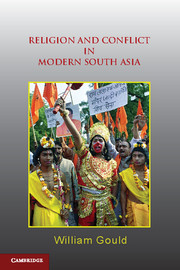
Religion and Conflict in Modern South Asia
This is one of the first single-author comparisons of different South Asian states around the theme of religious conflict. Based on new research and syntheses of the literature on 'communalism', it argues that religious conflict in this region in the modern period was never simply based on sectarian or theological differences or the clash of civilizations. Instead, the book proposes that the connection between religious radicalism and everyday violence relates to the actual (and perceived) weaknesses of political and state structures. For some, religious and ethnic mobilisation has provided a means of protest, where representative institutions failed. For others, it became a method of dealing with an uncertain political and economic future. For many it has no concrete or deliberate function, but has effectively upheld social stability, paternalism and local power, in the face of globalisation and the growing aspirations of the region's most underprivileged citizens.
eBook