
Catalogue Search | MBRL


Are you sure you want to remove the book from the shelf?

{{itemTitle}}
97
result(s) for
"REMITTANCE CHANNELS"
Sort by:

How Russia Affects the Neighborhood: Trade, Financial, and Remittance Channels
We test the extent to which growth in the 11 CIS countries (excluding Russia) was associated with developments in Russia, overall, as well as through the trade, financial and remittance channels over the last decade or so. The results point to the continued existence of economic links between the CIS countries and Russia, though these links may have altered since the 1998 crisis. Russia appears to influence regional growth mainly through the remittance channel and somewhat less so through the financial channel. There is a shrinking role of the trade (exports to Russia) channel. Russian growth shocks are associated with sizable effects on Belarus, Kazakhstan, Kyrgyz Republic, Tajikistan, and, to some extent, Georgia.
eBook

Alternative remittance systems and terrorism financing : issues in risk management
Terrorism can endanger innocent human life and tear the very threads that hold society together, namely, trust and security. Governments have mobilized a variety of tools in response, ranging from the political to the economic. In attempting to prevent and detect terrorist financing and other forms of material support, those offering financial services have been required to heighten their vigilance of potential terrorist abuse of those services. While protecting financial services from potential abuse, care should be taken not to deny access to those services to those most in need. Dejection and social exclusion are very often conducive to terrorism; therefore, ensuring inclusion of the disenfranchised and creating possibilities for their advancement are key parts of the broader, long-term struggle against terrorism and extremism. The paper begins with a brief description of alternative remittance system (ARS) models and their prevalence. It then covers their potential relationship with terrorist financing, citing cases where ARS have been abused for terrorism financing (TF) purposes. Ways in which countries may control these risks and indications of their effectiveness are covered next. The final chapter provides recommendations on how best to mitigate the risks while ensuring legitimate access to financial services via ARS.
eBook

The role of formal and informal remittances as the determinants of formal and informal financial services
Research background: The choice of financial services and remittances are important as they influence the livelihood of remittance recipients, who are mostly poor and financially excluded. In literature, extensive evidence suggests a positive impact of the size of remittances on access to financial inclusion and financial development of remittance-recipient countries. However, a concern of such studies is that they might provide a biased outcome as the available data of remittances tend to be formal, whereas informal remittances are difficult to observe. Hence, their evidence might not be applicable in developing countries where remittance transfer via informal channels is very popular. Purpose of the article: The main objective of this study is to examine the effect of the remittance channel (formal and informal) on the choice of formal, informal financial services of credit and savings of remittance recipients. Methods: As our dependent variable is a financial service which is a categorical variable (formal and informal), the paper will employ a multinomial logistic regression model to estimate the impact. The data employed in this analysis is from the Finscope survey conducted in Myanmar in 2013 and 2018. Myanmar is the best context for our study, as it is one of a big migrant-sending countries and a developing country whose financial sector is significantly underdeveloped. Findings value added: Our findings show that formal remittances promote the use of formal financial services such as credit and savings. However, there is no evidence regarding women recipients` informal channels and formal financial services. Our evidence also suggests there is a need for the government to encourage migrant workers to transform informal remittances into formal ones by removing the barriers of formal remittance channels to promote the use of formal credit and saving among remittance-recipients who are poor and financially excluded.
Journal Article
Leveraging migration for Africa : remittances, skills, and investments
A joint effort led by the African Development Bank and the World Bank, 'Leveraging Migration for Africa' is the first comprehensive publication on harnessing migration, remittances, and other diaspora resources for the development of Africa. It comes at a time when countries in Africa and elsewhere are grappling with difficult choices on how to manage migration.Policy makers can help leverage the contributions of migrants to the development of Africa, reduceremittance costs, improve the efficiency of remittance markets in both origin and destination countries, and address the needs of the origin countries without restricting the emigration of high-skilled professionals. Innovative financing mechanisms such as issuance of diaspora bonds and securitization of future remittance flows can help finance big-ticket projects, such as railways, roads, power plants, and institutions of higher learning that will, step by step, help to transform Africa. This volume contributes to a greater understanding of migration and its potential role in Africa?s development.
eBook

The Canada-Caribbean remittance corridor : fostering formal remittances to Haiti and Jamaica through effective regulation
Several economies in the Caribbean region, especially from the lower income group, are highly dependent on remittances. Between 1991 and 2006, the combined flows of total remittances reaching the Caribbean have seen almost a 17% average annual growth rate, surpassing USD 6billion in 2005 and overtaking ODA and FDI into the region. In addition, remittances represent more than 20% of the domestic gross domestic product (GDP) in some Caribbean countries and have played a significant role in lessening both balance of payment deficits and the impact of natural disasters to which the region is particularly vulnerable. Given the importance of such remittance flows, this study undertakes an analysis of the various dynamics underlying the Canada-Caribbean remittance corridor, including Caribbean migration issues, remittance market landscapes and regulatory frameworks. This study is intended to assist Canadian and Caribbean national authorities in their mandate of providing incentives for the continued growth and competitiveness of their remittance industries, while protecting remittance markets from being abused by criminals.
eBook
Migration and Remittances Factbook 2011
There are more than 215 million international migrants in the world. Recorded remittances received by developing countries, estimated to be US$325 billion in 2010, far exceed the volume of official aid flows and constitute more than 10 percent of gross domestic product (GDP) in many developing countries. Migration and remittances factbook 2011 provides a comprehensive picture of emigration, skilled emigration, immigration, and remittance flows for 210 countries and 15 country groups, drawing on authoritative, publicly available data. The current edition of the factbook updates the information in the popular 2008 edition with additional data for 71 countries collected from various sources, including national censuses, labor force surveys, population registers, and other national sources. In addition, it provides selected socioeconomic characteristics such as population, labor force, age dependency ratio, gross national income (GNI) per capita, and poverty headcount for each country and regional grouping. More frequent and timely monitoring of migration and remittance trends can provide policy makers, researchers, and the development community with the tools to make informed decisions. The factbook makes an important contribution to this effort by providing the latest available data and facts on migration and remittance trends worldwide in a comprehensive and readily accessible format.
eBook
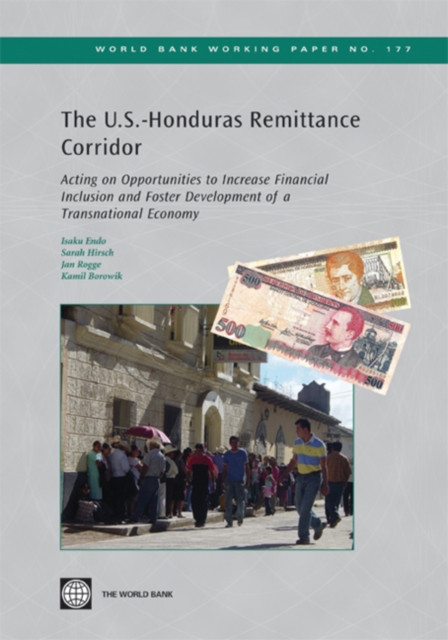
The U.S.-Honduras remittance corridor : acting on opportunities to increase financial inclusion and foster development of a transnational economy
This report on the U.S.- Honduras remittance corridor describes the remittance regulatory and market environment, financial inclusion strategies by financial institutions, transnational economic activities, and the impacts of remittances on the Honduran economy. Six areas provide the focus of this report: (i) regulatory reforms for the remittance market are urgent in order to improve clarity in regulations as well as to include money transfer companies in the regulatory framework; (ii) money service businesses will benefit from an examination of state regulation and their subsequent harmonization and coordination; (iii) rural areas need to improve distributive infrastructure to better reap the benefits of the remittance flows; (iv) financial education and awareness for Honduran migrant communities are critical components with the overall remittance flow equation; (v) the regulatory environment of remittance flows would be greatly enhanced through the promotion, inclusion, and expansion of proper identification; and (vi) public policies can be directed to building an environment for diaspora investments in the community and local business developments for exports to Honduran communities abroad.
eBook

The Malaysia-Indonesia remittance corridor : making formal transfers the best option for women and undocumented migrants
In Malaysia, Indonesian migrants are showing an increasingly clear preference for informal transfer mechanisms compared to their counterparts in other countries. A little less than half of all Indonesian migrants overseasthought to be around 2 millionare working in Malaysia. An increasing number of migrants are women, and the corridor is also marked by a high number of undocumented migrants. Despite the increasing flows of migrants, only about 10 percent of the estimated flow of remittances into Indonesia from Malaysia is transferred through the formal system. The extent of the preference for the informal sector is unique in this corridor. Indonesian migrants in other countries are using the formal sector far more than the migrants in Malaysia. In addition, Indonesian women and undocumented migrants in Malaysia especially find formal sector transfers either hard to access or inappropriate for their needs. To this end, the study assists policymakers efforts to increase the impact of remittances on economic development and poverty reduction in Indonesia and to investigate options for attracting more migrants to use the formal financial sector. The report provides a descriptive overview of the MalaysiaIndonesia remittance corridor and suggests policy avenues for improving access to formal remittance transfer channels; increasing the transparency of the flows and the cost structure; and facilitating remittance transfers, particularly for undocumented and female migrant workers.
eBook

The Germany-Serbia remittance corridor : challenges of establishing a formal money transfer system
Serbia has become one of the largest remittance-recipient countries in the world. It is estimated that in 2004 Serbia received US2.4 billion dollars in remittances from Serbian workers in Germany, the United States, Austria, Switzerland, Italy, and other countries. This amount represented 12 percent of Serbias GDP. This report provides an overview of remittance flows from Germany to Serbia and analyzes why a large part of remittance transfers take place outside financial institutions. The study presents a series of recommendations on needed policy changes to facilitate the transfer of remittance flows from the informal channels to licensed or registered financial institutions, thereby maximizing the developmental impact of remittances, reducing remittances fees, improving data collection practices, and strengthening the regulation and supervision of themoney transfer industry.
eBook

Migration and Remittances Factbook 2008
This book contains statistical snapshots for 195 countries and 13 regional and income groups. The 200+ tables, each focused on one country, region, or income group, explore immigration, emigration and skilled emigration, and inward and outward remittance flows. Summary reports on the top 10 countries in each category are also included.
eBook