
Catalogue Search | MBRL


Are you sure you want to remove the book from the shelf?

{{itemTitle}}
49,936
result(s) for
"RESEARCH TEAM"
Sort by:

Enhancing the Effectiveness of Team Science
The past half-century has witnessed a dramatic increase in the scale and complexity of scientific research. The growing scale of science has been accompanied by a shift toward collaborative research, referred to as \"team science.\" Scientific research is increasingly conducted by small teams and larger groups rather than individual investigators, but the challenges of collaboration can slow these teams' progress in achieving their scientific goals. How does a team-based approach work, and how can universities and research institutions support teams?
Enhancing the Effectiveness of Team Science synthesizes and integrates the available research to provide guidance on assembling the science team; leadership, education and professional development for science teams and groups. It also examines institutional and organizational structures and policies to support science teams and identifies areas where further research is needed to help science teams and groups achieve their scientific and translational goals. This report offers major public policy recommendations for science research agencies and policymakers, as well as recommendations for individual scientists, disciplinary associations, and research universities. Enhancing the Effectiveness of Team Science will be of interest to university research administrators, team science leaders, science faculty, and graduate and postdoctoral students.
eBook
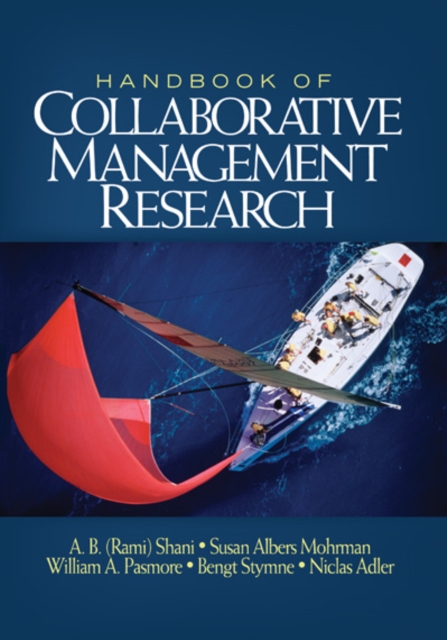
Handbook of collaborative management research
This handbook provides the latest thinking, methodologies and cases in the rapidly growing area of collaborative management research. What makes collaborative management research different is its emphasis on creating a close partnership between scholars and practitioners in the search for knowledge concerning organizations and complex systems. In the ideal situation, scholars and their managerial partners would work together to define the research focus, develop the methods to be used for data collection, participate equally in the analysis of data, and work together in the application and dissemination of knowledge. The handbook contains insightful reflections on the state of the art as well as detailed descriptions of the collaborative efforts of an international group of leading edge academics and their practitioner counterparts. The applications of collaborative research methods included in this volume include those aimed at individual development, organizational development, regional development efforts and economic policy. The insights from the cases suggest that collaborative management research has been a highly effective means of getting at issues that other research methods and intervention techniques have failed to address. The rationale for conducting this highly engaging type of research is explored in the first section of the handbook, followed by sections that offer new methodologies, descriptive cases, views from those directly involved, and issues and enablers about the use of this approach in advancing knowledge and practice. The handbook does appeal to scholarly practitioners as well as practical scholars.
eBook

Scientific collaboration : strategies for successful research teams
A narrative guide to help scientists improve their collaboration techniques and build trusting relationships with their research teams.The days of scientists conducting solitary inquiries in isolated labs are effectively over, with most researchers instead collaborating in cross-functional teams. In addition to mastering the technical skills necessary in their respective fields, scientists must now learn strategies for better communication and relationship building to succeed in reaching increasingly sophisticated and interdisciplinary research goals. In Scientific Collaboration, biosecurity researcher and animal disease ecologist Jeanne M. Fair shares exciting—and occasionally cringeworthy—stories of scientists working together as an approachable way to introduce and explain the principles crucial to effective scientific collaboration. From the global community of scientists measuring sea ice decline to cooperative private-public sector investigations of harrowing virus outbreaks, the real-life experiences provide examples of and insights into how scientists rise to meet challenges together. Fair highlights principles for fostering community, integrity, loyalty, communication, and compassion among teams. Scientists can adopt and apply these principles to research collaborations to improve communication and trust among their team members all while working toward the common goal of discovery. Covering multidisciplinary research teams that have led to transformational breakthroughs as well as stories of hurdles and tough lessons learned, Scientific Collaboration provides a foundation for increasing research productivity while bringing more fun and joy into the collaborative process. This book will appeal to any scientists and team leaders who need to function in this new scientific world, wherein the most important breakthroughs happen through cooperation, combined effort, and mutual trust.
eBook

Qualitative Virtual Team Research as Training Method in a Postgraduate Program in Administration
This study is a retrospective review of methodological strategies employed during a virtual team-based training qualitative study about the emergent process of adapting to remote education among students and professors from a Master Management Program. The aim of this study was to test the technique of collaborative research as an educational and training strategy for Ph.D. students of management who are inexperienced in qualitative inductive research carried out in a virtual environment. A professor and eight Ph.D. students formed the research team and applied a qualitative inductive approach. As a result, 18 methodological steps emerged, which required just over one hundred hours of work. We describe advantages and challenges faced during the process, including greater credibility and validity for the results, technical and interactional difficulties of the virtual research environment, and difficulty reaching consensus in the data analysis stage. The findings also highlight the importance of coordination, active participation, and continuous assessment as Ph.D. educational and teaching strategies. Qualitative Virtual Team Research has proved to be a potential training tool for beginning researchers. We also contribute to the body of research on Ph.D. education and teaching by detailing the procedures used to coordinate the project and clarifying details regarding the strategies used to reach consensus in data analysis development.
Journal Article
Emotionally Involved
Tackling difficult issues, Emotionally Involved gives a vivid picture the challenges researchers who studey traumatic events face. It is essential reading for researchers, therapists, fieldworkers, for those on the frontlines of rape crisis and domestic violence work, and for anyone concerned with the role of emotions in social science.
eBook
Fostering Integrity in Research
The integrity of knowledge that emerges from research is based on individual and collective adherence to core values of objectivity, honesty, openness, fairness, accountability, and stewardship. Integrity in science means that the organizations in which research is conducted encourage those involved to exemplify these values in every step of the research process. Understanding the dynamics that support - or distort - practices that uphold the integrity of research by all participants ensures that the research enterprise advances knowledge.
The 1992 report Responsible Science: Ensuring the Integrity of the Research Process evaluated issues related to scientific responsibility and the conduct of research. It provided a valuable service in describing and analyzing a very complicated set of issues, and has served as a crucial basis for thinking about research integrity for more than two decades. However, as experience has accumulated with various forms of research misconduct, detrimental research practices, and other forms of misconduct, as subsequent empirical research has revealed more about the nature of scientific misconduct, and because technological and social changes have altered the environment in which science is conducted, it is clear that the framework established more than two decades ago needs to be updated.
Responsible Science served as a valuable benchmark to set the context for this most recent analysis and to help guide the committee's thought process. Fostering Integrity in Research identifies best practices in research and recommends practical options for discouraging and addressing research misconduct and detrimental research practices.
eBook

The Social Politics of Research Collaboration
The past two decades have seen an increasing emphasis on large and interdisciplinary research configurations such as research networks, and centers of excellence including those in Social Sciences and Humanities research. Little research has been undertaken, however, to understand how these new large research structures that are being called forth by research funders and research/higher education institutions alike function socially, and what the impact of operating within such structures is on those working within, and those working with, them. Past writers have discussed the \"intra-agentic\" operations of human researchers and the material laboratory environment in its broadest sense. This volume is concerned with the social politics of research collaboration in relation to six key positions: leaders of large research formations, leaders of sub-projects within large collaborations, participant researchers, junior and early career researchers, advisory board members, and those who look in from the outside such as researchers who are un-funded. It explores the mostly unacknowledged but critical aspect of social structures in research, discussing issues such as struggles over leadership styles, the marginalization of researchers working cross-disciplinarily, power hierarchies and intellectual ownership, and the silencing of dissent in research.
eBook
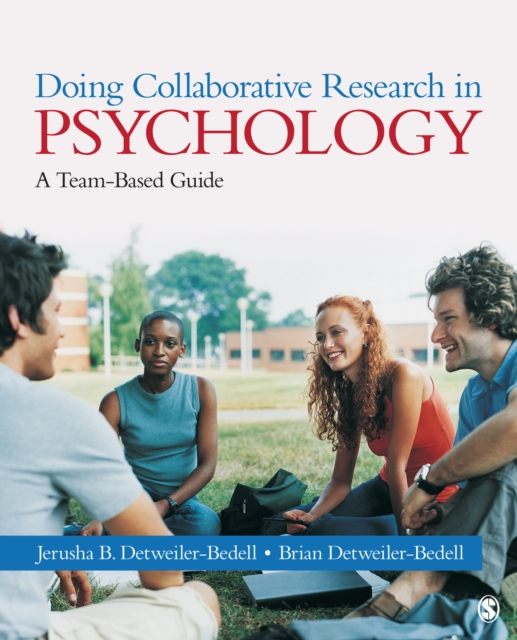
Doing collaborative research in psychology : a team-based guide
Doing Collaborative Research in Psychology offers an engaging journey through the process of conducting research in psychology. Using an innovative team-based approach, this hands-on guide will assist undergraduates with their research—in their courses and in collaboration with faculty or graduate student mentors. The focus on this team-based approach reflects the collaborative nature of research methods and experimental psychology. Students learn how to work as a team, generate creative research ideas, design and pilot studies, recruit participants, collect and analyze data, write up results in APA style, and prepare and give formal research presentations. Students also learn practical ways in which they can promote their research skills as they apply to jobs or graduate school. A unique feature to this book is the ability to read chapters of the text either sequentially or separately, which allows the instructor or research mentor the flexibility to assign those chapters most relevant to the current state of the research project.
eBook

Yet another problem with systematic reviews: a living review update
In February 2023, the Journal of Clinical Epidemiology published ‘The Problems with Systematic Reviews: A Living Systematic Review.’ In updating this living review for the first time a new problem and several themes relating to research culture have emerged.
Literature searches were rerun to identify articles published or indexed between May 2022 and May 2023. Thematic analysis coded articles and problems across four domains of systematic review conduct (1. comprehensive, 2. rigour, 3. transparent, 4. objective).
One hundred fifty-two newly included articles bring the total number of relevant articles to 637. A new problem (the lack of gender diversity of systematic review author teams) brings the total number of problems with systematic reviews up to 68. This update also reveals emerging themes such as: fast science from systematic reviews on COVID-19; the failure of citation of methodological or reporting guidelines to predict high-quality methodological or reporting quality; and the influence of vested interests on systematic review conclusions. These findings coupled with a proliferation of research waste from “me-too” meta-research articles highlighting well-established problems in systematic reviews underscores the need for reforms in research culture to address the incentives for producing and publishing research papers. This update also reports where the identified flaws in systematic reviews affect their conclusions drawing on 77 meta-epidemiological studies from the total 637 included articles. These meta-meta-analytic studies begin the important work of examining which problems threaten the reliability and validity of treatment effects or conclusions derived from systematic reviews.
This living review has captured an emerging theme in the published literature relating to the composition of the review author team and highlights a potential effect on the equity reporting of the systematic reviews. We recommend that meta-research endeavors evolve from merely documenting well-established issues to understanding lesser-known problems or consequences to systematic reviews.
[Display omitted]
•Updated living review brings the number of systematic review problems up to 68.•Team gender diversity correlates with reporting equity characteristics in reviews.•Research culture influences: fast science; research waste; conflicts of interest.•Some included articles study how problems affect reliability/validity of conclusions.•Metaresearch should progress forward from documenting well-established problems.
Journal Article

The changing ecology of teams: New directions for teams research
Summary The nature of collaboration has been changing at an accelerating pace, particularly in the last decade. Much of the published work in teams research, however, is still focused on the archetypal team that has well‐defined membership, purposes, leadership, and standards of effectiveness—all characteristics that are being altered by changes in the larger context of collaboration. Each of these features is worth attention as a dynamic construct in its own right. This article explores what the teams research community has to gain by researching, theorizing, and understanding the many new forms of contemporary collaboration. Copyright © 2012 John Wiley & Sons, Ltd.
Journal Article