
Catalogue Search | MBRL


Are you sure you want to remove the book from the shelf?

{{itemTitle}}
4,908
result(s) for
"RETIRED"
Sort by:


American Immunity
In 1955 the Supreme Court ruled that veterans of the U.S. armed forces could not be courtmartialed for overseas crimes that were not detected until after they had left military service. Territorial limitations placed such acts beyond the jurisdiction of civilian courts, and there was no other American court in which they could be adjudicated. As a result, a jurisdictional gap emerged that for decades exempted former troops from prosecution for war crimes. “This was not merely a theoretical possibility,” Patrick Hagopian writes. Over a dozen former soldiers who participated in the My Lai massacre did in fact “get away with murder.” Further court rulings expanded the gap to cover civilian employees and contractors that accompanied the armed forces. In American Immunity, Hagopian places what he calls the “superpower exemption” in the context of a longstanding tension between international law and U.S. sovereignty. He shows that despite the U.S. role in promulgating universal standards of international law and forming institutions where those standards can be enforced, the United States has repeatedly refused to submit its own citizens and troops to the jurisdiction of international tribunals and failed to uphold international standards of justice in its own courts. In 2000 Congress attempted to close the jurisdictional gap with passage of the Military Extraterritorial Jurisdiction Act. The effectiveness of that legislation is still in question, however, since it remains unclear how willing civilian American juries will be to convict veterans for conduct in foreign war zones.
eBook

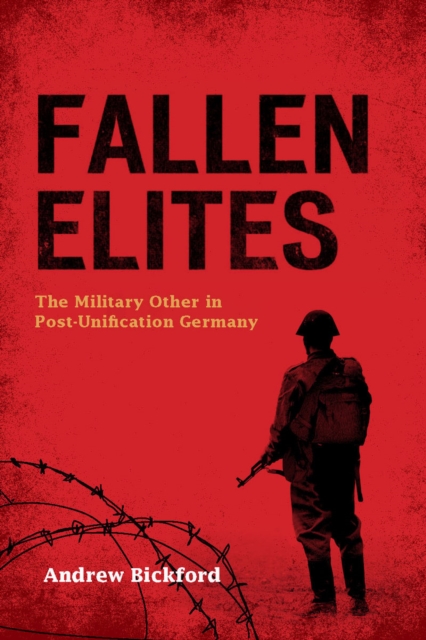
Fallen elites : the military other in post-unification Germany
Military officers are often the first to be considered politically dangerous when a state loses its authority. Overnight, actions once considered courageous are deemed criminal, and men once praised as heroes are redefined as villains. In Fallen Elites, Andrew Bickford examines how states make soldiers and what happens to fallen military elites when they no longer fit into the political spectrum.
Gaining unprecedented entry into the lives of former East German officers in unified Germany, Bickford relates how these men and their families have come to terms with the shock of unification, capitalism, and citizenship since the fall of the Berlin Wall. Often caricatured as unrepentant, hard-line communists, former officers recount how they have struggled with their identities and much-diminished roles. Their disillusionment speaks to global questions about the contentious relationship between the military, citizenship, masculinity, and state formation today. Casting a critical eye on Western triumphalism, they provide a new perspective on our own deep-seated assumptions about \"soldier making,\" both at home and abroad.
eBook


The Templar cross
\"Retired Army Ranger John Holliday has reluctantly settled into his teaching position at West Point, when young Israeli archaeologist Rafi Wanounou comes to him with desperate news. Holliday's niece--and Rafi's financâee--Peggy has been kidnapped while photographing the excavation of an ancient tomb in Egypt. Her captors are known as the Brotherhood of the Temple of Isis--murderous fanatics who worship a dead god. Holliday sets out with Rafi to find the only family he has left. But their search for Peggy will lead them to a trail of clues that spans across the globe, and into the heart of a conspiracy involving an ancient Egyptian legend and the darkest secrets of the Order of Templar Knights. Secrets that, once known, cannot be survived...\"--p.[4] of cover.
Book

Employment status and subjective well-being
This article examines to what extent a social norm to work moderates the relationship between employment status and subjective well-being. It was expected that the detrimental impact of non-employment on subjective well-being would be larger in countries with a stronger social norm. Using a direct measure of the social norm to work and employing data from 45 European countries, this study assessed subjective well-being levels of five employment status groups for men and women separately. Results showed that subjective well-being of unemployed men and women is unaffected by the social norm to work. However, non-working disabled men are worse off in countries with a stronger norm. Living in such a country also decreases the well-being gap between employed and retired men, whereas retired women are worse off in these countries. This effect for retirees disappears when a country’s GDP is taken into account, suggesting that norms matter less than affluence.
Journal Article