
Catalogue Search | MBRL


Are you sure you want to remove the book from the shelf?

{{itemTitle}}
129,787
result(s) for
"ROMANS"
Sort by:

Law, Language, and Empire in the Roman Tradition
The Romans depicted the civil law as a body of rules crafted through communal deliberation for the purpose of self-government. Yet, as Clifford Ando demonstrates inLaw, Language, and Empire in the Roman Tradition, the civil law was also an instrument of empire: many of its most characteristic features developed in response to the challenges posed when the legal system of Rome was deployed to embrace, incorporate, and govern people and cultures far afield.
Ando studies the processes through which lawyers at Rome grappled with the legal pluralism resulting from imperial conquests. He focuses primarily on the tools-most prominently analogy and fiction-used to extend the system and enable it to regulate the lives of persons far from the minds of the original legislators, and he traces the central place that philosophy of language came to occupy in Roman legal thought.
In the second part of the book Ando examines the relationship between civil, public, and international law. Despite the prominence accorded public and international law in legal theory, it was civil law that provided conceptual resources to those other fields in the Roman tradition. Ultimately it was the civil law's implication in systems of domination outside its own narrow sphere that opened the door to its own subversion. When political turmoil at Rome upended the institutions of political and legislative authority and effectively ended Roman democracy, the concepts and language that the civil law supplied to the project of Republican empire saw their meanings transformed. As a result, forms of domination once exercised by Romans over others were inscribed in the workings of law at Rome, henceforth to be exercised by the Romans over themselves.
eBook

Staying Roman
What did it mean to be Roman once the Roman Empire had collapsed in the West? Staying Roman examines Roman identities in the region of modern Tunisia and Algeria between the fifth-century Vandal conquest and the seventh-century Islamic invasions. Using historical, archaeological and epigraphic evidence, this study argues that the fracturing of the empire's political unity also led to a fracturing of Roman identity along political, cultural and religious lines, as individuals who continued to feel 'Roman' but who were no longer living under imperial rule sought to redefine what it was that connected them to their fellow Romans elsewhere. The resulting definitions of Romanness could overlap, but were not always mutually reinforcing. Significantly, in late antiquity Romanness had a practical value, and could be used in remarkably flexible ways to foster a sense of similarity or difference over space, time and ethnicity, in a wide variety of circumstances.
eBook

The housemaid is watching
\"\"You must be our new neighbors!\" Mrs. Lowell gushes and waves across the picket fence. I clutch my daughter's hand and smile back: but the second Mrs. Lowell sees my husband a strange expression crosses her face. In that moment I make a promise. We finally have a family home. My past is far, far behind us. And I'll do anything to keep it that way... I used to clean other people's houses - now, I can't believe this home is actually mine. The charming kitchen, the quiet cul-de-sac, the huge yard where my kids can play. My husband and I saved for years to give our children the life they deserve. Even though I'm wary of our new neighbor Mrs. Lowell, when she invites us over for dinner it's our chance to make friends. Her maid opens the door wearing a white apron, her hair in a tight bun. I know exactly what it's like to be in her shoes. But her cold stare gives me chills... The Lowells' maid isn't the only strange thing on our street. I'm sure I see a shadowy figure watching us. My husband leaves the house late at night. And when I meet a woman who lives across the way, her words chill me to the bone: Be careful of your neighbors. Did I make a terrible mistake moving my family here? I thought I'd left my darkest secrets behind. But could this quiet suburban street be the most dangerous place of all?\"-- Provided by publisher.
Book

Roman Period Statuettes in the Netherlands and beyond
The subject of this study is a relatively rare category of artefacts, bronze and terracotta statuettes that represent deities, human figures and animals. They were introduced in the northwestern provinces by Roman troops from the end of the first century BCE onwards. The statuettes have been recovered from military and non-military settlements, the surrounding landscape and, to a far lesser extent, from sanctuaries and graves. Until now, their meaning and function have seldom been analysed in relation to their find-spots. Contrary to traditional studies, they have been examined as one separate category of artefacts, which offers new insights into the distribution pattern and iconographic representation of deities. When studying a group of artefacts, a large research area or a large dataset is required, as well as dateable artefacts and find-contexts. These conditions do not apply to the Netherlands and to the majority of statuettes that are central to this study. Moreover, although the changing appearance of statuettes suggest a transformation of cults, the identities of the owners of these statuettes remain invisible to us. Therefore, the issue of Romanization is not put central here. Instead, the focus is on a specific aspect of religion, known as lived religion, within the wider subject of its transformation in the Roman period: how people used statuettes in everyday life, in the context of their houses and settlements.
eBook

Perilous waters
FBI dive instructor Jessie Madison's survival skills are stretched to breaking point when she is plunged into danger in this exhilarating thriller--the first in a pulsating new series. Jessie Madison escaped to the Bahamas when she made a terrifying discovery at home and a bad decision got her dismissed from the FBI training program. Three months later, Jessie is ready to return to Virginia to pick up the pieces of her shattered life--until she and a friend are attacked during a boat ride and thrown overboard, with devastating consequences.
BOOK
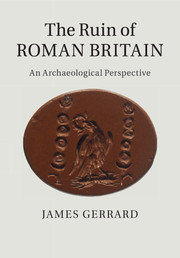
The Ruin of Roman Britain
How did Roman Britain end? This new study draws on fresh archaeological discoveries to argue that the end of Roman Britain was not the product of either a violent cataclysm or an economic collapse. Instead, the structure of late antique society, based on the civilian ideology of paideia, was forced to change by the disappearance of the Roman state. By the fifth century elite power had shifted to the warband and the edges of their swords. In this book Dr Gerrard describes and explains that process of transformation and explores the role of the 'Anglo-Saxons' in this time of change. This profound ideological shift returned Britain to a series of 'small worlds', the existence of which had been hidden by the globalizing structures of Roman imperialism. Highly illustrated, the book includes two appendices, which detail Roman cemetery sites and weapon trauma, and pottery assemblages from the period.
eBook

Once more from the top : a novel
\"Everyone in America knows Dylan Read, or at least has heard her music. Since releasing her debut album her senior year of high school, Dylan's spent fifteen years growing up in the public eye. She's not only perfected her skills when it comes to lyrics and melody; she's also learned how to craft a public narrative that satisfies her fans, her label, and the media. In the circles of fame and celebrity in which she now travels, the careful maintenance of Dylan Read pop star is often more important than the songs themselves. ... But what no one knows is the part of her origin story she has successfully kept hidden: her childhood best friend Kelsey vanished the year before Dylan became famous. Now, as Dylan's at the height of her career, Kelsey's body is found at the bottom of their hometown lake--forcing Dylan to reckon with their shared past, her friend's influence on her music, and whether there's more to their story than meets the eye. Immersive, page-turning, and psychologically astute, \"Once More from the Top\" is a riveting and keenly observant novel about friendship, ambition, and the cost of fame\"-- Dust jacket flap.
BOOK

The 2003-2007 Excavations in the Late Roman Fort at Yotvata
No detailed description available for \"The 2003-2007 Excavations in the Late Roman Fort at Yotvata\".
eBook