
Catalogue Search | MBRL


Are you sure you want to remove the book from the shelf?

{{itemTitle}}
437
result(s) for
"Rabelais, François."
Sort by:
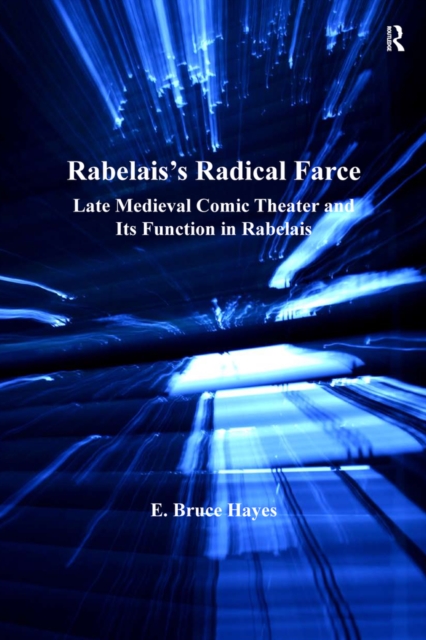
Rabelais's Radical Farce
In the first extended investigation of the importance of dramatic farce in Rabelais studies, Bruce Hayes makes an important contribution to the understanding of the theater of farce and its literary possibilities. By tracing the development of farce in late medieval and Renaissance comedic theater in comparison to the evolution of farce in Rabelais's work, Hayes distinguishes Rabelais's use of the device from traditional farce. While traditional farce is primarily conservative in its aims, with an emphasis on maintaining the status quo, Rabelais puts farce to radical new uses, making it subversive in his own work.
Bruce Hayes examines the use of farce in Pantagruel, Gargantua, and the Tiers and Quart livres, showing how Rabelais recast farce in a humanist context, making it a vehicle for attacking the status quo and posing alternatives to contemporary legal, educational, and theological systems.
Rabelais's Radical Farce illustrates the rich possibilities of a genre often considered simplistic and unsophisticated, disclosing how Rabelais in fact introduced both a radical reformulation of farce, and a new form of humanist satire.
eBook


Popular Songs Disguised in Prose
This paper will explore the effects of integrating short poetic forms into a prose text. It examines Johann Fischart’s Geschichtklitterung (1575), a German adaptation/translation of François Rabelais’s novel Gargantua that incorporates various citations to produce an intricate text in prose. Among them are over one hundred excerpts from contemporary popular songs that contain both verse and rhyme. Instead of arranging them as a prosimetrum with clear separations between prose and poetry, Fischart fits these songs seamlessly into his prose fabric, leaving no formal features that instantly distinguish them as non-prose. As a result, he obliterates the distinction between poetry and prose. This paper will argue that there are no concepts from humanist poetics capable of explaining this way of mixing poetry and prose. Through extensive formal analysis, it will reconstruct Fischart’s particular technique of incorporating short poetic forms into a prose text, arguing that this technique produces an original form of hybrid textuality.
Journal Article
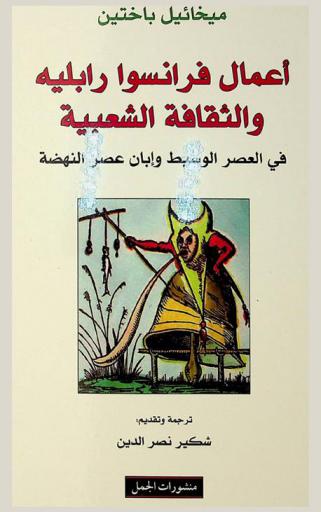
أعمال فرانسوا رابليه والثقافة الشعبية في العصر الوسيط وإبان عصر النهضة
في هذا الكتاب يقوم المؤلف بدراسة الثقافة الهزلية الشعبية التي لم تنصهر أبدا في ثقافة الطبعات السائدة الرسمية، باعتماده على ممثلها المرموق فرانسوا رابليه الذي يستمد أسلوبه من الثقافة الهزلية الشعبية، وثانيا عبر التتبع الدقيق لمظاهرها المتعددة: الضحك الشعبي، اللغة المألوفة، الاحتفال الشعبي والكرنفال بالأساس، أدب النجاسة، الأسفل المادي والجسدي، المأدبة وغيرها. إنها المرة الأولى التي يتشكل فيها موضوع الدراسة من الشعب الذي يضحك في الساحة العامة وما تعج به من حركات وإيماءات، وصيحات، مصدرها مغفلون أو مهرجون، عمالقة أو أقزام ومخلوقات ممسوخة، مضحكة، وأشكال الشعائر والطقوس والاستعراضات والعروض الفرجوية الهزلية في العصر الوسيط وإبان عصر النهضة، وذلك من خلال وضع مشكل الغروتيسك وماهيته الجمالية على نحو سليم بدراسة مصادره وتجلياته المتنوعة.
Book

Advertising the Self in Renaissance France
Advertising the Self in Renaissance France is a study of how authors and readers are represented in printed editions of three major literary figures of the French Renaissance: Jean Lemaire de Belges, Clément Marot, and François Rabelais.
eBook


The Alchemy of Excess: The Hermetic Prologues of François Rabelais for Gargantua and Miguel de Cervantes for the Novelas ejemplares
In the prologues to the readers of Gargantua (1535) and the Novelas ejemplares (1613) François Rabelais and Miguel de Cervantes express personal pride in their creative processes and in the content of their works. Utilizing a series of comparable images, examples, and recommendations, both authors acknowledge some intellectual concerns of their times, such as the Aristotelian principle of honest entertainment, exemplarity, and the very human tendency to judge the value of people and objects based on their appearance, and by extension, judging literary works based on casual readings. Both Rabelais and Cervantes enjoin their readers to consider that behind anodyne appearances, the stories presented in Gargantua and the Novelas ejemplares provide valuable knowledge hidden between the lines, underscore the value of humbleness, and exhort their audiences to read wisely to find the mysteries contained therein. In addition to similarities in language and images, scholars have addressed other creative points of contact between the works of François Rabelais and Miguel de Cervantes, including their common penchant for humorous and realistic expression.1 This study explores further points of contact in the creative processes of Rabelais and Cervantes summarized in the prologues of Gargantua and the Novelas ejemplares which can be associated with Hermetic and alchemical principles, in view of the well documented presence of esoteric knowledge in the intellectual and philosophical environment during their lifetime.2
Journal Article

In a “Rabelaisian Mood”: Laughter, Shock, and Cowardice in James Jones’s \The Thin Red Line\
James Jones’s second war trilogy, “The Thin Red Line” (1962), sketches the comic cycle of infantrymen undeterred by the relentless battles of Guadalcanal. In the name of bravery, Jones’s characters refuse to suffer by veiling their cowardice, insecurities, and anxieties under a burst of nervous laughter. In his mission to offer a verisimilar description of the Pacific struggle, Jones interrupts the bleak realism of his literary canon by carnivalesque episodes of combat festivals filled with tough humor at the act of killing and the spectacle of death. The aim behind this technique is to ridicule the tedious routine of military life, in particular, and war, in general. Most importantly, his narrative style conceals through laughter the traumas of his soldiers by offering a temporary therapy to their combat stress. Thus, “The Thin Red Line” does not only show Jones’s antiwar stance but also his endeavor to create characters who repress their anxieties to resist the pain inflicted by a higher order.
Journal Article
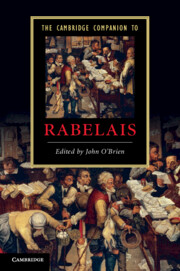
The Cambridge Companion to Rabelais
The Franciscan monk, humanist and physician François Rabelais, who flourished in sixteenth-century France, is widely considered as the Renaissance's greatest comic writer. His work - including most notably Gargantua and Pantagruel - continues to enthral readers with its complex and delicately crafted humour. 'Rabelaisian' and 'Gargantuan' have entered the lexicon but are often misunderstood; this Companion explains the literary and historical reality behind these notions. It provides an accessible account of Rabelais' major works and the contextual information and conceptual tools needed to understand the author and his world. The most up-to-date book on Rabelais to be designed specifically for English-speaking audiences, the Companion is intended to enable a broad spectrum of readers both to appreciate and to enjoy Rabelais. With a detailed guide to further reading and a chronology, and with all quotations given in translation, this is an ideal guide for students and scholars of French and comparative literature.
eBook