
Catalogue Search | MBRL


Are you sure you want to remove the book from the shelf?

{{itemTitle}}
26
result(s) for
"Racconti"
Sort by:

La memoria culturale dei Romani
Questo saggio affronta il problema della memoria culturale dei Romani, relativamente ai primi secoli della loro storia. Lo studio è condotto nella prospettiva delle ricerche inaugurate da Maurice Halbwachs e Jan Asmmann e pone le basi teoriche della ricerca a partire da un importante passo del De republica di Cicerone. Nella seconda parte passa in rassegna i principali ‘strumenti di memoria’ che hanno facilitato la trasmissione della memoria culturale a Roma: come la permanenza dei mores, i riti, i luoghi, i racconti e così via attraverso i quali la più antica memoria culturale romana ha potuto consolidarsi ed essere trasmessa.
Journal Article


Allegories of Contamination
The Trilogia della vita (Trilogy of Life) is a series of three films that Pier Paolo Pasolini completed before his horrifying assassination in 1975, and it remains among the most controversial of his cinematic works. In Allegories of Contamination Patrick Rumble provides an incisive critical and theoretical study of these films and the Marxist filmmaker's complex, original concept of the cinematic medium.
With the three films that make up the Trilogy of Life – The Decameron , Canterbury Tales , and The Arabian Nights – Pasolini attempts to recapture the aura surrounding popular, predominantly oral forms of storytelling through a pro-modern vision of innocent, unalienated bodies and pleasures. In these works Pasolini appears to abandon the explicitly political engagement that marked his earlier works - films that led him to be identified with other radical filmmakers such as Bellocchio, Bertolucci, and Godard. However, Pasolini insisted that these were his 'most ideological films,' and his political engagement translates into a mannerist, anti-classical style or what he called a 'cinema of poetry.' Rumble offers a comparative study based on the concept of 'aesthetic contamination,' which is fundamental to the understanding of Pasolini's poetics. Aesthetic contamination concerns the mediation between different cultures and different historical moments. Through stylistic experimentation, the Trilogy of Life presents a genealogy of visual codes, an interrogation of the subjectivity of narrative cinema. In these films Pasolini celebrates life, and perhaps therein lies their simple heresy.
eBook

Difficult Games
Examining Calvino's literary experiments as a young artist in search of his narrative voice, Ricci explores the psychological and existential motivations intrinsically linked to the writer's need for textual and systemic patterning. I racconti contains some of Calvino's least-read works, yet these early stories address issues, present scenarios and generate a growing variation of themes that form the heart of Calvino's narrative discourse. Ricci points out that melancholy permeates Calvino's works—even at his most playful. He suggests that if Calvino's highest merit was his sense of wonder and his urge to transform and defeat obscurantism with all the joy he could muster, one must remember that his work expressed, often painfully, the limits of human rationalism. I racconti can thus be read as a catalogue of the anxieties of both the young author and postwar Italian society.
eBook

Transfiguring the World through Fantasy. Fantastic Elements in Elsa Morante’s and Anna Maria Ortese’s Short Stories
This article compares Elsa Morante’s with Anna Maria Ortese’s short stories. There are several reasons why Morante and Ortese can be juxtaposed. In both cases, the content of their short stories became a significant part of their novels. Morante’s early short stories can be considered as preliminary to her later output; Ortese re-used many situations and characters of her short stories in her novels. A visionary element is evident in both authors, whose stories often take place outside common reality, even though they deal with realistic situations. Their narrations develop in real places, though filled with unrealistic details and atmospheres. They wanted to free the imagination and find an innovative balance between reality and fiction. Another common element is the love and care for humble and harmless creatures, that are numerous in their writings. Besides, both authors were self-educated, and often pointed out their atypical condition. They had the same problems to affirm their personality in a male, chauvinist milieu. For Morante and Ortese, writing was a practice of self-knowledge and a way of investigating the world.
Journal Article

Narrativa in Viaggio e Incontro con Boccaccio
L'articolo focalizza l'attenzione sul concetto dell'incontro tra le letterature mondiali, soprattutto la narrativa. Gli esempi che portiamo tendono a dare una visione storica su come il genere narrativo fece il suo viaggio lungo i millenni, partendo dai semplici antichi concetti orientali per arrivare al suo traguardo all'epoca di Giovanni Boccaccio, in Italia, e ripartire nuovamente come vera e propria arte tra le più note partecipanti alla comparsa del Rinascimento europeo.
Journal Article
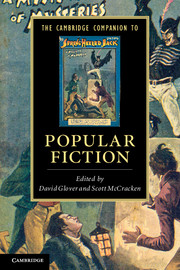
The Cambridge Companion to Popular Fiction
Popular commercial fiction emerged in the nineteenth century, with serialised novels and sensational penny dreadfuls. Today it remains a multi-million dollar industry giving pleasure to many, but it is also a field of growing interest for scholars and students of literature. This Companion covers the major developments in the history of popular fiction, with specially commissioned chapters on pulp fiction, bestsellers, and comics and graphic narratives. The volume also examines the public and personal everyday contexts within which popular texts are read, highlighting the ways in which such narratives have circulated across a variety of constantly changing media, including theatre, television, cinema and new computer-based digital forms. Case studies from key genres - crime fiction, romance and Gothic horror - as well as a full chronology and guide to further reading make this collection indispensable to all those interested in this complex and vibrant cultural field.
eBook

THE REPRIEVE: WEAK MESSIANISM AND THE EVENT IN PRIMO LEVI'S \MOMENTS OF REPRIEVE\
In this article, I analyse Primo Levi's work on Auschwitz, in particular his Moments of Reprieve. Against the overdetermined inhuman economy of the camp, I find that 'the reprieve' is what philosopher John D. Caputo has described as an Event, a stirring prompted by a call from alterity. Because it does not redeem or provide salvation, the reprieve is a weak form of messianism, suspending but not cancelling the camp. Because every other Other remains ultimately incomprehensible, I argue that even in the most repressive of the circumstances there remains the possibility of the reprieve.
Journal Article


Recensione di Concetta Maria Pagliuca e Filippo Pennacchio (a cura di), Tempora, i tempi verbali nel racconto Vol.1 (Biblion, 2023) e Francesco De Cristofaro, Paolo Giovannetti e Giovanni Maffei (a cura di), Tempora, i tempi verbali nel racconto Vol. 2 (Biblion, 2024)
Recensione di Concetta Maria Pagliuca e Filippo Pennacchio (a cura di), Tempora, i tempi verbali nel racconto Vol.1. Biblion, 2023; Francesco De Cristofaro, Paolo Giovannetti e Giovanni Maffei (a cura di), Tempora, i tempi verbali nel racconto Vol. 2. Biblion, 2024. Review of Concetta Maria Pagliuca e Filippo Pennacchio (a cura di), Tempora, i tempi verbali nel racconto Vol.1. Biblion, 2023; Francesco De Cristofaro, Paolo Giovannetti e Giovanni Maffei (a cura di), Tempora, i tempi verbali nel racconto Vol. 2. Biblion, 2024.
Journal Article