
Catalogue Search | MBRL


Are you sure you want to remove the book from the shelf?

{{itemTitle}}
8,674
result(s) for
"Race horses."
Sort by:

Man o' War.
A fictionalized biography of the American race horse who won twenty of twenty-one races, told by a stable boy who grew up with the great horse.
Book

Secretariat
\"This full arc of life-bigger than imagination in a raging fire-is set on paper by a poet obsessed with beauty, hooves, and the passion of flight...In Lifshin's language, spare yet metaphorically profound, we enter into that animal grace that only a true poet can convey, as we race on from poem to poem, joining Secretariat in triumph-'not for a win but a coronation.'\" --Laura ChesterAS THE DAYS GET LONGERthe horse dreamsof flying in the airlike a gust of windon an abandonedChristmas tree,red exploding likea spurt of light,flaming wildly likethose boughs ofnorthern lightsout of darkness.
eBook


A tainted reputation it deserves? Crime in the trotting sector of Dutch horse racing
The Netherlands are a small country with an urban underworld history before a serious problem of organized crime has developed since the 1980. The interest of the mob in Horse Race Betting flourished before that time. After a long period of Prohibition since 1911 horse racing (especially trotting) and betting on the results has become a very popular pastime since it was permitted in 1948. Especially during the nineteen seventies and eighties horse races drew a large audience and to a lesser degree they still do. However, bookmaking has always been forbidden since 1911 and that by itself presented in invitation to (organized) crime. Other well-known criminal byproducts of horse racing such as drugging horses, laundering money and matchfixing have been observed but as we measured only to a very moderate degree. The social variety of aficionados for the races is amazing. While doing historical and ethnographic field research at the race tracks we registered a mixture of people of humble origins as well as big entrepreneurs. There were members of the royal family but also well-known criminals. It is amazing to find out to what degree the latter have been accepted by the entire horse racing community.
Journal Article

Horse welfare, use not abuse
\"Horse Welfare, Use not Abuse is about all equines from The Pony Club to the highest levels of performance-racing, show jumping, eventing and endurance riding. The book challenges all horse and pony owners to care better for their animals. In his travels, Christopher has met the leaders of most of the equestrian sports both nationally and internationally. Stories about some of these are featured, as well as anecdotes about the work of World Horse Welfare, calling on his role as a leading regulator, chairman of World Horse Welfare and lifelong horseman. From a position of authority-he held one of the highest profile jobs in the Jockey Club, steward in charge of enforcing the rules of horse racing-he provides an insight into the high stakes world of racing where winning is everything. In a sport where controversy is never far away, he calls for tougher measures to fight drug abuse. He believes the real victims are the horses. There is a warning to the professionals in the sport that they have a duty of care not just for the horses, which are the real stars, but for the sport they enjoy.\"--provided by publisher.
Book

Six Weeks in Saratoga
Semifinalist for the 2011 Dr. Tony Ryan Book Award
presented by Castleton Lyons and Thoroughbred Times When
Rachel Alexandra thundered to a stylish win against the boys in the
2009 Preakness Stakes, her connections came to the 141st Saratoga
Race Course meeting wanting more than just another victory. They
wanted Horse of the Year. Her jockey, Calvin Borel, pointed
triumphantly to the three-year-old filly beneath him. Rachel
Alexandra was the best horse he had ever ridden and it was his job
to ensure that she and her connections didn't leave Saratoga
Springs without a victory. Hall of Fame trainer and gruff New
Yorker Nick Zito felt he could slay the queen. He'd take his shots
with two rival horses, Da' Tara and Cool Coal Man, because, as he
well knew, you can't win if you don't play. New York Racing
Association president and CEO Charlie Hayward knew that Rachel
Alexandra could run elsewhere and didn't have to come to Saratoga.
The pressure was on him to keep this talented and magnetic filly on
his property, but how far could he go without compromising his
values? Then there were the other horses at the meet: the
Zito-trained Commentator, eight years old and looking for one last
try in the Whitney Handicap; Kentucky Derby-winner Mine That Bird,
aiming to reclaim his glory if he could only stay healthy; and
Summer Bird, the Belmont Stakes winner, who demanded respect.
Everyone was in the twilight of their careers. What would be their
legacies? How would they be remembered? Never before has the famous
racing season at Saratoga been illustrated through these threads,
in real time. As we follow the jockey, the trainer, and the
executive, we come to understand how they, and so many other racing
fans and professionals, were drawn to the magnetism of one special
horse, Rachel Alexandra. All of this happens in six weeks, all at
Saratoga.
eBook

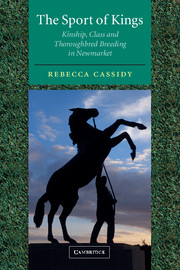
The Sport of Kings
The Sport of Kings is an ethnography of the British racing industry based upon two years of participant observation in Newmarket, the international headquarters of flat racing. Racing in Britain provides a lens through which ideas of class, status, tradition and hierarchy can be examined in an environment which is both superficially familiar and richly exotic. This book explores concepts about 'nature' specific to thoroughbred racehorse breeding, and pursues the idea that in making statements about animals, we reveal something of ourselves. It explains the action that takes place on racecourses, in training yards, on studs and at bloodstock auctions. It analyses the consumption of racing through betting on the racecourse and in betting shops, and it proffers an insightful description of a unique class system: that of the humans and animals involved in the production of British flat racing.
eBook

Warriors on horseback : the inside story of the professional jockey
A remarkable and riveting insight into the lives of jockeys. Jockeys who earn a living race riding on racehorses are a remarkable group. They are fiercely competitive on the racecourse but enjoy a tribal kinship in the weighing room. The minimum requirements for long-term success are courage, skill, athleticism and an intuitive understanding of how to \"get a tune\" out of a horse. This book celebrates these warriors on horseback, both the old and the new, highlighting the headline performers for jump racing and flat racing in the last five centuries--male and female and from around the globe--as well as taking the reader on a behind-the-scenes look at the lifestyle of professional jockeys in the 21st century. The book takes a tour of Aintree's weighing room, tracks a day in the life of a Derby-winning jockey and investigates the twin challenges faced by jockeys: inevitable injuries and 24/7 weight management. The book also looks back at historical events where jockeys have made the headlines, including the scandal of jockey Sam Chifney, Lord Bunbury and the Prince of Wales; Captain Becher and his attempt to negotiate Aintree's formidable fences during the Grand National's inaugural running; Fred Archer, who committed suicide in the mists of mental and physical misery; Red Pollard's partnership with the great American horse, Seabiscuit; Bob Champion, who recovered from cancer to win the Grand National, and Frankie Dettori's magnificent seven wins in one day at Ascot. Dettori is just one of the more recent jockeys featured; others include Lester Piggott, Bill Shoemaker, Scobie Breasley, Julie Krone, John Francome and Tony McCoy. The book features quotes and insights from eminent jockeys and racing insiders, people who know the profession and the sport; and is illustrated with captivating images from the world of horseracing. Includes foreword by Bob Champion MBE, former jump jockey and Grand National winner.
Book

Never Say Die
A quarter of a million people braved miserable conditions at Epsom Downs on June 2, 1954, to see the 175th running of the prestigious Derby Stakes. Queen Elizabeth II and Sir Winston Churchill were in attendance, along with thousands of Britons who were all convinced of the unfailing superiority of English bloodstock and eager to see a British colt take the victory. They were shocked when a Kentucky-born chestnut named Never Say Die galloped to a two-length triumph at odds of 33--1, winning Britain's greatest race and beginning an important shift in the world of Thoroughbred racing. Never Say Die traces the history of this extraordinary colt, beginning with his foaling in Lexington, Kentucky, when a shot of bourbon whiskey revived him and earned him his name. Author James C. Nicholson also tells the stories of the influential individuals brought together by the horse and his victory -- from the heir to the Singer sewing machine fortune to the Aga Khan. Most fascinating is the tale of Mona Best of Liverpool, England, whose well-placed bet on the long-shot Derby contender allowed her to open the Casbah Coffee Club. There, her son met musicians John Lennon, Paul McCartney, and George Harrison and later joined their band. Featuring a foreword by the original drummer for the Beatles, Pete Best, this remarkable book reveals how an underdog's surprise victory played a part in the formation of the most successful and influential rock band in history and made the Bluegrass region of Kentucky the center of the international Thoroughbred industry.
eBook