
Catalogue Search | MBRL


Are you sure you want to remove the book from the shelf?

{{itemTitle}}
11
result(s) for
"Racism -- Europe, Central -- History -- 20th century"
Sort by:

Blood and Homeland
The history of eugenics and racial nationalism in Central and Southeast Europe is a neglected topic of analysis in contemporary scholarship. The 20 essays in this volume, written by distinguished scholars of eugenics and fascism alongside a new generation of scholars, excavate the hitherto unknown eugenics movements in Central and Southeast Europe, including Austria and Germany. Eugenics and racial nationalism are topics that have constantly been marginalized and rated as incompatible with local national traditions in Central and Southeast Europe. These topics receive a new treatment here. On the one hand, the historiographic perspective connects developments in the history of anthropology and eugenics with political ideologies such as racial nationalism and anti-Semitism; on the other hand, it contests the 'Sonderweg' approach adopted by scholars dealing with these issues.
eBook
Beyond the Border : The German-Jewish Legacy Abroad
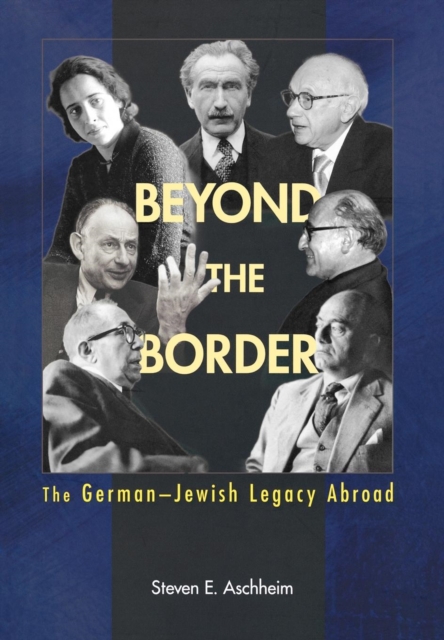
The modern German-Jewish experience through the rise of Nazism in 1933 was characterized by an explosion of cultural and intellectual creativity. Yet well after that history has ended, the influence of Weimar German-Jewish intellectuals has become ever greater. Hannah Arendt, Gershom Scholem, Theodor Adorno, Walter Benjamin, Franz Rosenzweig, and Leo Strauss have become household names and possess a continuing resonance. \"Beyond the Border\" seeks to explain this phenomenon and analyze how the German-Jewish legacy has continuingly permeated wider modes of Western thought and sensibility, and why these Émigrés occupy an increasingly iconic place in contemporary society. Steven Aschheim traces the odyssey of a fascinating group of German-speaking Zionists--among them Martin Buber and Hans Kohn--who recognized the moral dilemmas of Jewish settlement in pre-Israel Palestine and sought a binationalist solution to the Arab-Israel conflict. He explores how German-Jewish Émigré historians like Fritz Stern and George Mosse created a new kind of cultural history written against the background of their exile from Nazi Germany and in implicit tension with postwar German social historians. And finally, he examines the reasons behind the remarkable contemporary canonization of these Weimar intellectuals--from Arendt to Strauss--within Western academic and cultural life. Beyond the Border is about more than the physical act of departure. It also points to the pioneering ways these Émigrés questioned normative cognitive boundaries and have continued to play a vital role in addressing the predicaments that engage and perplex us today.
eBook

Hormones, Heredity, and Race
Early in the twentieth century, arguments about \"nature\" and \"nurture\" pitted a rigid genetic determinism against the idea that genes were flexible and open to environmental change. This book tells the story of three Viennese biologists-Paul Kammerer, Julius Tandler, and Eugen Steinach-who sought to show how the environment could shape heredity through the impact of hormones. It also explores the dynamic of failure through both scientific and social lenses. During World War I, the three men were well respected scientists; by 1934, one was dead by his own hand, another was in exile, and the third was subject to ridicule.Paul Kammerer had spent years gathering zoological evidence on whether environmental change could alter heredity, using his research as the scientific foundation for a new kind of eugenics-one that challenged the racism growing in mainstream eugenics. By 1918, he drew on the pioneering research of two colleagues who studied how secretions shaped sexual attributes to argue that hormones could alter genes. After 1920, Julius Tandler employed a similar concept to restore the health and well-being of Vienna's war-weary citizens. Both men rejected the rigidly acting genes of the new genetics and instead crafted a biology of flexible heredity to justify eugenic reforms that respected human rights. But the interplay of science and personality with the social and political rise of fascism and with antisemitism undermined their ideas, leading to their spectacular failure.
eBook

Violence Elsewhere 2
Examines ideas of violence in German culture after 9/11 through the lens of \"violence elsewhere\" - exploring works and discourses about violence in distant locations or times. Following the Nazi era, the Holocaust, and the Second World War, in postwar Germany thinking or speaking about that extreme violence seemed distinctively difficult - even perhaps, at times, impossible. Yet we can learn about understandings of violence in this period in novel ways by exploring images and constructions in German culture of faraway violence, as shown in the recent volume Violence Elsewhere 1: Imagining Distant Violence in Germany, 1945-2001. As of September 11, 2001, violence came to appear transnationally, spectacularly mobile in new ways. Consequently, Violence Elsewhere 2 explores ideas about \"violence elsewhere\" in German-language culture since 2001. Here, \"elsewhere\" can mean not only distant places; it may also be violence perceived as foreign, or in the past. Simultaneously, this work suggests that the idea of 9/11 as a watershed in thinking about violence is more complex than meets the eye. Here, nine essays consider classic literary forms like poetry and prose fiction, from the short story to the intergenerational German family novel to Black feminist speculative fiction. Contributors examine, too, philosophy, performance and multimedia art, political and other forms of public discourse, and film. Topics include, amongst others, the \"war on terror,\" slow environmental violence, the Armenian genocide, portrayals of refugees and migrants, legacies of colonial violence, space travel, and the persistent resonance of the German past. Contributors: Sofía Forchieri, Susanne C. Knittel, Marie Kolkenbrock, Priscilla Layne, Joanne Leal, Francesca Lewis, Frauke Matthes, Lizzie Stewart, Nicola Thomas, and Kathrin Wunderlich. This book is available as Open Access under the Creative Commons license CC BY-NC-ND.
eBook

Histories of Nationalism in Ireland and Germany
Focusing on the era in which the modern idea of nationalism emerged as a way of establishing the preferred political, cultural, and social order for society, this book demonstrates that across different European societies the most important constituent of nationalism has been a specific understanding of the nation’s historical past. Analysing Ireland and Germany, two largely unconnected societies in which the past was peculiarly contemporary in politics and where the meaning of the nation was highly contested, this volume examines how narratives of origins, religion, territory and race produced by historians who were central figures in the cultural and intellectual histories of both countries interacted; it also explores the similarities and differences between the interactions in these societies. Histories of Nationalism in Ireland and Germany investigates whether we can speak of a particular common form of nationalism in Europe. The book draws attention to cultural and intellectual links between the Irish and the Germans during this period, and what this meant for how people in either society understood their national identity in a pivotal time for the development of the historical discipline in Europe. Contributing to a growing body of research on the ‘transnationality’ of nationalism, this new study of a hitherto-unexplored area will be of interest to historians of modern Germany and Ireland, comparative and transnational historians, and students and scholars of nationalism, as well as those interested in the relationship between biography and writing history.
eBook

Strangers on the Western Front : Chinese workers in the Great War
During World War I, Britain and France imported workers from their colonies to labor behind the front lines. The single largest group of support labor came not from imperial colonies, however, but from China. Xu Guoqi tells the remarkable story of the 140,000 Chinese men recruited for the Allied war effort. These laborers, mostly illiterate peasants from north China, came voluntarily and worked in Europe longer than any other group. Xu explores China's reasons for sending its citizens to help the British and French (and, later, the Americans), the backgrounds of the workers, their difficult transit to Europe—across the Pacific, through Canada, and over the Atlantic—and their experiences with the Allied armies. It was the first encounter with Westerners for most of these Chinese peasants, and Xu also considers the story from their perspective: how they understood this distant war, the racism and suspicion they faced, and their attempts to hold on to their culture so far from home. In recovering this fascinating lost story, Xu highlights the Chinese contribution to World War I and illuminates the essential role these unsung laborers played in modern China's search for a new national identity on the global stage.
eBook
Handbuch der völkischen Wissenschaften : Akteure, Netzwerke, Forschungsprogramme
Seit dem Beginn des 19.Jahrhunderts und verstärkt im Deutschen Kaiserreich war der völkische Nationalismus in der Rechten verankert und gewann während der Weimarer Republik sichtlich an politischer Relevanz.
eBook
Nazism
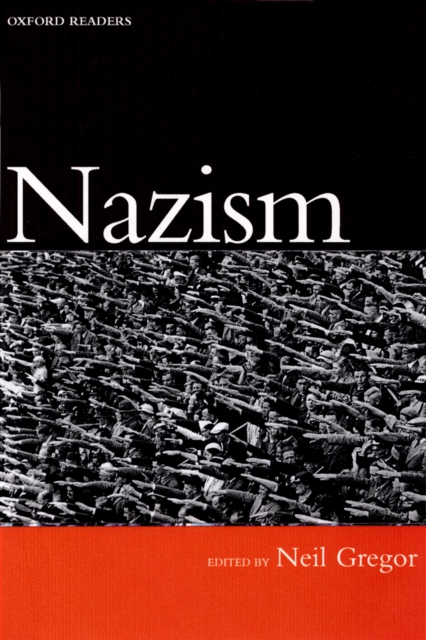
This unique collection brings together extracts both from the most innovative and stimulating recent studies of Nazism as well as many forgotten or ignored older works. Nazism explores how successive generations of commentators and historians have sought to explain and understand the origins, nature, impact, and legacy of this regime of unprece.
eBook
Tunnel Visions and Mysterious Trees: Modernist Projects of National and Racial Regeneration, 1880-1939
The No could not be so powerful if there were not simultaneously in our midst a Yes worth fighting for that is lethal to it; if beneath the veils separating us from life, below the nihilism of the new age, there did not stir all the time a force unknown to our morality or imagination, one which has been constantly thwarted by every sort of fear and obstacle. It is via this hazardous path that almost everything has reached us, fleeing a world inhospitable to life so as to find refuge in us as gardeners of the most mysterious tree, a tree which has yet to grow. In us alone the light still burns while earth and heaven collapse all around: the supreme creative, philosophical moment has arrived.
Book Chapter
Eugenics, Race and Nation in Central and Southeast Europe, 1900-1940: A Historiographic Overview
In the concluding chapter to The Wellborn Science: Eugenics in Germany, France, Brazil and Russia (1990), Mark B. Adams complained about the lack of diversity in the comparative history of eugenics: \"We are beginning to know something of Russian eugenics, but what of the Austro-Hungarian Empire and Slavic eastern Europe--Czechoslovakia, Hungary, Bulgaria, and the Ukraine? As a Catholic Slavic country, Poland should be an especially intriguing test case. Lemaine, Schneider, Clark, and others are clarifying the character of eugenics in France; what of other Latin cultures of Europe, what of eugenics in Italy, Spain, Portugal, Romania?\"
1
After the collapse of Communism in 1989, topics such as eugenics, anti-Semitism and racism were resurrected as scholarly areas of interest, and researchers were given access to materials previously controlled by Communist regimes. As a result, a number of recently published monographs have quickly become essential readings of eugenic movements in Romania, Austria and Poland.
2
Yet studies and monographs are still lacking on the history of eugenic movements in other Central and Southeast European countries.
3
However, as this volume demonstrates, substantial analytical effort has been recently devoted to compensate for the lack of historiographic interest in these topics.
Book Chapter