
Catalogue Search | MBRL


Are you sure you want to remove the book from the shelf?

{{itemTitle}}
10
result(s) for
"Radio broadcasting Political aspects United States 20th century."
Sort by:


Sound Business
American newspapers have faced competition from new media for over ninety years. Today digital media challenge the printed word. In the 1920s, broadcast radio was the threatening upstart. At the time, newspaper publishers of all sizes turned threat into opportunity by establishing their own stations. Many, such as theChicago Tribune's WGN, are still in operation. By 1940 newspapers owned 30 percent of America's radio stations. This new type of enterprise, the multimedia corporation, troubled those who feared its power to control the flow of news and information. InSound Business, historian Michael Stamm traces how these corporations and their critics reshaped the ways Americans received the news. Stamm is attuned to a neglected aspect of U.S. media history: the role newspaper owners played in communications from the dawn of radio to the rise of television. Drawing on a wide array of primary sources, he recounts the controversies surrounding joint newspaper and radio operations. These companies capitalized on synergies between print and broadcast production. As their advertising revenue grew, so did concern over their concentrated influence. Federal policymakers, especially during the New Deal, responded to widespread concerns about the consequences of media consolidation by seeking to limit and even ban cross ownership. The debates between corporations, policymakers, and critics over how to regulate these new kinds of media businesses ultimately structured the channels of information distribution in the United States and determined who would control the institutions undergirding American society and politics.Sound Businessis a timely examination of the connections between media ownership, content, and distribution, one that both expands our understanding of mid-twentieth-century America and offers lessons for the digital age.
eBook


Radio Utopia
As World War II drew to a close and radio news was popularized through overseas broadcasting, journalists and dramatists began to build upon the unprecedented success of war reporting on the radio by creating audio documentaries. Focusing particularly on the work of radio luminaries such as Edward R. Murrow, Fred Friendly, Norman Corwin, and Erik Barnouw, Radio Utopia: Postwar Audio Documentary in the Public Interest traces this crucial phase in American radio history, significant not only for its timing immediately before television, but also because it bridges the gap between the end of the World Wars and the beginning of the Cold War._x000B__x000B_Matthew C. Ehrlich closely examines the production of audio documentaries disseminated by major American commercial broadcast networks CBS, NBC, and ABC from 1945 to 1951. Audio documentary programs educated Americans about juvenile delinquency, slums, race relations, venereal disease, atomic energy, arms control, and other issues of public interest, but they typically stopped short of calling for radical change. Drawing on rare recordings and scripts, Ehrlich traces a crucial phase in the evolution of news documentary, as docudramas featuring actors were supplanted by reality-based programs that took advantage of new recording technology. Paralleling that shift from drama to realism was a shift in liberal thought from dreams of world peace to uneasy adjustments to a cold war mentality._x000B__x000B_Influenced by corporate competition and government regulations, radio programming reflected shifts in a range of political thought that included pacifism, liberalism, and McCarthyism. In showing how programming highlighted contradictions within journalism and documentary, Radio Utopia reveals radio's response to the political, economic, and cultural upheaval of the post-war era.
eBook

Cold War on the airwaves : the radio propaganda war against East Germany
\"Cold War on the Airwaves offers a history of the Berlin-based American propaganda broadcaster Radio in the American Sector (RIAS) and its impact on the political culture of the German Democratic Republic during the early Cold War. Founded in 1946 to serve as America's official radio station in Berlin and as a counterweight to the Communist-controlled broadcasters in East Germany, RIAS quickly became one of the United States' most successful public information operations conducted against the Soviet Bloc. Nicholas Schlosser examines how the RIAS fast became one of the most trusted sources for news inside East Germany during a dynamic period following World War II that included the Berlin Airlift, the East German rising of 1954, and building of the Berlin Wall. Drawing on a wealth of broadcast transcripts, internal memoranda, listener letters, and surveys of East Germans by the U.S. Information Agency, he attributes RIAS's success to its conscious effort to balance accuracy with partisanship. Claiming objective journalism, RIAS reporters nevertheless used the language, style, and tone of neutral broadcasting to openly attack the Soviet Union and undermine the GDR's legitimacy. Through information from East German citizens visiting or escaping to West Berlin, the reporters broadcast stories to counter official statements from East Germany's ruling party, reported on bad economic conditions, and encouraged listeners to oppose the GDR. Thus, as with other U.S. anticommunist public information programs, RIAS attempted to resolve the inherent contradictions of conducting a propaganda operation in name of creating a democratic society built upon an objective press\"-- Provided by publisher.
BOOK
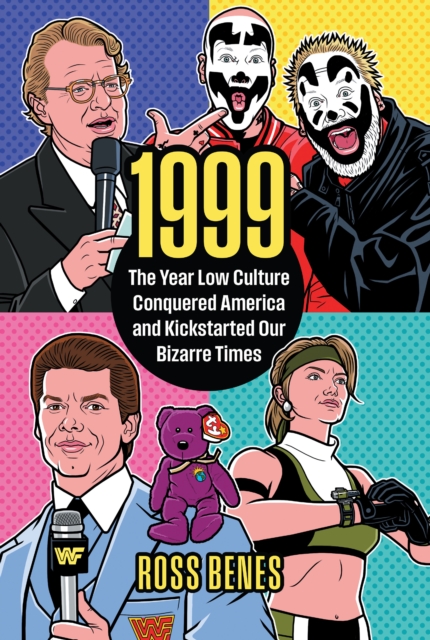
1999
From pro wrestling and Pokémon to Insane Clown Posse
and Jerry Springer, this look at the low culture of the late
’90s reveals its profound impact and how it continues to
affect our culture and society today.
The year 1999 was a high-water mark for popular culture.
According to one measure, it was the “best movie year
ever.” But as journalist Ross Benes shows, the end of the
’90s was also a banner year for low culture. This was the
heyday of Jerry Springer, Jenna Jameson, and Vince McMahon, among
many others. Low culture had come into its own and was poised for
world domination. The reverberations of this takeover continue to
shape American society.
During its New Year’s Eve countdown, MTV entered 1999
with Limp Bizkit covering Prince’s famous anthem to the new
year. The highlights of the lowlights continued when WCW and WWE
drew 35 million American viewers each week with sex appeal and
stories about insurrections. Insane Clown Posse emerged from the
underground with a Woodstock set and platinum records about magic
and murder. Later that year,
Dance Dance Revolution debuted in North America and
Grand Theft Auto emerged as a major video game
franchise. Beanie Babies and Pokémon so thoroughly seized
the wallets and imagination of collectors that they created
speculative investment bubbles that anticipated the faddish
obsession over nonfungible tokens (NFTs). The trashy talk show
Jerry Springer became daytime TV’s most-watched
program and grew so mainstream that
Austin Powers ,
Sabrina the Teenage Witch ,
The Wayans Bros. ,
The Simpsons , and
The X-Files incorporated Springer into their own plots
during the late ’90s. Donald Trump even explored a
potential presidential nomination with the Reform Party in 1999
and wanted his running mate to be Oprah Winfrey, whose own talk
show would make Dr. Oz a household name.
Benes shows us how so
many of the strangest features of culture in 1999 predicted and
influenced American life today. This wild ride through pop
culture uncovers the connections between the kayfabe of WWE and
the theatrics of politics, between the faddish obsession with
Beanie Babies and with NFTs, between faithful fans and political
loyalists, between violent video games and society’s
scapegoats, and much more.
1999 is not just a nostalgic look at the past. It is
also a window into our contentious present.
eBook

Cold War on the Airwaves
Founded as a counterweight to the Communist broadcasters in East Germany, Radio in the American Sector (RIAS) became one of the most successful public information operations conducted against the Soviet Bloc. Cold War on the Airwaves examines the Berlin-based organization's history and influence on the political worldview of the people--and government--on the other side of the Iron Curtain. Nicholas Schlosser draws on broadcast transcripts, internal memoranda, listener letters, and surveys by the U.S. Information Agency to profile RIAS. Its mission: to undermine the German Democratic Republic with propaganda that, ironically, gained in potency by obeying the rules of objective journalism. Throughout, Schlosser examines the friction inherent in such a contradictory project and propaganda's role in shaping political culture. He also portrays how RIAS's primarily German staff influenced its outlook and how the organization both competed against its rivals in the GDR and pushed communist officials to alter their methods in order to keep listeners. From the occupation of Berlin through the airlift to the construction of the Berlin Wall, Cold War on the Airwaves offers an absorbing view of how public diplomacy played out at a flashpoint of East-West tension.
eBook

The NBC Advisory Council and radio programming, 1926-1945
In 1926, the new NBC network established an advisory board of prominent citizens to help it make program decisions and to deflect concerns over NBC’s dominance over radio. The book critiques the Council’s influence over programming, U.S. society, and the broadcast industry during its almost two-decade existence.
eBook
Regulating the Future: Broadcasting Technology and Governmental Control
This comprehensive study examines the case of AM stereo and subsequent technologies to demonstrate the FCC's evolution from stern to reluctant regulator. It also examines emerging technologies, such as multichannel television sound, digital audio broadcasting, and high definition television, and discusses their impact on the evolution of broadcast regulation. In the 1980s the tension between governmental control and the marketplace resulted in the FCC's deregulation of TV and radio, electing to set only technical operating parameters and allowing legal operation of any system that meets those minimal standards. Huff argues that this approach is likely to influence regulatory approaches to other new developments in broadcast technologies. The extensive overview of the industry and the study of the interrelationships between the technologies will appeal to communication scholars in the fields of radio and television as well as interest industry professionals.
eBook
MoneyWatch Report
Meanwhile, stocks closed mixed yesterday led by gains in tech and industrial companies. The Dow did decline twenty-six points. The NASDAQ closed up eighteen, hitting a new record. The S&P 500 gained three points.
Transcript