
Catalogue Search | MBRL


Are you sure you want to remove the book from the shelf?

{{itemTitle}}
30,713
result(s) for
"Radio programs"
Sort by:


A Word from Our Sponsor: Admen, Advertising, and the Golden Age of Radio
The behind-the-scenes story of how admen and sponsors helped shape broadcasting into a popular commercial entertainment medium. During the \"golden age\" of radio, from roughly the late 1920s until the late 1940s, advertising agencies were arguably the most important sources of radio entertainment. Most nationally broadcast programs on network radio were created, produced, written, and/or managed by advertising agencies: for example, J. Walter Thompson produced \"Kraft Music Hall\" for Kraft; Benton & Bowles oversaw \"Show Boat\" for Maxwell House Coffee; and Young & Rubicam managed \"Town Hall Tonight\" with comedian Fred Allen for Bristol-Myers. Yet this fact has disappeared from popular memory and receives little attention from media scholars and historians. By repositioning the advertising industry as a central agent in the development of broadcasting, author Cynthia B. Meyers challenges conventional views about the role of advertising in culture, the integration of media industries, and the role of commercialism in broadcasting history. Based largely on archival materials, A Word from Our Sponsor mines agency records from the J. Walter Thompson papers at Duke University, which include staff meeting transcriptions, memos, and account histories; agency records of BBDO, Benton & Bowles, Young & Rubicam, and N. W. Ayer; contemporaneous trade publications; and the voluminous correspondence between NBC and agency executives in the NBC Records at the Wisconsin Historical Society. Mediating between audiences' desire for entertainment and advertisers' desire for sales, admen combined \"showmanship\" with \"salesmanship\" to produce a uniquely American form of commercial culture. In recounting the history of this form, Meyers enriches and corrects our understanding not only of broadcasting history but also of advertising history, business history, and American cultural history from the 1920s to the 1940s.
eBook

Aliens are coming! : the true account of the 1938 War of the worlds radio broadcast
The story of the practical joke that fooled American radio listeners and made Orson Welles famous.
Book

Thrillers, Chillers, and Killers
Film noir is one of the most exciting and most debated products of studio-era Hollywood, but did you know that American radio broadcast many programs in the noir vein through the 1940s and 1950s? These included adaptations of such well-known films as The Maltese Falcon, Murder, My Sweet, and Double Indemnity, detective series devoted to the adventures of private eyes Philip Marlowe and Sam Spade, and the spine-tingling anthology programs Lights Out and Suspense. Thrillers, Chillers, and Killers is the first book to explore in detail noir storytelling on the two media, arguing that radio's noir dramas played an important role as a counterpart to, influence on, or a spin-off from the noir films. Besides shedding new light on long-neglected radio dramas, and a medium that was cinema's major rival, this scrupulously researched yet accessible study also uses these programs to challenge conventional understandings of the much-debated topic of noir.
eBook

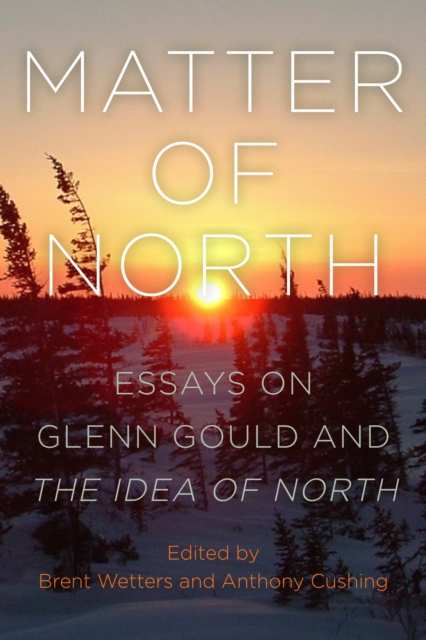
Matter of North
Documents and illuminates Glenn Gould's groundbreaking radio composition, The Idea of North.Matter of North collects essays and source material related to Glenn Gould's landmark 1967 radio documentary The Idea of North. The most famous product (other than his studio piano recordings) of Gould's 1964 decision to abandon the concert stage for the recording studio, it combines Gould's interests in the contrapuntal (by the simultaneous layering of speaking voices) with philosophy and a life-long fascination with the Canadian Arctic. Because the documentary is a multivalent work, the contributors approach the documentary from unique perspectives (sociological, philosophical, music-theoretical, ethnomusicological), each illuminating a salient aspect of the work. The source-material section includes for the first time the complete interview responses by Gould's five participants, along with other important documentation.
eBook


Harnessing energy for wearables: a review of radio frequency energy harvesting technologies
Wireless energy harvesting enables the conversion of ambient energy into electrical power for small wireless electronic devices. This technology offers numerous advantages, including availability, ease of implementation, wireless functionality, and cost-effectiveness. Radio frequency energy harvesting (RFEH) is a specific type of wireless energy harvesting that enables wireless power transfer by utilizing RF signals. RFEH holds immense potential for extending the lifespan of wireless sensors and wearable electronics that require low-power operation. However, despite significant advancements in RFEH technology for self-sustainable wearable devices, numerous challenges persist. This literature review focuses on three key areas: materials, antenna design, and power management, to delve into the research challenges of RFEH comprehensively. By providing an up-to-date review of research findings on RFEH, this review aims to shed light on the critical challenges, potential opportunities, and existing limitations. Moreover, it emphasizes the importance of further research and development in RFEH to advance its state-of-the-art and offer a vision for future trends in this technology.
Journal Article


A Review of Radio Frequency Based Localisation for Aerial and Ground Robots with 5G Future Perspectives
Efficient localisation plays a vital role in many modern applications of Unmanned Ground Vehicles (UGV) and Unmanned Aerial Vehicles (UAVs), which contributes to improved control, safety, power economy, etc. The ubiquitous 5G NR (New Radio) cellular network will provide new opportunities to enhance the localisation of UAVs and UGVs. In this paper, we review radio frequency (RF)-based approaches to localisation. We review the RF features that can be utilized for localisation and investigate the current methods suitable for Unmanned Vehicles under two general categories: range-based and fingerprinting. The existing state-of-the-art literature on RF-based localisation for both UAVs and UGVs is examined, and the envisioned 5G NR for localisation enhancement, and the future research direction are explored.
Journal Article