
Catalogue Search | MBRL


Are you sure you want to remove the book from the shelf?

{{itemTitle}}
101,065
result(s) for
"Rain forests"
Sort by:

The lost rainforests of Britain
In 2020, Guy Shrubsole moved from London to Devon. As he began to explore the wooded valleys, rivers and tors of Dartmoor, he discovered an extraordinary habitat that he had never come across before: temperate rainforest. Entranced, he would spend the coming months exploring and researching the history and distribution of rainforest in the British Isles. Britain, Guy discovered, was once a rainforest nation. This is the story of a unique habitat that has become so denuded and fragmented, most people today don't realise it exists.
Book

Fine roots stimulate nutrient release during early stages of leaf litter decomposition in a Central Amazon rainforest
Purpose
Large parts of the Amazon rainforest grow on weathered soils depleted in phosphorus and rock-derived cations. We tested the hypothesis that in this ecosystem, fine roots stimulate decomposition and nutrient release from leaf litter biochemically by releasing enzymes, and by exuding labile carbon stimulating microbial decomposers.
Methods
We monitored leaf litter decomposition in a Central Amazon tropical rainforest, where fine roots were either present or excluded, over 188 days and added labile carbon substrates (glucose and citric acid) in a fully factorial design. We tracked litter mass loss, remaining carbon, nitrogen, phosphorus and cation concentrations, extracellular enzyme activity and microbial carbon and nutrient concentrations.
Results
Fine root presence did not affect litter mass loss but significantly increased the loss of phosphorus and cations from leaf litter. In the presence of fine roots, acid phosphatase activity was 43.2% higher, while neither microbial stoichiometry, nor extracellular enzyme activities targeting carbon- and nitrogen-containing compounds changed. Glucose additions increased phosphorus loss from litter when fine roots were present, and enhanced phosphatase activity in root exclusions. Citric acid additions reduced litter mass loss, microbial biomass nitrogen and phosphorus, regardless of fine root presence or exclusion.
Conclusions
We conclude that plant roots release significant amounts of acid phosphatases into the litter layer and mobilize phosphorus without affecting litter mass loss. Our results further indicate that added labile carbon inputs (
i.e
. glucose) can stimulate acid phosphatase production by microbial decomposers, highlighting the potential importance of plant-microbial feedbacks in tropical forest ecosystems.
Journal Article

What are tropical rainforests?
\"Readers will encounter the fascinating plants and animals that can be found in the canopy, understory, and forest floor. They'll also learn about the importance of rainforests, as well as the causes and effects of rainforest destruction\"-- Provided by publisher.
Book

Recurrent droughts increase risk of cascading tipping events by outpacing adaptive capacities in the Amazon rainforest
Tipping elements are nonlinear subsystems of the Earth system that have the potential to abruptly shift to another state if environmental change occurs close to a critical threshold with large consequences for human societies and ecosystems. Among these tipping elements may be the Amazon rainforest, which has been undergoing intensive anthropogenic activities and increasingly frequent droughts. Here, we assess how extreme deviations fromclimatological rainfall regimes may cause local forest collapse that cascades through the coupled forest–climate system. We develop a conceptual dynamic network model to isolate and uncover the role of atmospheric moisture recycling in such tipping cascades. We account for heterogeneity in critical thresholds of the forest caused by adaptation to local climatic conditions. Our results reveal that, despite this adaptation, a future climate characterized by permanent drought conditions could trigger a transition to an open canopy state particularly in the southern Amazon.Theloss of atmospheric moisture recycling contributes to one-third of the tipping events.Thus, by exceeding local thresholds in forest adaptive capacity, local climate change impacts may propagate to other regions of the Amazon basin, causing a risk of forest shifts even in regions where critical thresholds have not been crossed locally.
Journal Article

Tropical rain forests
Explains what tropical rain forests are like, looks at the plants and animals that live in rain forests, and includes information on why tropical rain forests are important and what is being done to save them.
Book
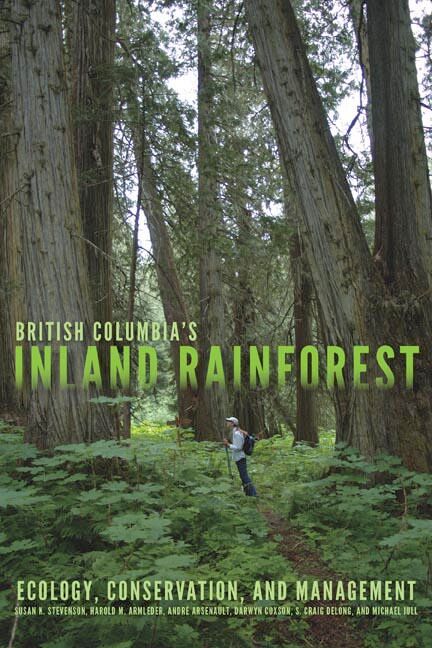
British Columbia's inland rainforest
This book brings together information from a wide range of sources about the ecology, management, and conservation of British Columbia's inland rainforest.
eBook

Rain forests : a nonfiction companion to Magic tree house #6, Afternoon on the Amazon
A nonfiction companion to the fiction book Afternoon on the Amazon which presents facts about the rain forest.
Book

Giant eucalypts – globally unique fire-adapted rain-forest trees?
Tree species exceeding 70 m in height are rare globally. Giant gymnosperms are concentrated near the Pacific coast of the USA, while the tallest angiosperms are eucalypts (Eucalyptus spp.) in southern and eastern Australia. Giant eucalypts co-occur with rain-forest trees in eastern Australia, creating unique vegetation communities comprising fire-dependent trees above fire-intolerant rain-forest. However, giant eucalypts can also tower over shrubby understoreys (e.g. in Western Australia). The local abundance of giant eucalypts is controlled by interactions between fire activity and landscape setting. Giant eucalypts have features that increase flammability (e.g. oil-rich foliage and open crowns) relative to other rain-forest trees but it is debatable if these features are adaptations. Probable drivers of eucalypt gigantism are intense intra-specific competition following severe fires, and inter-specific competition among adult trees. However, we suggest that this was made possible by a general capacity of eucalypts for ‘hyper-emergence’. We argue that, because giant eucalypts occur in rain-forest climates and share traits with rain-forest pioneers, they should be regarded as long-lived rain-forest pioneers, albeit with a particular dependence on fire for regeneration. These unique ecosystems are of high conservation value, following substantial clearing and logging over 150 yr.
Journal Article

Do you really want to visit a rainforest?
\"A child goes on an adventure to the Amazon Rainforest, discovering what the climate is like and encountering some of the many species of animals and plants that live in a tropical rainforest. Includes world map of tropical rainforests and glossary\"-- Provided by publisher.
Book

Long-term decline of the Amazon carbon sink
The capacity of Amazonian forests to sequester carbon has weakened with potentially important implications for climate change.
Long-term decline of the Amazon carbon sink
The Amazon is a globally important carbon sink, with tree growth incorporating carbon dioxide from the atmosphere. This paper suggests that the capacity of Amazonian forests to sequester carbon has weakened, with potentially important implications for climate change. Using on-the-ground measurements from a network of more than 300 long-term monitoring plots across the region, Roel Brienen and colleagues show that the rates of net increase in above-ground biomass have declined by a third during the past decade compared to the 1990s as a consequence of growth rate increases levelling off. At the same time biomass mortality persistently increased.
Atmospheric carbon dioxide records indicate that the land surface has acted as a strong global carbon sink over recent decades
1
,
2
, with a substantial fraction of this sink probably located in the tropics
3
, particularly in the Amazon
4
. Nevertheless, it is unclear how the terrestrial carbon sink will evolve as climate and atmospheric composition continue to change. Here we analyse the historical evolution of the biomass dynamics of the Amazon rainforest over three decades using a distributed network of 321 plots. While this analysis confirms that Amazon forests have acted as a long-term net biomass sink, we find a long-term decreasing trend of carbon accumulation. Rates of net increase in above-ground biomass declined by one-third during the past decade compared to the 1990s. This is a consequence of growth rate increases levelling off recently, while biomass mortality persistently increased throughout, leading to a shortening of carbon residence times. Potential drivers for the mortality increase include greater climate variability, and feedbacks of faster growth on mortality, resulting in shortened tree longevity
5
. The observed decline of the Amazon sink diverges markedly from the recent increase in terrestrial carbon uptake at the global scale
1
,
2
, and is contrary to expectations based on models
6
.
Journal Article