
Catalogue Search | MBRL


Are you sure you want to remove the book from the shelf?

{{itemTitle}}
1,089
result(s) for
"Rare birds"
Sort by:


Endangered and Disappearing Birds of Appalachia and the Southeast
From the most unforgiving of concrete jungles to the pastoral
reaches of the countryside, birds are among the most plentiful and
plainly visible animals on the planet. For millions of years, they
have survived in every known biome, carving out ecological niches
for themselves and their offspring and often thriving. But this
remarkable adaptability can only go so far. With the recent
acceleration of habitat loss, climate change, spread of invasive
species, and other detrimental environmental developments, birds
are disappearing across the world. Yet despite such wide-ranging
decimation, birdwatching remains one of the fastest growing hobbies
in the United States.
Endangered and Disappearing Birds of Appalachia and the
Southeast , by award-winning author and photographer Matt
Williams, is an essential guide for the bird-curious in the
Appalachian and southeastern regions of the United States.
Combining brilliant photography with taxonomic classification,
identification tips, and other information, the book goes beyond
the scope of a traditional field guide. Each profile includes
descriptions of current species-conservation efforts, as well as
tips on how to get involved in the ongoing work to save these
endangered creatures. This carefully compiled guide offers a
detailed introduction to the birds that most need our help and to
the steps we can all take to protect their future.
eBook


Rare birds of North America
Rare Birds of North Americais the first comprehensive illustrated guide to the vagrant birds that occur throughout the United States and Canada. Featuring 275 stunning color plates, this book covers 262 species originating from three very different regions--the Old World, the New World tropics, and the world's oceans. It explains the causes of avian vagrancy and breaks down patterns of occurrence by region and season, enabling readers to see where, when, and why each species occurs in North America. Detailed species accounts describe key identification features, taxonomy, age, sex, distribution, and status.
Rare Birds of North Americaprovides unparalleled insights into vagrancy and avian migration, and will enrich the birding experience of anyone interested in finding and observing rare birds.
Covers 262 species of vagrant birds found in the United States and CanadaFeatures 275 stunning color plates that depict every speciesExplains patterns of occurrence by region and seasonProvides an invaluable overview of vagrancy patterns and migrationIncludes detailed species accounts and cutting-edge identification tips
eBook


Optimization of Ecological Water Supplement Scheme for Improved Suitable Habitat Area for Rare Migratory Birds in Nature Reserves Using Interval-Parameter Fuzzy Two-Stage Stochastic Programming Model
The optimization of ecological water supplement scheme in Momoge National Nature Reserve (MNNR), using an interval-parameter two-stage stochastic programming model (IPTSP), still experiences problems with fuzzy uncertainties and the wide scope of the obtained optimization schemes. These two limitations pose a high risk of system failure causing high decision risk for decision-makers and render it difficult to further undertake optimization schemes respectively. Therefore, an interval-parameter fuzzy two-stage stochastic programming (IPFTSP) model derived from an IPTSP model was constructed to address the random variable, the interval uncertainties and the fuzzy uncertainties in the water management system in the present study, to reduce decision risk and narrow down the scope of the optimization schemes. The constructed IPFTSP model was subsequently applied to the optimization of the ecological water supplement scheme of MNNR under different scenarios, to maximize the recovered habitat area and the carrying capacity for rare migratory water birds. As per the results of the IPFTSP model, the recovered habitat areas for rare migratory birds under low, medium and high flood flow scenarios were (14.06, 17.88) × 103, (14.92, 18.96) × 103 and (15.83, 19.43) × 103 ha, respectively, and the target value was (14.60, 18.47) × 103 ha with a fuzzy membership of (0.01, 0.83). Fuzzy membership reflects the possibility level that the model solutions satisfy the target value and the corresponding decision risk. We further observed that the habitat area recovered by the optimization schemes of the IPFTSP model was significantly increased compared to the recommended scheme, and the increases observed were (5.22%, 33.78%), (11.62%, 41.88%) and (18.44%, 45.39%). In addition, the interval widths of the recovered habitat areas in the IPFTSP model were reduced by 17.15%, 17.98% and 23.86%, in comparison to those from the IPTSP model. It was revealed that the IPFTSP model, besides generating the optimal decision schemes under different scenarios for decision-makers to select and providing decision space to adjust the decision schemes, also shortened the decision range, thereby reducing the decision risk and the difficulty of undertaking decision schemes. In addition, the fuzzy membership obtained from the IPFTSP model, reflecting the relationship among the possibility level, the target value, and the decision risk, assists the decision-makers in planning the ecological water supplement scheme with a preference for target value and decision risk.
Journal Article

Vanished and vanishing parrots : profiling extinct and endangered species
\"Parrots comprise one of the most endangered groups of birds, with a growing number of species nearing extinction. The purpose of this book is to bring together information on species that have become extinct in historical times with information on species that are in danger of becoming extinct so that public awareness of the plight of these magnificent birds may be increased. The main text will comprise species accounts with accompanying illustrations. Vivid color plates will draw attention to the spectacular species that we have lost or that could be lost. There will be a comprehensive Introduction focusing on the three major regions of distribution, namely the Australasian distribution, the Afro-Asian distribution and the Neotropical distribution. The status of parrots in each of these distributions will be discussed, with particular attention given to threats that caused the extinction of species or are endangering extant species, as well as conservation measures being implemented or that should be implemented. Additionally, there will be an appendix with brief accounts of eight species with endangered subspecies. This will have a full-page color plate depicting these subspecies in field guide style illustrations\"-- Provided by publisher.
Book
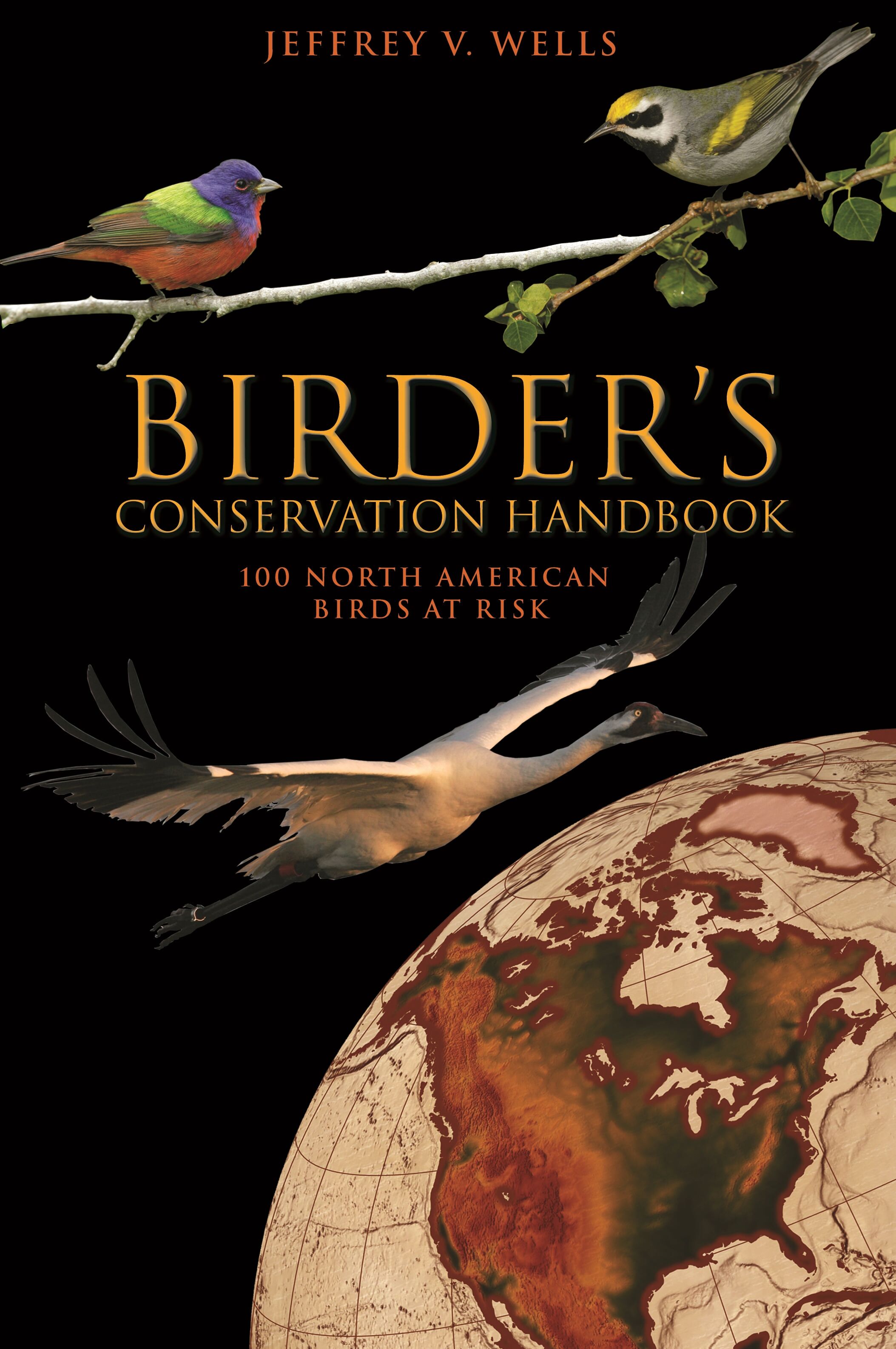
Birder’s conservation handbook
Until now there has been no single, comprehensive resource on the status of North America's most threatened birds and what people can do to help protect them. Birder's Conservation Handbook is the only book of its kind, written specifically to help birders and researchers understand the threats while providing actions to protect birds and their habitats. Jeffrey Wells has distilled vast amounts of essential information into a single easy-to-use volume-required reading for anyone who loves birds and wants to ensure they are protected. At-a-glance species accounts cover in detail North America's one hundred most at-risk birds; each account is beautifully illustrated by today's top bird artists. The text includes status, distribution, ecology, threats, conservation actions and needs, and references. A distribution map accompanies each entry. Chapters discuss birds as indicators of environmental health, the state of North American bird populations, major conservation issues, and initiatives now underway to improve the health of North America's birds.
eBook

Feather trails : a journey of discovery among endangered birds
\"The story of one woman's remarkable work with a trio of charismatic, endangered bird species-and her discoveries about the devastating threats that imperil them. In Feather Trails, wildlife biologist and birder Sophie A. H. Osborn reveals how the harmful environmental choices we've made-including pesticide use, the introduction of invasive species, lead poisoning, and habitat destruction-have decimated Peregrine Falcons, Hawaiian Crows, and California Condors. In the Rocky Mountains, the cloud forests of Hawai'i, and the Grand Canyon, Sophie and her colleagues work day-to-day to try to reintroduce these birds to the wild, even when it seems that the odds are steeply stacked against their survival. With humor and suspense, Feather Trails introduces us to the fascinating behaviors and unique personalities of Sophie's avian charges and shows that what endangers them ultimately threatens all life on our planet. More than a deeply researched environmental investigation, Feather Trails is also a personal journey and human story, in which Sophie overcomes her own obstacles-among them heat exhaustion, poachers, rattlesnakes, and chauvinism. Ultimately, Feather Trails is an inspiring, poignant narrative about endangered birds and how our choices can help to ensure a future not only for the rarest species, but for us too\"-- Provided by publisher.
BOOK
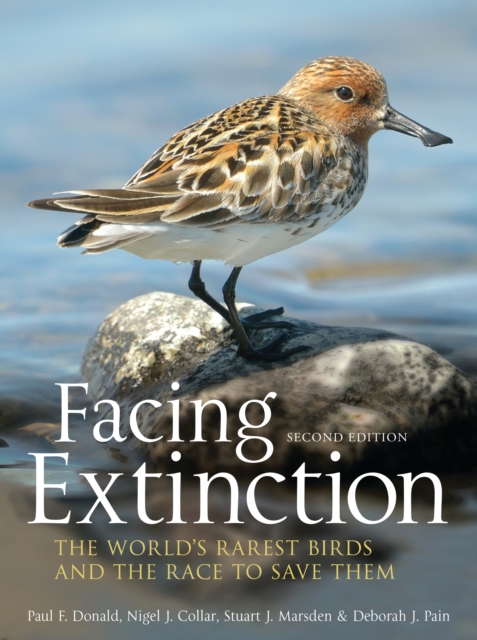
Facing Extinction
Almost two hundred species of birds have become extinct in the past 400 years, and a similar number today are in imminent danger of following them. The world’s conservationists are leading the fight to prevent the demise of these remaining critically endangered birds, with a fair degree of success. This new book examines the process and issues concerning extinction – how and why it happens and what can be done about it. Whilst man is to blame for many of the causes, such as persecution and habitat loss, species have become extinct on a regular basis since life began. After several thought-provoking introductory chapters, the book showcases about 20 species on the brink of extinction from around the world and describes the work that is being undertaken to save them. Some are success stories, but a few are not. This is a subject close to the hearts of all birders and ornithologists and this book, written by a team of leading conservationists, will strike a chord in most of them.
eBook