
Catalogue Search | MBRL


Are you sure you want to remove the book from the shelf?

{{itemTitle}}
549
result(s) for
"Rationalisme."
Sort by:
Veḷiccappāṭint̲e bhārya : andhaviśvāsattint̲e ar̲upat Malayāḷa varṣaṅṅaḷ
Studies on religious superstition and rational thinking in Kerala, India.
Book

Logic and the Foundations of Game and Decision Theory (LOFT 7)
This volume collects together revised papers originally presented at the 7th Conference on Logic and the Foundations of Game and Decision Theory (LOFT 2006). LOFT is a key venue for presenting research at the intersection of logic, economics and computer science, and the present collection gives a lively and wide-ranging view of an exciting and rapidly growing area. This title is available in the OAPEN Library - http://www.oapen.org.
eBook

The Outer Limits of Reason
This exploration of the scientific limits of knowledge challenges our deep-seated beliefs about our universe, our rationality, and ourselves.\"A must-read for anyone studying information science.\" -- Publishers Weekly, starred review Many books explain what is known about the universe.This book investigates what cannot be known.
eBook
Suspension of Reason in Hegel and Schelling
In this rigorous historical analysis, Lauer challenges traditional readings that have reduced two of German idealism’s most important thinkers to opposing caricatures: Hegel the uncompromising systematist blind to the novelty and contingency of human life and Schelling the protean thinker drawn to all manner of pseudoscientific charlatanry. Bringing together recent scholarship that is just beginning to realise Schelling’s centrality in the overthrow of metaphysics and Hegel’s openness to diversity and innovation, this book shows that both thinkers can be read as contributing to the Kantian project of showing both the utter necessity and the limitations of reason. In readings of texts spanning each thinker’s career, Lauer shows that animating much of Hegel and Schellings’ most passionate work is their recognition of the need neither for a canonization of reason nor for its overthrow, but for its ‘suspension’. Their lifelong willingness to revisit both their definitions of reason and their accounts of its role in philosophy give these discussions a vitality and depth that few in the history of philosophy can match.
eBook
How We Reason
Good reasoning can lead to success; bad reasoning can lead to catastrophe. Yet, it's not obvious how we reason, and why we make mistakes. This new book by one of the pioneers of the field, Philip Johnson-Laird, looks at the mental processes that underlie our reasoning. It provides the most accessible account yet of the science of reasoning.
eBook


Diotima's children : German aesthetic rationalism from Leibniz to Lessing
This book is a re-examination of the rationalist tradition of aesthetics which prevailed in Germany in the late 17th and 18th century. It is partly an historical survey of the central figures and themes of this tradition, but it is also a philosophical defence of some of its leading ideas such as: that beauty plays an integral role in life; that aesthetic pleasure is the perception of perfection; and that aesthetic rules are inevitable and valuable. It shows that the criticisms of Kant and Nietzsche of this tradition are largely unfounded. The rationalist tradition deserves re-examination because it is of great historical significance, marking the beginning of modern aesthetics, art criticism, and art history.
eBook

In praise of reason
Why does reason matter, if (as many people seem to think) in the end everything comes down to blind faith or gut instinct? Why not just go with what you believe even if it contradicts the evidence? Why bother with rational explanation when name-calling, manipulation, and force are so much more effective in our current cultural and political landscape? Michael Lynch's In Praise of Reason offers a spirited defense of reason and rationality in an era of widespread skepticism-when, for example, people reject scientific evidence about such matters as evolution, climate change, and vaccines when it doesn't jibe with their beliefs and opinions. In recent years, skepticism about the practical value of reason has emerged even within the scientific academy. Many philosophers and psychologists claim that the reasons we give for our most deeply held views are often little more than rationalizations of our prior convictions. In Praise of Reason gives us a counterargument. Although skeptical questions about reason have a deep and interesting history, they can be answered. In particular, appeals to scientific principles of rationality are part of the essential common currency of any civil democratic society. The idea that everything is arbitrary-that reason has no more weight than blind faith-undermines a key principle of a civil society: that we owe our fellow citizens explanations for what we do. Reason matters-not just for the noble ideal of truth, but for the everyday world in which we live. Summary reprinted by permission of MIT Press
eBook
Re-thinking the cogito : naturalism, reason and the venture of thought
Re-Thinking the Cogito seeks to combine a strongly naturalistic with a distinctively rationalist perspective on some nowadays much-discussed issues in philosophy of mind.Against the common view that they involve downright incompatible conceptions of mind, knowledge and ethics it seeks to unite a naturalism that draws on recent advances in.
eBook
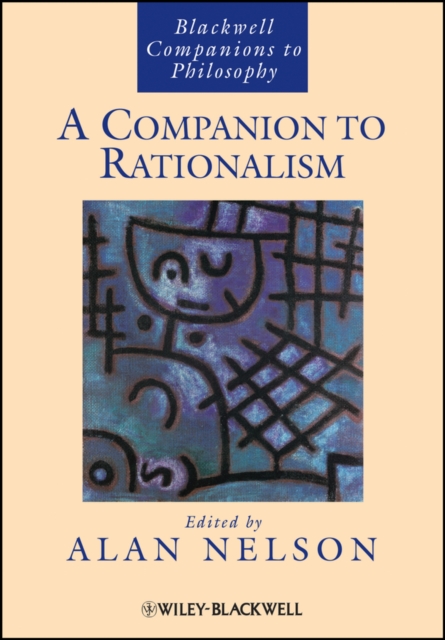
A Companion to Rationalism
This book is a wide-ranging examination of rationalist thought in philosophy from ancient times to the present day.
* Written by a superbly qualified cast of philosophers
* Critically analyses the concept of rationalism
* Focuses principally on the golden age of rationalism in the seventeenth and early eighteenth centuries
* Also covers ancient rationalism, nineteenth-century rationalism, and rationalist themes in recent thought
* Organised chronologically
* Various philosophical methods and viewpoints are represented
eBook