
Catalogue Search | MBRL


Are you sure you want to remove the book from the shelf?

{{itemTitle}}
567,411
result(s) for
"Raw Materials"
Sort by:

Making the modern world : materials and dematerialization
\"How much further should the affluent world push its material consumption? Does relative dematerialization lead to absolute decline in demand for materials? These and many other questions are discussed and answered in Making the Modern World: Materials and Dematerialization.Over the course of time, the modern world has become dependent on unprecedented flows of materials. Now even the most efficient production processes and the highest practical rates of recycling may not be enough to result in dematerialization rates that would be high enough to negate the rising demand for materials generated by continuing population growth and rising standards of living. This book explores the costs of this dependence and the potential for substantial dematerialization of modern economies. Making the Modern World: Materials and Dematerialization considers the principal materials used throughout history, from wood and stone, through to metals, alloys, plastics, and silicon, describing their extraction and production as well as their dominant applications. The evolving productivities of material extraction, processing, synthesis, finishing, and distribution, and the energy costs and environmental impact of rising material consumption are examined in detail. The book concludes with an outlook for the future, discussing the prospects for dematerialization and potential constraints on materials.This interdisciplinary text will provide useful perspectives for readers with backgrounds including resource economics, environmental studies, energy analysis, mineral geology, industrial organization, manufacturing, and material science\"-- Provided by publisher.
Book

The Critical Raw Materials in Cutting Tools for Machining Applications: A Review
A variety of cutting tool materials are used for the contact mode mechanical machining of components under extreme conditions of stress, temperature and/or corrosion, including operations such as drilling, milling turning and so on. These demanding conditions impose a seriously high strain rate (an order of magnitude higher than forming), and this limits the useful life of cutting tools, especially single-point cutting tools. Tungsten carbide is the most popularly used cutting tool material, and unfortunately its main ingredients of W and Co are at high risk in terms of material supply and are listed among critical raw materials (CRMs) for EU, for which sustainable use should be addressed. This paper highlights the evolution and the trend of use of CRMs) in cutting tools for mechanical machining through a timely review. The focus of this review and its motivation was driven by the four following themes: (i) the discussion of newly emerging hybrid machining processes offering performance enhancements and longevity in terms of tool life (laser and cryogenic incorporation); (ii) the development and synthesis of new CRM substitutes to minimise the use of tungsten; (iii) the improvement of the recycling of worn tools; and (iv) the accelerated use of modelling and simulation to design long-lasting tools in the Industry-4.0 framework, circular economy and cyber secure manufacturing. It may be noted that the scope of this paper is not to represent a completely exhaustive document concerning cutting tools for mechanical processing, but to raise awareness and pave the way for innovative thinking on the use of critical materials in mechanical processing tools with the aim of developing smart, timely control strategies and mitigation measures to suppress the use of CRMs.
Journal Article
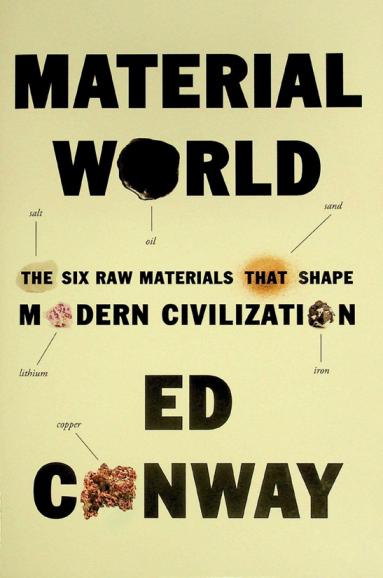
Material world : the six raw materials that shape modern civilization
\"The story of civilization from an entirely new vantage point-the six raw materials that have shaped and will continue to shape humanity's destiny. Sand, iron, salt, oil, copper and lithium: The struggle for these fundamental materials has created empires, razed civilizations, and fed our ingenuity and our greed for thousands of years. It is a story that is far from finished. Though we are told we now live in a weightless world of information, we dug more stuff out of the earth in 2017 than in all of human history before 1950. And it's getting exponentially worse. To make one bar of gold, we now have to dig 5,000 tons of earth. For every ton of fossil fuels, we extract six tons of other materials-from sand to stone to wood to metal. Even as we pare back our consumption of fossil fuels we continue to redouble our consumption of everything else. Why? Because these ingredients are the basis for everything. They power our phones and electric cars, build our homes and offices, enable the printing of our books, and supply our packaging. Our modern world would not exist without them, and the hidden battle to control them will shape our future. This is an epic journey across continents, cultures and epochs that captures the astonishing extent to which humanity's prosperity is intertwined with what we extract from the earth and adapt to our needs and desires. It is a story of our past and future, from the ground up\"-- Provided by publisher.
Book

Lignins as Promising Renewable Biopolymers and Bioactive Compounds for High-Performance Materials
The recycling of biomass into high-value-added materials requires important developments in research and technology to create a sustainable circular economy. Lignin, as a component of biomass, is a multipurpose aromatic polymer with a significant potential to be used as a renewable bioresource in many fields in which it acts both as promising biopolymer and bioactive compound. This comprehensive review gives brief insights into the recent research and technological trends on the potential of lignin development and utilization. It is divided into ten main sections, starting with an outlook on its diversity; main properties and possibilities to be used as a raw material for fuels, aromatic chemicals, plastics, or thermoset substitutes; and new developments in the use of lignin as a bioactive compound and in nanoparticles, hydrogels, 3D-printing-based lignin biomaterials, new sustainable biomaterials, and energy production and storage. In each section are presented recent developments in the preparation of lignin-based biomaterials, especially the green approaches to obtaining nanoparticles, hydrogels, and multifunctional materials as blends and bio(nano)composites; most suitable lignin type for each category of the envisaged products; main properties of the obtained lignin-based materials, etc. Different application categories of lignin within various sectors, which could provide completely sustainable energy conversion, such as in agriculture and environment protection, food packaging, biomedicine, and cosmetics, are also described. The medical and therapeutic potential of lignin-derived materials is evidenced in applications such as antimicrobial, antiviral, and antitumor agents; carriers for drug delivery systems with controlled/targeting drug release; tissue engineering and wound healing; and coatings, natural sunscreen, and surfactants. Lignin is mainly used for fuel, and, recently, studies highlighted more sustainable bioenergy production technologies, such as the supercapacitor electrode, photocatalysts, and photovoltaics.
Journal Article

Materials for design
Over the last ten years there has been a huge growth in the area of materials for design, but most books on this subject deal with advanced, semi-formed materials (that is, materials sold as sheet, rod, tube, etc.). This book provides much-needed information on the raw materials, and the low-down on how these can be used.
Book

Green and Bio-Based Solvents
Chemical reactions and many of the procedures of separation and purification employed in industry, research or chemistry teaching utilize solvents massively. In the last decades, with the birth of Green Chemistry, concerns about the employment of solvents and the effects on human health, as well as its environmental impacts and its dependence on non-renewable raw materials for manufacturing most of them, has drawn the attention of the scientific community. In this work, we review the concept of green solvent and the properties and characteristics to be considered green. Additionally, we discuss the different possible routes to prepare many solvents from biomass, as an alternative way to those methods currently applied in the petrochemical industry.
Journal Article

Material world : the six raw materials that shape modern civilization
\"The story of civilization from an entirely new vantage point-the six raw materials that have shaped and will continue to shape humanity's destiny. Sand, iron, salt, oil, copper and lithium: The struggle for these fundamental materials has created empires, razed civilizations, and fed our ingenuity and our greed for thousands of years. It is a story that is far from finished. Though we are told we now live in a weightless world of information, we dug more stuff out of the earth in 2017 than in all of human history before 1950. And it's getting exponentially worse. To make one bar of gold, we now have to dig 5,000 tons of earth. For every ton of fossil fuels, we extract six tons of other materials-from sand to stone to wood to metal. Even as we pare back our consumption of fossil fuels we continue to redouble our consumption of everything else. Why? Because these ingredients are the basis for everything. They power our phones and electric cars, build our homes and offices, enable the printing of our books, and supply our packaging. Our modern world would not exist without them, and the hidden battle to control them will shape our future. This is an epic journey across continents, cultures and epochs that captures the astonishing extent to which humanity's prosperity is intertwined with what we extract from the earth and adapt to our needs and desires. It is a story of our past and future, from the ground up\"-- Provided by publisher.
Book

Challenges and opportunities of the European Critical Raw Materials Act
The Critical Raw Materials Act (CRMA) is an essential regulatory framework designed to address the pressing challenges faced by the European Union (EU) in the strategic sectors of decarbonization, digitalization, and aerospace and defense. It aims to tackle the lack of secure and sustainable access to critical raw materials (CRMs) by increasing anticipation and mitigation of supply risks, fostering domestic CRM potential, and promoting sustainable sourcing practices. Part of a broader “Green Industrial Plan” and aligned with the “Net-Zero Industry Act” (NZIA), the CRMA strives to position the EU as a leading hub for clean tech industries. The NZIA and CRMA packages respond to international trends of protecting clean energy technology and resources, akin to the US Inflation Reduction Act. Defining materials as “strategic” based on their relevance and expected demand for strategic technologies, the CRMA regulation establishes benchmarks for minimum shares of EU demand to be covered by domestically sourced and processed as well as recycled raw materials and aims at reducing dependencies on single third country suppliers in all steps of the supply chain. A communication complements the regulation by focusing on increasing CRM supply security and sustainability through circularity, standardization efforts, skill development, and strategic actions for research and innovation. Establishing a “CRM Club” and partnerships with like-minded countries intend to strengthen international partnerships to safeguard CRM supply security and facilitate sustainable investment in resource-rich nations. Challenges arise concerning the concept of “strategic raw materials” and meeting benchmarks, particularly in materials availability, recycling targets, diversification, and the establishment of necessary skills. Data gaps, potential national differences, coherence with national legislation, long-term economic viability, and potential fuelling of international tensions also pose significant challenges to the effective implementation of the CRMA. Addressing these challenges and embracing the opportunities presented by the CRMA are crucial steps toward achieving sustainable resource management and advancing the EU’s clean tech industries.
Journal Article

Ancient Egyptian materials and technology
This is a study of the procurement and processing of raw materials employed by the ancient Egyptians over the five millennia of the Predynastic and Pharaonic periods (c. 5500-332 BC).
Book

Understanding Rare Earth Elements as Critical Raw Materials
The boom in technological advances in recent decades has led to increased demand for rare earth elements (REEs) (also known as rare earth metals) across various industries with wide-ranging industrial applications, including in the clean energy sector, but with some environmental, economic, and social footprint concerns. This paper reviews the complexities of the production, consumption, and reuse or recovery of REEs, presenting current trends in terms of potentials and challenges associated with this. This paper in particular focuses on the supply, demand, and (environmental and economic) sustainability of REEs, as a subset of critical raw materials. It does so via a critical stocktaking of key discussions and debates in the field over the past 15 years up until now, through a thematic analysis of the published and gray (policy) literature with a grounded theory approach. The paper finds that carefully balanced lifecycle sustainability assessments are needed for assessing the respective dimensions of the extraction, processing, and reuse or recovery methods for different types of REE sources and supplies to meet current and future demands. It furthermore diagnoses the need for taking into account some shifts and substitutions among REEs also for reasons of cost and locational supplies for the security of supply. Finally, the paper provides some overall policy recommendations for addressing current problems, with a conceptual framing of the UN Sustainable Development Goals.
Journal Article