
Catalogue Search | MBRL


Are you sure you want to remove the book from the shelf?

{{itemTitle}}
35,858
result(s) for
"Reading (Secondary)"
Sort by:


Creating a Reading Culture in Primary and Secondary Schools
Did your school encourage a life-long love of reading? Children who identify as readers are three times more likely to have good mental wellbeing. A reading culture that permeates a school can transform it into a space where reading is supported, encouraged, normalised and valued. Creating a Reading Culture in Primary and Secondary Schools will help teachers and librarians to: advocate for the importance of a whole-school reading culture with recent research in this field; select from a number of research-supported strategies underpinning a whole-school reading culture to tailor your school's approach according to resourcing and priorities; develop a clear trajectory for building and sustaining stakeholder engagement and resourcing, including securing external funding for related initiatives; and plan and manage a multi-faceted approach to enable real change within your school.
Drawing on the author's internationally-recognised experience in this field, this book will be essential reading for anyone looking to develop reading in schools.
eBook

Literacy Is Liberation
Literacy is the foundation for all learning and must be accessible to all students. This fundamental truth is where Kimberly Parker begins to explore how culturally relevant teaching can help students work toward justice. Her goal is to make the literacy classroom a place where students can safely talk about key issues, move to dismantle inequities, and collaborate with one another. Introducing diverse texts is an essential part of the journey, but teachers must also be equipped with culturally relevant pedagogy to improve literacy instruction for all.
In Literacy Is Liberation, Parker gives teachers the tools to build culturally relevant intentional literacy communities (CRILCs) with students. Through CRILCs, teachers can better shape their literacy instruction by
* Reflecting on the connections between behaviors, beliefs, and racial identity.
* Identifying the characteristics of culturally relevant literacy instruction and grounding their practice within a strengths-based framework.
* Curating a culturally inclusive library of core texts, choice reading, and personal reading, and teaching inclusive texts with confidence.
* Developing strategies to respond to roadblocks for students, administrators, and teachers.
* Building curriculum that can foster critical conversations between students about difficult subjects—including race.
In a culturally relevant classroom, it is important for students and teachers to get to know one another, be vulnerable, heal, and do the hard work to help everyone become a literacy high achiever. Through the practices in this book, teachers can create the more inclusive, representative, and equitable classroom environment that all students deserve.
eBook


Using literature in English language education
Covering Green's The Fault in Our Stars, Collins' The Hunger Games, Selznick's The Invention of Hugo Cabret, Rowling's Wizarding World, Staake's Bluebird and Winton's Lockie Leonard, contributors consider how literature can be used for teaching literary literacy, creative writing, intercultural learning, critical pedagogy and deep reading in school settings where English is the teaching medium. Leading scholars from around the world explore pedagogical principles for English Language Teaching (ELT) widening children's and teenagers' literacy competences as well as their horizons through insightful engagement with texts. From challenging picturebooks for primary and secondary students, to graphic novels, to story apps, film and drama, as well as speculative fiction on provocative topics, recent research on literature education in ELT settings combines with cognitive criticism in the field of children's, young adult and adult literature.
eBook

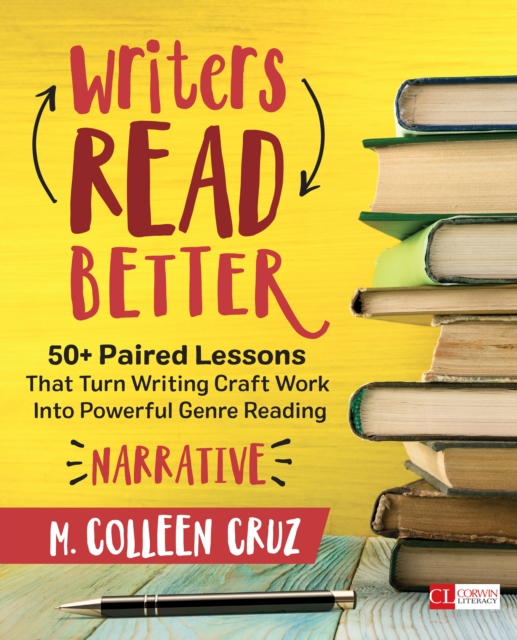
Writers Read Better: Narrative: 50+ Paired Lessons That Turn Writing Craft Work Into Powerful Genre Reading
When It Comes to Reading, Writers Have an Advantage We know that writing skills reinforce reading skills, but what’s the best way to capitalize on this beneficial relationship? By flipping the traditional “reading lesson first, writing lesson second” sequence, Colleen Cruz ingeniously helps you make the most of the writing-to-reading connection with carefully matched, conceptually connected lesson pairs. The result is a healthy reciprocity that effectively and efficiently develops students’ literacy skills. Backed by long-term academic and field research, Writers Read Better: Narrative presents a series of 50 tightly interconnected lesson pairs that can be implemented either as a complete curriculum or as a supplement to an existing program. Each pairing leads with a writing lesson, used as a springboard for the reading lesson that will follow. Throughout the book’s four sections, organized to help you teach tightly aligned lessons and units on reading and writing narrative, you’ll discover • Kid-friendly approaches to virtually every matter of craft, including symbolism, tenses, the role of first and last words, dialogue as character fingerprint, giving weight to what's important, and much more • Clear guidance on the intention of each lesson, the type of narrative genre it’s ideally suited for, and step-by-step plans • Sample teacher language for introducing and coaching each lesson • Mentor text excerpts to use as models for personal narrative, memoir, and story writing • Tips on building and organizing a contemporary classroom library filled with inspiring, illustrative texts, and how you can incorporate the tools, technology and media available in your classroom to make each lesson most effective • Sample student work, online videos and other supporting resources Complete with practical suggestions on adapting the lessons to suit the particular needs of your classroom as well as individual students, Writers Reader Better: Narrative offers a solid foundation for giving your students the advantage of powerful, transferable literacy skills.
eBook

Reading for understanding : how reading apprenticeship improves disciplinary learning in secondary and college classrooms
\"A teacher-tested, research-based resource for dramatically improving reading skills. Published in partnership with WestEd, this significantly updated second edition of the bestselling book contains strategies for helping students in middle school through community college gain the reading independence to master subject area textbooks and other material. Based on the Reading Apprenticeship program, which three rigorous \"gold standard\" research studies have shown to be effective in raising students' reading achievement. Presents a clear framework for improving the reading and subject area learning of all students, including English learners, students with special needs, as well as those in honors and AP courses. Provides concrete tools for classroom use and examples from a range of classrooms. Presents a clear how-to for teachers implementing the subject area literacies of the Common Core Standards. Reading for Understanding proves it's never too late for teachers and students to work together to boost literacy, engagement, and achievement\"-- Provided by publisher.
Book
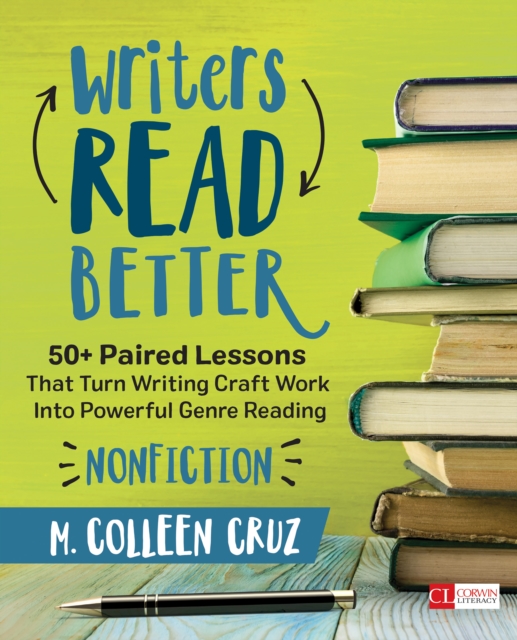
Writers Read Better: Nonfiction: 50+ Paired Lessons That Turn Writing Craft Work Into Powerful Genre Reading
We know that writing skills reinforce reading skills, but what’s the best way to capitalize on this beneficial relationship? By flipping the traditional “reading lesson first, writing lesson second” sequence, Colleen Cruz ingeniously helps you make the most of the writing-to-reading connection with carefully matched, conceptually connected lesson pairs. The result is a healthy reciprocity that effectively and efficiently develops students’ literacy skills. Backed by long-term academic and field research, Writers Read Better presents a series of 30 tightly interconnected lesson pairs that can be implemented either as supplement existing curriculum or as a stand alone module. Each pairing leads with a writing lesson, used as a springboard for the reading lesson that will follow. Throughout the book’s four sections, organized to cover distinct and complementary phases of working with non-fiction texts, you’ll discover • Helpful insights on preparing for the section’s overarching goals • Clear guidance on the intention of each lesson, what materials are required, and step-by-step plans for leading the activity • Sample teacher language for leading the lesson Tips on building and organizing your classroom library, and how you can incorporate the tools, technology and media available in your classroom to make each lesson most effective Sample student work, online videos and other supporting resources Complete with practical suggestions on adapting the lessons to suit the particular needs of your classroom as well as individual students, Writers Reader Better offers a solid foundation for giving your students the advantage of powerful, transferable literacy skills.
eBook