
Catalogue Search | MBRL


Are you sure you want to remove the book from the shelf?

{{itemTitle}}
251
result(s) for
"Reason-Philosophy"
Sort by:


Irrationality : a history of the dark side of reason
\"What every leader needs to know about dignity and how to create a culture in which everyone thrives. This landmark book from an expert in dignity studies explores the essential but under-recognized role of dignity as part of good leadership. Extending the reach of her award-winning book Dignity: Its Essential Role in Resolving Conflict, Donna Hicks now contributes a specific, practical guide to achieving a culture of dignity. Most people know very little about dignity, the author has found, and when leaders fail to respect the dignity of others, conflict and distrust ensue. She highlights three components of leading with dignity: what one must know in order to honor dignity and avoid violating it; what one must do to lead with dignity; and how one can create a culture of dignity in any organization, whether corporate, religious, governmental, healthcare, or beyond. Brimming with key research findings, real-life case studies, and workable recommendations, this book fills an important gap in our understanding of how best to be together in a conflict-ridden world.\"-- Publisher's description.
Book

Mendelssohn's Defense of Reason in \Jerusalem\
Moses Mendelssohn's \"Jerusalem\" is considered to be the most important Jewish apologia of the eighteenth century Enlightenment. Mendelssohn defends the authenticity and legitimacy of Jewish life during the the Enlightenment. \"Jerusalem\" is discussed.
Journal Article

Reasons in action : a reductionist account of intentional action
\"Ingmar Persson offers an original view of the processes of human action: deliberating on the basis of reasons for and against actions, making a decision about what to do, and from there implementing the decision in action in a way that makes the action intentional. Persson's analysis is mainly developed to suit physical actions, though how it needs to be modified to cover mental acts is also discussed. The interpretation of intentional action that is presented is reductionist in the sense that it does not appeal to any concepts that are distinctive of the domain of action theory, such as a unique type of agent-causation, or irreducible mental acts, like acts of will, volitions, decisions, or tryings. Nor does it appeal to any unanalyzed attitudes or states essentially related to intentional action, like intentions and desires to act. Instead, the intentionality of actions is construed as springing from desires conceived as physical states of agents which cause facts because of the way agents think of them. A sense of our having responsibility that is sufficient for our acting for reasons is also sketched out.\"-- Provided by publisher.
Book
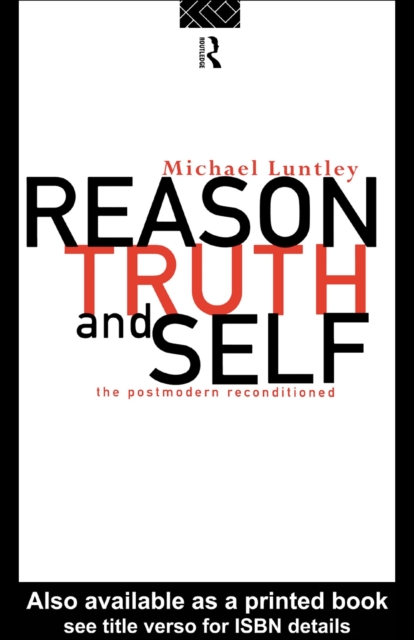
Reason, Truth and Self
Michael Luntley provides a lively introduction to the debate over postmodernism.Sympathisers of the postmodernist critique of absolute knowledge have jetisoned concepts of reason,truth and self;this abandonment has fuelled their opponents' case against postmodernism.This has led them to ignore the very real problems raised by the postmodernists.Luntley offers a clear and careful exposition of how rational debate survives despite the Enlightenment's failings. Reason,Truth and Self covers many of the key questions of our age: * How rational is science? * Can we really know the truth about ourselves and the world? * What is the nature of the mind? * Can we know the difference between right and wrong? Reason,Truth and Self is ideal for introductory courses in philosophy and the social sciences.
eBook

The edge of reason : a rational skeptic in an irrational world
\"Reason, long held as the highest human achievement, is under siege. According to Aristotle, the capacity for reason sets us apart from other animals, yet today it has ceased to be a universally admired faculty. Rationality and reason have become political, disputed concepts, subject to easy dismissal. Julian Baggini argues eloquently that we must recover our reason and reassess its proper place, neither too highly exalted nor completely maligned. Rationality does not require a sterile, scientistic worldview, it simply involves the application of critical thinking wherever thinking is needed. Addressing such major areas of debate as religion, science, politics, psychology, and economics, the author calls for commitment to the notion of a \"community of reason,\" where disagreements are settled by debate and discussion, not brute force or political power. His insightful book celebrates the power of reason, our best hope--indeed our only hope--for dealing with the intractable quagmires of our time\"-- Provided by publisher.
Book

Reason and Rationality
One of the world's most important political philosophers, Jon Elster is a leading thinker on reason and rationality and their roles in politics and public life. In this short book, he crystallizes and advances his work, bridging the gap between philosophers who use the idea of reason to assess human behavior from a normative point of view and social scientists who use the idea of rationality to explain behavior. In place of these approaches, Elster proposes a unified conceptual framework for the study of behavior.
Drawing on classical moralists as well as modern scholarship, and using a wealth of historical and contemporary illustrations,Reason and Rationalitymarks a new development in Elster's thinking while at the same time providing a brief, elegant, and accessible introduction to his work.
eBook


On What Matters
This is the first volume of a major work in moral philosophy, the long-awaited follow-up to Parfit's classic Reasons and Persons, a landmark of 20th-century philosophy. Parfit presents a powerful new treatment of reasons and a critical examination of the most prominent systematic moral theories, leading to his own ground-breaking conclusion.
eBook