
Catalogue Search | MBRL


Are you sure you want to remove the book from the shelf?

{{itemTitle}}
73
result(s) for
"Recurrent sequences (Mathematics)"
Sort by:

Wild Fibonacci : nature's secret code revealed
Discover the fibonacci sequence as it appears in nature, from the curves of a sundial shell, to a parrot's beak, a hawk's talon, a ram's horn, and even human teeth!
Book

Introduction to Recognition and Deciphering of Patterns
Introduction to Recognition and Deciphering of Patterns aims to get STEM and non-STEM students acquainted with different patterns, as well as where and when specific patterns arise. In addition, the book seeks to get students to learn how to recognize patterns and distinguish the similarities and differences between them.
Patterns emerge on an everyday basis, such as weather patterns, traffic patterns, behavioral patterns, geometric patterns, linguistic patterns, structural patterns, digital patterns, etc. Recognizing patterns and studying their unique traits is essential for the development and enhancement of our intuitive skills and in strengthening our analytical skills. Mathematicians often apply patterns to get acquainted with new concepts, but this is a technique that can be applied across many disciplines.
Throughout this book we will encounter assorted patterns that emerge from various geometrical configurations of squares, circles, right triangles and equilateral triangles that either repeat at the same scale or at different scales. The book will also focus on describing linear patterns, geometric patterns, alternating patterns, piecewise patterns, summation-type patterns and factorial-type patterns analytically. Deciphering the details of these distinct patterns will lead to the proof by induction method. Furthermore, the book will render properties of Pascal's triangle and provide supplemental practice in deciphering specific patterns and verifying them.
The book will adjourn with first-order recursive relations: describing sequences as recursive relations, obtaining the general solution by solving an initial value problem and determining the periodic traits.
eBook
Revisiting Fibonacci numbers through a computational experiment
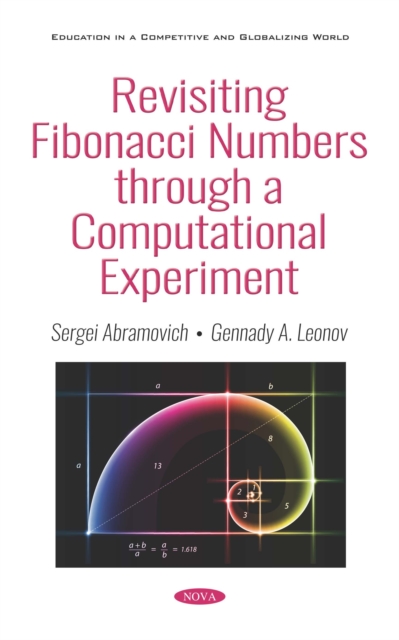
The material of this book stems from the idea of integrating a classic concept of Fibonacci numbers with commonly available digital tools including a computer spreadsheet, Maple, Wolfram Alpha, and the graphing calculator. This integration made it possible to introduce a number of new concepts such as: Generalized golden ratios in the form of cycles represented by the strings of real numbers; Fibonacci-like polynomials the roots that define those cycles' dependence on a parameter; the directions of the cycles described in combinatorial terms of permutations with rises, as the parameter changes on the number line; Fibonacci sieves of order k; (r, k)-sections of Fibonacci numbers; and polynomial generalizations of Cassini's, Catalan's, and other identities for Fibonacci numbers. The development of these concepts was motivated by considering the difference equation f_(n+1)=af_n+bf_(n-1),f_0=f_1=1, and, by taking advantage of capabilities of the modern-day digital tools, exploring the behavior of the ratios f_(n+1)/f_n as n increases. The initial use of a spreadsheet can demonstrate that, depending on the values of a and b, the ratios can either be attracted by a number (known as the Golden Ratio in the case a = b = 1) or by the strings of numbers (cycles) of different lengths. In general, difference equations, both linear and non-linear ones serve as mathematical models in radio engineering, communication, and computer architecture research. In mathematics education, commonly available digital tools enable the introduction of mathematical complexity of the behavior of these models to different groups of students through the modern-day combination of argument and computation. The book promotes experimental mathematics techniques which, in the digital age, integrate intuition, insight, the development of mathematical models, conjecturing, and various ways of justification of conjectures. The notion of technology-immune/technology-enabled problem solving is introduced as an educational analogue of the notion of experimental mathematics. In the spirit of John Dewey, the book provides many collateral learning opportunities enabled by experimental mathematics techniques. Likewise, in the spirit of George Plya, the book champions carrying out computer experimentation with mathematical concepts before offering their formal demonstration. The book can be used in secondary mathematics teacher education programs, in undergraduate mathematics courses for students majoring in mathematics, computer science, electrical and mechanical engineering, as well as in other mathematical programs that study difference equations in the broad context of discrete mathematics.
eBook


Polynomial root-finding and polynomiography
This book offers fascinating and modern perspectives into the theory and practice of the historical subject of polynomial root-finding, rejuvenating the field via polynomiography, a creative and novel computer visualization that renders spectacular images of a polynomial equation. Polynomiography will not only pave the way for new applications of polynomials in science and mathematics, but also in art and education. The book presents a thorough development of the basic family, arguably the most fundamental family of iteration functions, deriving many surprising and novel theoretical and practical applications such as: algorithms for approximation of roots of polynomials and analytic functions, polynomiography, bounds on zeros of polynomials, formulas for the approximation of Pi, and characterizations or visualizations associated with a homogeneous linear recurrence relation.
eBook
Fibonacci and Catalan numbers
\"In this one-of-a-kind book, Ralph Grimaldi uses his extensive experience from the classroom and as a leader of mini-courses to present an accessible, single resource on the topics of Fibonacci Numbers and Catalan Numbers. The book first embarks on a complete treatment of Fibonacci numbers. Starting with a historical background on the topic, the author goes on to present the properties of Fibonacci numbers, a slew of introductory-level examples, and in-depth discussion of related topics including compositions and palindromes; tiling and Fibonacci numbers; solving linear recurrence relations; graph theory; Lucas numbers; and alternate Fibonacci numbers. The second half of the book explores Catalan numbers, and the author builds a complete foundation to the topic using a historical background and introductory examples, along with coverage of partial orders, total orders, topological sorting, graph theory, rooted ordered binary trees, pattern avoidance, and the Narayana numbers. Coverage of both topics are accompanied by interesting, real-world examples from areas such as sports, botany, and computer science. Each section concludes with detailed exercise sets that can also serve as extended examples of the presented material along with selected solutions. An Instructor's Manual featuring complete solutions is available upon written request, and extensive reference sections outline resources for further study of the discussed topics.\"--
eBook
Density of prime divisors of linear recurrences
A result due to Hasse says that, on average, 17 out of 24 consecutive primes will divide a number in the sequence $U_n = 2^n+1$. There are few sequences of integers for which this relative density can be computed exactly. In this work, Ballot links Hasse's method to the concept of the group associated with the set of second-order recurring sequences having the same characteristic polynomial and to the concept of the rank of prime division in a Lucas sequence. This combination of methods and ideas allows the establishment of new density results. Ballot also shows that this synthesis can be generalized to recurring sequences of any order, for which he also obtains new density results. All the results can be shown to be in close agreement with the densities computed using only a small set of primes. This well-written book is fairly elementary in nature and requires only some background in Galois theory and algebraic number theory.
eBook
Visual guide to Elliott Wave trading
Jeffrey Kennedy is Chief Commodity Analyst at Elliott Wave International (EWI), and editor of the Monthly Futures Junctures publication. A recognized expert in Elliott wave analysis and trading with more than 20 years of experience, Kennedy has taught thousands of people how to improve their trading with the Elliott Wave Principle. Kennedy's polished wit and proven trading wisdom have made him a sought-after public speaker. He teaches online learning courses and conducts in-person seminars at Elliott Wave International, and is also an adjunct professor of technical analysis at Georgia Tech's Quantitative and Computational Finance program. His precise and memorable trading maxims make technical analysis accessible to anyone with an interest in the markets, regardless of experience level or account size. Wayne Gorman is Senior Tutorial Instructor at Elliott Wave International. With more than 30 years of experience as a risk manager and trader, he began his career at Citibank managing money market and derivative portfolios, and then went on to forex trading and various treasury management roles in London and New York. Wayne has been using the Wave Principle since 1986, and traded full time with his own capital for more than four years. He has worked exclusively with Elliott Wave International since 2002. Known for his ability to explain the logic behind technical and contrarian trading methods in a careful and understated manner, Wayne is a consummate Elliottician. His experiences helped him develop an impressive breadth of educational materials, which any trader can use to learn Elliott wave analysis successfully.
eBook
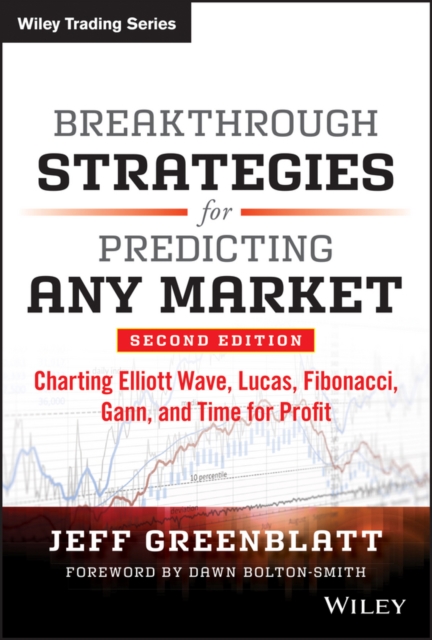
Breakthrough Strategies for Predicting Any Market
The revised and updated edition of the book that changed the way you think about trading In the Second Edition of this groundbreaking book by star trader Jeff Greenblatt, he continues to shares his hard-won lessons on what it takes to be a professional trader, while detailing his proven techniques for mastering market timing. With the help of numerous case studies and charts, Greenblatt develops his original high-probability pattern recognition system which, once mastered, endows its user with a deeper understanding of how the markets really work and boosts the efficiency of any trading methodology. Following in the footsteps of the great W.D. Gann, Jeff Greenblatt helps investors gain greater precision with any instrument they trade, during any time frame. * Shows how to combine a variety of technical indicators to pinpoint turning points in the financial markets * Makes even the most complex subject matter easy to understand with crystal-clear explanations and step-by-step guidance on all concepts, terms, processes, and techniques * Reveals how to use Elliott Wave Analysis, Fibonacci, candlesticks, and momentum indicators to interpret market movements Breakthrough Strategies for Predicting Any Market shares fascinating and enlightening personal anecdotes from Jeff Greenblatt's career along with his candid reflection on developing and maintaining the mental discipline of a successful trader.
eBook
Harmonic Elliott wave
An update to the Elliot Wave Principle that corrects a fundamental error The Elliot Wave Principle has been widely adopted as a tool for traders analyzing market cycles, but Ian Copsey has unearthed a fundamental error in the way it defines the structural development of price behavior. Harmonic Elliott Wave: The Case for Modification of R. N. Elliott's Impulsive Wave Structure explains what's wrong with the Principle, outlining a modification that allows for more accurate trading predictions. Revealing the methodology that led to this discovery, the common ratios that link different parts of the wave structure, and providing a wealth of practical examples to explain his findings, Copsey shows how waves really develop, dispelling the misconceptions that have been practiced by Elliotticians for years. Supporting his methods by consistently ensuring that waves are related by common ratios, Copsey helps the reader apply the revised version of the Principle with greater understanding and accuracy. Reveals a fundamental error in the popular Elliot Wave Principle Outlines a tried and tested modification that fixes this mistake and allows for more accurate analysis Offers essential information on applying the new model to the markets With far-reaching implications for traders everywhere, Harmonic Elliott Wave is a must-read for anyone who puts their faith in the Elliot Wave Principle.
eBook