
Catalogue Search | MBRL


Are you sure you want to remove the book from the shelf?

{{itemTitle}}
46
result(s) for
"Redefreiheit."
Sort by:


When the State Speaks, What Should It Say?
How should a liberal democracy respond to hate groups and others that oppose the ideal of free and equal citizenship? The democratic state faces the hard choice of either protecting the rights of hate groups and allowing their views to spread, or banning their views and violating citizens' rights to freedoms of expression, association, and religion. Avoiding the familiar yet problematic responses to these issues, political theorist Corey Brettschneider proposes a new approach called value democracy. The theory of value democracy argues that the state should protect the right to express illiberal beliefs, but the state should also engage in democratic persuasion when it speaks through its various expressive capacities: publicly criticizing, and giving reasons to reject, hate-based or other discriminatory viewpoints.
Distinguishing between two kinds of state action--expressive and coercive--Brettschneider contends that public criticism of viewpoints advocating discrimination based on race, gender, or sexual orientation should be pursued through the state's expressive capacities as speaker, educator, and spender. When the state uses its expressive capacities to promote the values of free and equal citizenship, it engages in democratic persuasion. By using democratic persuasion, the state can both respect rights and counter hateful or discriminatory viewpoints. Brettschneider extends this analysis from freedom of expression to the freedoms of religion and association, and he shows that value democracy can uphold the protection of these freedoms while promoting equality for all citizens.
eBook

Free Speech and Hate Speech in the United States
Free Speech and Hate Speech in the United States explores the concept and treatment of hate speech in light of escalating social tensions in the global twenty-first century, proposing a shift in emphasis from the negative protection of individual rights toward a more positive support of social equality.
Drawing on Axel Honneth’s theory of recognition, the author develops a two-tiered framework for free speech analysis that will promote a strategy for combating hate speech. To illustrate how this framework might impact speech rights in the United States, she looks specifically at hate speech in the context of symbolic speech, disparaging speech, Internet speech, and speech on college campuses.
Entering into an ongoing debate about the role of speech in society, this book will be of key importance to First Amendment scholars, and to scholars and students of communication studies, media studies, media law, political science, feminist studies, American studies, and history.
eBook

Filibuster
Parliamentary obstruction, popularly known as the \"filibuster,\" has been a defining feature of the U.S. Senate throughout its history. In this book, Gregory J. Wawro and Eric Schickler explain how the Senate managed to satisfy its lawmaking role during the nineteenth and early twentieth century, when it lacked seemingly essential formal rules for governing debate.
What prevented the Senate from self-destructing during this time? The authors argue that in a system where filibusters played out as wars of attrition, the threat of rule changes prevented the institution from devolving into parliamentary chaos. They show that institutional patterns of behavior induced by inherited rules did not render Senate rules immune from fundamental changes.
The authors' theoretical arguments are supported through a combination of extensive quantitative and case-study analysis, which spans a broad swath of history. They consider how changes in the larger institutional and political context--such as the expansion of the country and the move to direct election of senators--led to changes in the Senate regarding debate rules. They further investigate the impact these changes had on the functioning of the Senate. The book concludes with a discussion relating battles over obstruction in the Senate's past to recent conflicts over judicial nominations.
eBook
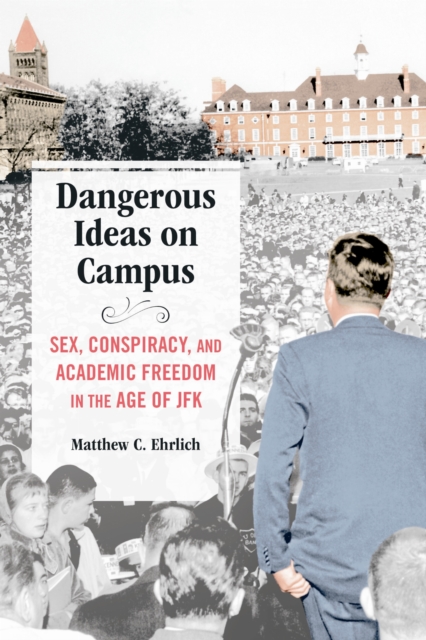
Dangerous Ideas on Campus
In 1960, University of Illinois professor Leo Koch wrote a public
letter condoning premarital sex. He was fired. Four years later, a
professor named Revilo Oliver made white supremacist remarks and
claimed there was a massive communist conspiracy. He kept his job.
Matthew Ehrlich revisits the Koch and Oliver cases to look at
free speech, the legacy of the 1960s, and debates over sex and
politics on campus. The different treatment of the two men marked a
fundamental shift in the understanding of academic freedom. Their
cases also embodied the stark divide over beliefs and values--a
divide that remains today. Ehrlich delves into the issues behind
these academic controversies and places the events in the context
of a time rarely associated with dissent, but in fact a harbinger
of the social and political upheavals to come.
An enlightening and entertaining history, Dangerous Ideas on
Campus illuminates how the university became a battleground
for debating America's hot-button issues.
eBook

Media and Law: Between Free Speech and Censorship
For its breadth and depth of research, this is an essential text for researchers and students of, sociology, law, criminology, and criminal justice. Everything from traditional mass media, to increasingly important social networking sites are explored to understand issues around free speech and censorship, in the modern day.
eBook


License to Harass
Offensive street speech--racist and sexist remarks that can make its targets feel both psychologically and physically threatened--is surprisingly common in our society. Many argue that this speech is so detestable that it should be banned under law. But is this an area covered by the First Amendment right to free speech? Or should it be banned?
In this elegantly written book, Laura Beth Nielsen pursues the answers by probing the legal consciousness of ordinary citizens. Using a combination of field observations and in-depth, semistructured interviews, she surveys one hundred men and women, some of whom are routine targets of offensive speech, about how such speech affects their lives. Drawing on these interviews as well as an interdisciplinary body of scholarship, Nielsen argues that racist and sexist speech creates, reproduces, and reinforces existing systems of hierarchy in public places. The law works to normalize and justify offensive public interactions, she concludes, offering, in essence, a \"license to harass.\"
Nielsen relates the results of her interviews to statistical surveys that measure the impact of offensive speech on the public. Rather than arguing whether law is the appropriate remedy for offensive speech, she allows that the benefits to democracy, to community, and to society of allowing such speech may very well outweigh the burdens imposed. Nonetheless, these burdens, and the stories of the people who bear them, should not remain invisible and outside the debate.
eBook

Religious Expression and the American Constitution
First Amendment rights have been among the most fiercely debated topics in the aftermath of 9/11. In the current environment and fervor for \"homeland security,\" personal freedoms in exchange for security are coming under more scrutiny. Among these guaranteed freedoms are the protection of religious expression given by the U.S. Constitution and the constitutional prohibitions against behaviors that violate the separation of church and state. The mandate that the government \"shall make no law respecting an establishment of religion, or prohibiting the free exercise thereof\" is a general principle that has guided American courts in interpreting the original intent of the First Amendment. InReligious Expression and the American Constitution, Haiman focuses on the current state of American law with respect to a broad range of controversial issues affecting religious expression, both verbal and nonverbal, along with a review of the recent history of each issue to provide a full understanding.
eBook