
Catalogue Search | MBRL


Are you sure you want to remove the book from the shelf?

{{itemTitle}}
20,706
result(s) for
"Refraction"
Sort by:


An experimental research of the influence of the concentrated force application point on the hinge supported beam deflection under the condition of its value constancy in the middle
An experimental research of the hinge supported beam maximal deflection under the condition of one’s constant value at the middle point subjected to concentrated force is carried. The influence of the force application point on the maximal deflection under the above-mentioned condition is studied. The comparison of experimentally obtained results with the theoretical ones is brought.
Journal Article

Update in myopia and treatment strategy of atropine use in myopia control
The prevalence of myopia is increasing globally. Complications of myopia are associated with huge economic and social costs. It is believed that high myopia in adulthood can be traced back to school age onset myopia. Therefore, it is crucial and urgent to implement effective measures of myopia control, which may include preventing myopia onset as well as retarding myopia progression in school age children. The mechanism of myopia is still poorly understood. There are some evidences to suggest excessive expansion of Bruch’s membrane, possibly in response to peripheral hyperopic defocus, and it may be one of the mechanisms leading to the uncontrolled axial elongation of the globe. Atropine is currently the most effective therapy for myopia control. Recent clinical trials demonstrated low-dose atropine eye drops such as 0.01% resulted in retardation of myopia progression, with significantly less side effects compared to higher concentration preparation. However, there remain a proportion of patients who are poor responders, in whom the optimal management remains unclear. Proposed strategies include stepwise increase of atropine dosing, and a combination of low-dose atropine with increase outdoor time. This review will focus on the current understanding of epidemiology, pathophysiology in myopia and highlight recent clinical trials using atropine in the school-aged children, as well as the treatment strategy in clinical implementation in hyperopic, pre-myopic and myopic children.
Journal Article

3-year results of 0.01% and 0.1% loading dose atropine treatment including washout in Danish children with myopia: a placebo-controlled, randomised clinical trial
AimTo examine the safety and efficacy of low-dose atropine (0.01% and 0.1% loading dose) after 2-year treatment and 1-year washout in 6-year-old to 12-year-old Danish children with myopia.MethodsInvestigator-initiated, placebo-controlled, double-blind, randomised clinical trial. Of 124 screened children, 97 were randomised to receive 0.01% low-dose atropine for 24 months (0.01%) or 0.1% low-dose atropine for 6 months, then 0.01% for 18 months (0.1% loading dose) or placebo, followed by a 1-year washout. Altogether, 91 participants completed the study. The primary outcome was myopia progression (axial length (AL) and spherical equivalent refraction (SER)). Secondary outcomes were adverse events, ocular biometrical measurements and treatment responder eyes (myopia progression less than −0.50 diopters (D)). Constrained linear mixed models were constructed with individual eyes nested by participant ID, according to intention-to-treat. The responder analysis used Fisher’s exact test. Significance levels were adjusted for multiple comparisons. Adjusted p values <0.05 were considered significant.ResultsAt 3 years, the mean AL was −0.06 mm (95% CI −0.18; 0.07) and −0.09 mm (95% CI −0.21; 0.04) less compared with placebo in the 0.1% loading dose group and 0.01% group. Mean SER was −0.02 D (95% CI −0.30; 0.26) less and 0.17 D (95% CI −0.11; 0.45) more compared with placebo in the 0.1% loading dose group and 0.01% group. There was no significant group difference in the responder eyes.ConclusionThere was no difference in myopia progression between groups following washout. A 6-month 0.1% loading dose did not improve efficacy compared with 0.01%. The 0.1% loading dose showed a rebound effect after dose switching.
Journal Article

Combination effect of optical defocus and low dose atropine in myopia control: Study protocol for a randomized clinical trial
Myopia, characterized by excessive axial elongation of the eyeball, increases risks of having sight-threatening diseases and impose a financial burden to healthcare system. Although myopic control interventions showed their effectiveness in slowing progression, the efficacy varies between individuals and does not completely halt progression. The study aims to investigate the efficacy of combining 0.01% atropine administered twice daily with optical defocus for myopia control in schoolchildren.
This is a prospective, parallel-group, single-blinded, randomized, active-control trial (ClinicalTrials.gov identifier: NCT06358755). Myopic schoolchildren with no previous myopic control interventions aged between 7 to 12 years will be recruited. They will be randomly allocated into two groups (n = 56 per group) after baseline measurement. Both groups will receive 0.01% atropine twice per day for 18 months (one drop in the morning and the other drop at night before bedtime). Defocus incorporated multiple segments (DIMS) spectacle lenses will be prescribed in atropine plus optical defocus (ATD) treatment group while single vision spectacle lenses will be given in atropine only (AT) group. Cycloplegic refraction and axial lengths will be monitored every 6 months over 18-month study period. The primary outcomes are changes in cycloplegic refraction and axial lengths relative to the baseline over the study period.
The result will examine the combination effect of low dose atropine and myopic defocus on myopia control in a randomized controlled study. The findings will also explore the potential benefits of applying 0.01% atropine twice per day on myopic control and its potential side effects.
Journal Article
Effect of low-dose atropine on myopia progression, pupil diameter and accommodative amplitude: low-dose atropine and myopia progression
PurposeTo evaluate the effects of 0.01% and 0.02% atropine eye drops on myopia progression, pupil diameter and accommodative amplitude in myopic children.MethodsA cohort study assessed 400 myopic children divided into three groups: 138 and 142 children were randomised to use either 0.02% or 0.01% atropine eye drops, respectively. They wore single-vision (SV) spectacles, with one drop of atropine eye drop applied to both eyes once nightly. Control children (n=120) only wore SV spectacles. Repeated measurements of spherical equivalent refractive errors (SERs), axial length (AL), pupil diameter and accommodative amplitude were performed at baseline, and 4, 8 and 12 months after treatment.ResultsAfter 12 months, the SER change was −0.38±0.35D, −0.47±0.45D, −0.70±0.60D and AL change was 0.30±0.21 mm, 0.37±0.22 mm, 0.46±0.35 mm in the 0.02%, 0.01% atropine and control groups, respectively. There were significant differences in the change in AL and SER between three groups (all p<0.001). Between baseline and the 12-month visit, the overall change in accommodative amplitude was 1.50±0.25D, 1.61±0.31D and change in pupil diameter was 0.78±0.42 mm, 0.69±0.39 mm, with 0.02% and 0.01% atropine, respectively. Accommodative amplitude significantly decreased and pupil diameter significantly increased in two atropine groups (all p<0.001). Moreover, there was no statistical difference in the change difference in accommodative amplitude and pupil diameter between two atropine groups (p=0.24, p=0.38), whereas the accommodative amplitude (p=0.45) and pupil diameter (p=0.39) in the control group remained stable.Conclusions0.02% atropine eye drops had a better effect on myopia progression than 0.01% atropine, but 0.02% and 0.01% atropine showed similar effects on pupil diameter and accommodative amplitude after 12 months of treatment.Trial registration numberChiCTR-IPD-16008844.
Journal Article
Defocus Incorporated Multiple Segments (DIMS) spectacle lenses slow myopia progression: a 2-year randomised clinical trial
AimTo determine if ‘Defocus Incorporated Multiple Segments’ (DIMS) spectacle lenses slow childhood myopia progression.MethodsA 2-year double-masked randomised controlled trial was carried out in 183 Chinese children aged 8–13 years, with myopia between −1.00 and −5.00 D and astigmatism ≤1.50 D. Children were randomly assigned to wear DIMS (n=93) or single vision (SV) spectacle lenses (n=90). DIMS lens incorporated multiple segments with myopic defocus of +3.50 D. Refractive error (cycloplegic autorefraction) and axial length were measured at 6month intervals.Results160 children completed the study, n=79 in the DIMS group and n=81 in the SV group. Average (SE) myopic progressions over 2 years were −0.41±0.06 D in the DIMS group and −0.85±0.08 D in the SV group. Mean (SE) axial elongation was 0.21±0.02 mm and 0.55±0.02 mm in the DIMS and SV groups, respectively. Myopia progressed 52% more slowly for children in the DIMS group compared with those in the SV group (mean difference −0.44±0.09 D, 95% CI −0.73 to −0.37, p<0.0001). Likewise, children in the DIMS group had less axial elongation by 62% than those in the SV group (mean difference 0.34±0.04 mm, 95% CI 0.22 to 0.37, p<0.0001). 21.5% children who wore DIMS lenses had no myopia progression over 2 years, but only 7.4% for those who wore SV lenses.ConclusionsDaily wear of the DIMS lens significantly retarded myopia progression and axial elongation in myopic children. Our results demonstrated simultaneous clear vision with constant myopic defocus can slow myopia progression.Trial registration number NCT02206217.
Journal Article
Effectiveness of repeated low-level red light in myopia prevention and myopia control
Background/aimsTo compare the effects of repeated low-level red light (RLRL) treatment on axial length growth and refractive error changes in myopic and premyopic children.MethodsSubjects were assigned randomly to four subgroups: myopia-RLRL group (M-RL), myopia-control group (M-C), premyopia-RLRL group (PM-RL) and premyopia-control group (PM-C). Subjects in the RLRL group completed a 12-month treatment composed of a 3 min RLRL treatment session twice daily, with an interval of at least 4 hours, for 7 days per week. Visits were scheduled before and at 1-month, 3-month, 6-month, 9-month and 12-month follow-up after the treatment. Repeated-measures analysis of variance was used to compare the spherical equivalent refractive errors (SE) and axial length (AL) changes between the groups across the treatment period.ResultsAfter 12 months of treatment, in the myopia group, SE and AL changes were −0.078±0.375 D and 0.033±0.123 mm for M-RL and −0.861±0.556 D and 0.415±0.171 mm for M-C; in the premyopia group, the progression of SE and AL was −0.181±0.417 D and 0.145±0.175 mm for PM-RL and −0.521±0.436 D and 0.292±0.128 mm for PM-C. PM-RL indicated a lower myopia incidence than PM-C (2.5% vs 19.4%). Additionally, the percentage of AL shortening in the M-RL was higher than that in the PM-RL before the 9-month follow-up.ConclusionRLRL effectively delayed myopia progression in children with myopia and reduced the incidence of myopia in premyopic children. Moreover, RLRL exhibited a stronger impact on myopic children compared with premyopic individuals.
Journal Article
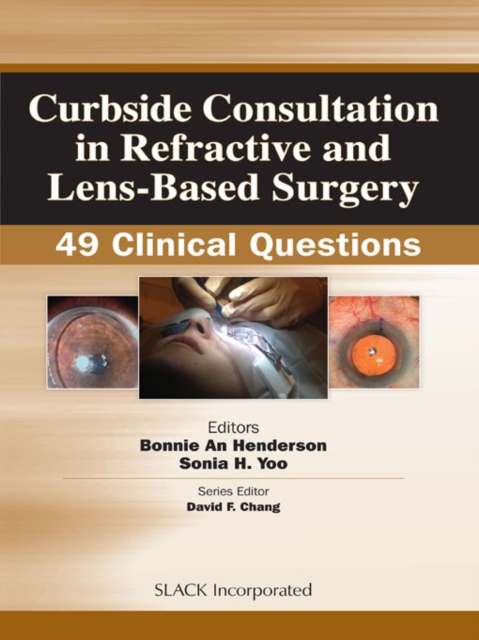
Curbside Consultation in Refractive and Lens-Based Surgery
Are you looking for concise, practical answers to questions that are often left unanswered by traditional references on refractive surgery? Are you seeking brief, evidence-based advice for the daily examination of patients?
Curbside Consultation in Refractive and Lens-Based Surgery: 49 Clinical Questions
provides quick and direct answers to the thorny questions most commonly posed during a \"curbside consultation\" between experienced clinicians.
Drs. Bonnie An Henderson and Sonia H. Yoo have designed this unique reference in which refractive specialists offer expert advice, preferences, and opinions on tough clinical questions commonly encountered by ophthalmologists, residents, and other health care professionals. The unique Q&A format provides quick access to current information related to refractive and lens-based surgery with the simplicity of a conversation between two colleagues. Images, diagrams, and references are included to enhance the text and to illustrate clinical diagnoses and treatment plans.
Based on clinical scenarios that a refractive surgeon might encounter in real life,
Curbside Consultation in Refractive and Lens-Based Surgery
provides information basic enough for residents while also incorporating expert pearls that even high-volume ophthalmologists will appreciate. General ophthalmologists and residents alike will enjoy the user-friendly and casual format.
Some of the questions that are answered:
How do I manage epithelial ingrowth after LASIK? What if it recurs?
Should I perform PRK in patients with forme fruste keratoconus?
How do I manage patients with dry eyes after LASIK surgery?
How do I determine my surgically induced astigmatism?
Is a monocular implantation of a multifocal IOL tolerated?
How do you manage an unhappy multifocal patient who is experiencing halos and glare?
eBook

Light Propagation with Phase Discontinuities: Generalized Laws of Reflection and Refraction
Conventional optical components rely on gradual phase shifts accumulated during light propagation to shape light beams. New degrees of freedom are attained by introducing abrupt phase changes over the scale of the wavelength. A two-dimensional array of optical resonators with spatially varying phase response and subwavelength separation can imprint such phase discontinuities on propagating light as it traverses the interface between two media. Anomalous reflection and refraction phenomena are observed in this regime in optically thin arrays of metallic antennas on silicon with a linear phase variation along the interface, which are in excellent agreement with generalized laws derived from Fermat's principle. Phase discontinuities provide great flexibility in the design of light beams, as illustrated by the generation of optical vortices through use of planar designer metallic interfaces.
Journal Article