
Catalogue Search | MBRL


Are you sure you want to remove the book from the shelf?

{{itemTitle}}
212
result(s) for
"Refugees, Arab Government policy."
Sort by:


The politics of denial : Israel and the Palestinian refugee problem
Explores historical roots and controversies surrounding the 1948 Palestinian exodus, the Zionist position on refugee status and right of return, Israel's moral and legal responsibility and refugee policy since 1948, resettlement schemes, the 1967 exodus, internally displaced Palestinians in Israel, and revisionist Israeli historians'views.
eBook
Israel and the Palestinian refugee issue
Examining the development of Israel's policy toward the Palestinian refugee issue, this book spans the period following the first Arab-Israeli War until the mid-1950s, when the basic principles of Israel's policy were finalized.
Israel and the Palestinian Refugee Issue outlines and analyzes the various aspects that, together, created the mosaic of the \"refugee problem\" with which Israel has since had to contend. These aspects include issues of repatriation, resettlement, compensation, blocked bank accounts, internal refugees and family reunification.
Drawing on extensive archival research, this book uses documents from Israeli government meetings, from the Foreign Affairs and Defense Committee and files from the office of the Prime Minister's advisor on Arab affairs to address the many diverse aspects of this topic, and will be essential reading for academics and researchers with an interest in Israel, the Middle East, and political science more broadly.
eBook

Palestinian Refugees
With contributions from a range of international experts, including Edward W. Said, Noam Chomsky, Ilan Pappe, Alain Gresh and Norman Finkelstein, this collection examines the Palestinians' right of return.
Chapters cover the historical roots of the Palestinian refugee question; the rights of the refugees under international law; the special case of Lebanon; Israeli perceptions of the refugee question; the practical feasibility of the return; the role of the United States and the European Union and the Refugee Question; the value of the refugee property; the principles of compensation; and a programme for an Independent Rights Campaign.
eBook
Reparations to Palestinian Refugees
This book delves into the issue of reparations in relation to Palestinian refugees in their search for a solution to their displacement and dispossession. Highlighting the broad spectrum of reparations available as forms of remedy for a historical injustice, the author probes the reasons behind the failure to reach a reparations agreement till the present day and discusses the significance of issues of apology, recognition and acknowledgement of responsibility.
In its approach, the book departs from traditional and modern perceptions of reparations as featuring in international law, history, politics and philosophy. The analysis is focused on a comparative study of two other cases - the German-Jewish reparations agreement of 1952 and the Cypriot conflict - in search of parameters that may constitute a framework to a potential reparations model applicable to the case of Palestinian refugees. When compared to the history of negotiations over reparations in the Israeli-Palestinian case, the findings of the comparison shed light on why reparations are still illusive. The book thus offers an explanation of why reparations to Palestinian refugees have failed, and offers suggestions on how to enhance prospects for reparations to Palestinian displacement and dispossessions.
A unique contribution to the study of the Arab-Israeli peace process, this book will be an important reference for scholars of the Arab-Israeli conflict, and for students and scholars of politics, conflict resolution and history.
Introduction 1. Reparations in the Palestinian Context 2. Reparations: In Search of a Definition 3. The German-Jewish Reparations Agreement of 1952 4. Cyprus 5. Prospects of Reparations to Palestinian Refugees. Conclusion
Shahira Samy is Jarvis Doctorow Junior Research Fellow in International Relations and Conflict Resolution in the Middle East at St Edmund Hall and the Department of Politics and International Relations at the University of Oxford. Her research interests focus on reparations politics, in addition to refugee issues in the Middle East.
eBook
The Palestinian Refugee Problem
In this unique volume, leading analysts – many of whom have been actively involved in past negotiations on this issue – provide an overview of the key dimensions of the Palestinian refugee problem. Mindful of the sensitive and contested nature of the subject, none offers a single solution. Instead, each contribution summarises and synthesises the existing scholarly and governmental work on the topic. Each paper develops an array of policy options for resolving various aspects of the refugee issue, written in such a way as to provide a broad menu of choices rather than a single narrow set of recommendations. No other work on the Palestinian refugee issue has undertaken such a task. The Palestinian Refugee Problem: The Search for a Resolution is likely to be a pre-eminent reference and analytical work on the topic for many years to come.
eBook

The precarious lives of Syrians : migration, citizenship, and temporary protection in Turkey
Turkey now hosts the largest number of Syrian refugees in the world, more than 3.6 million of the 12.7 million displaced by the Syrian Civil War. Many of them are subject to an unpredictable temporary protection, forcing them to live under vulnerable and insecure conditions.
The Precarious Lives of Syrians examines the three dimensions of the architecture of precarity: Syrian migrants' legal status, the spaces in which they live and work, and their movements within and outside Turkey. The difficulties they face include restricted access to education and healthcare, struggles to secure employment, language barriers, identity-based discrimination, and unlawful deportations. Feyzi Baban, Suzan Ilcan, and Kim Rygiel show that Syrians confront their precarious conditions by engaging in cultural production and community-building activities, and by undertaking perilous journeys to Europe, allowing them to claim spaces and citizenship while asserting their rights to belong, to stay, and to escape. The authors draw on migration policies, legal and scholarly materials, and five years of extensive field research with local, national, and international humanitarian organizations, and with Syrians from all walks of life.
The Precarious Lives of Syrians offers a thoughtful and compelling analysis of migration precarity in our contemporary context.
eBook

Transnational Palestine : migration and the right of return before 1948
Tens of thousands of Palestinians migrated to the Americas in the final decades of the nineteenth century and early decades of the twentieth. By 1936, an estimated 40,000 Palestinians lived outside geographic Palestine. Transnational Palestine is the first book to explore the history of Palestinian immigration to Latin America, the struggles Palestinian migrants faced to secure Palestinian citizenship in the interwar period, and the ways in which these challenges contributed to the formation of a Palestinian diaspora and to the emergence of Palestinian national consciousness.
Nadim Bawalsa considers the migrants' strategies for economic success in the diaspora, for preserving their heritage, and for resisting British mandate legislation, including citizenship rejections meted out to thousands of Palestinian migrants. They did this in newspapers, social and cultural clubs and associations, political organizations and committees, and in hundreds of petitions and pleas delivered to local and international governing bodies demanding justice for Palestinian migrants barred from Palestinian citizenship. As this book shows, Palestinian political consciousness developed as a thoroughly transnational process in the first half of the twentieth century—and the first articulation of a Palestinian right of return emerged well before 1948.
eBook
Compensation to Palestinian Refugees and the Search for Palestinian-Israeli Peace
One of the core aspects of the Palestinian refugee question is that of compensation or reparations for Palestinian refugees forcibly displaced by the establishment of Israel. Despite the importance of the issue, many of the complex technical issues compensation would entail have not received adequate attention. In this volume, a rich variety of contributors – including Palestinian, Israeli, and international scholars, analysts, and former officials – examine the topic from an array of legal, economic, and political perspectives. In doing so, they cast new and important light on the way the issue has been approached in past negotiations, the structure of possible compensation regimes and potential challenges and obstacles to implementation.
eBook
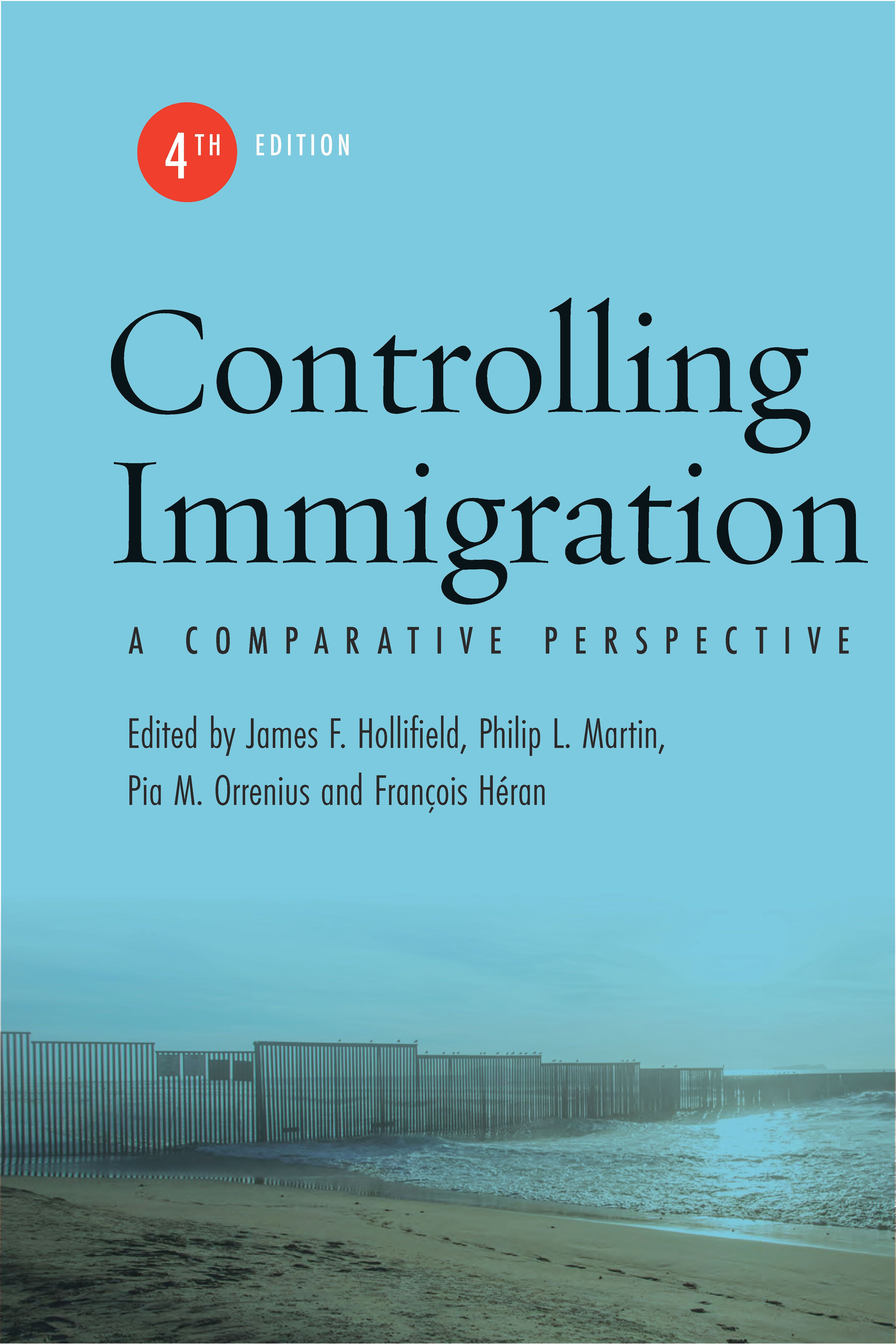
Controlling Immigration
The fourth edition of this classic work provides a systematic, comparative assessment of the efforts of major immigrant-receiving countries and the European Union to manage migration, paying particular attention to the dilemmas of immigration control and immigrant integration.
Retaining its comprehensive coverage of nations built by immigrants—the so-called settler societies of the United States, Canada, Australia and New Zealand— the new edition explores how former imperial powers—France, Britain and the Netherlands—struggle to cope with the legacies of colonialism, how social democracies like Germany and the Scandinavian countries balance the costs and benefits of migration while maintaining strong welfare states, and how more recent countries of immigration in Southern Europe—Italy, Spain, and Greece—cope with new found diversity and the pressures of border control in a highly integrated European Union.
The fourth edition offers up-to-date analysis of the comparative politics of immigration and citizenship, the rise of reactive populism and a new nativism, and the challenge of managing migration and mobility in an age of pandemic, exploring how countries cope with a surge in asylum seeking and the struggle to integrate large and culturally diverse foreign populations.
eBook