
Catalogue Search | MBRL


Are you sure you want to remove the book from the shelf?

{{itemTitle}}
30
result(s) for
"Refugees, Palestinian Arab Biography."
Sort by:

Mapping my return : a Palestinian memoir
\"Salman Abu Sitta was just ten years old when the Nakba--the mass expulsion of Palestinians in 1948--happened, forcing him from his home near Beersheba. Like many Palestinians of his generation, this traumatic loss and his enduring desire to return would be the defining features of his life from that moment on. Abu Sitta vividly evokes the vanished world of his family and home on the eve of the Nakba, giving a personal and very human face to the dramatic events of 1930s and 1940s Palestine as Zionist ambitions and militarization expanded under the British mandate. He chronicles his life in exile, from his family's flight to Gaza, his teenage years as a student in Nasser's Egypt, his formative years in 1960s London, his life as a family man and academic in Canada, to several sojourns in Kuwait. Abu Sitta's long and winding journey has taken him through many of the seismic events of the era, from the 1956 Suez War to the 1991 Gulf War. This rich and moving memoir is imbued throughout with a burning sense of justice and a determination to recover and document what rightfully belongs to his people, given expression in his groundbreaking mapping work on his homeland. Abu Sitta, with warmth and wit, tells his story and that of Palestine.\"--Page 4 of cover.
Book
The modern Israeli and Palestinian diasporas : a comparative approach
A comparative study of contemporary Israeli and Palestinian diasporas.Exilic and diasporic experience have become ubiquitous in recent decades.Jews, lacking a homeland, spread to various parts of the world, making the Jewish diaspora paradigmatic.
eBook


Palestinian Autobiographical Memory Regarding the 1948 Palestinian Exodus
Background: Collective memory of intractable conflict is an important sociopsychological phenomenon which influences the psychological and behavioral reactions of each party to the conflict. This memory is composed of two kinds of memories: autobiographical memory—the memory of the people who experienced the given events directly—and indirect-collective memory—the memory of the people who learned about the given events second hand, via books, etc. Purpose: This study explores the characteristics of Palestinian autobiographical memory with respect to the causes of the 1948 Palestinian exodus and how it relates to other Palestinian memories of that exodus (official, historical/academic, and indirect-collective). From these empirical findings, theoretical insights are concluded. Method: This is done by analyzing the content of four oral history projects of 1948 Palestinians refugees (in total, 131 interviewees from 38 localities). In addition, the content of these projects is compared to the accounts of documented Israeli history (using the research of Israeli historian Benny Morris). Studies of the other Palestinian memories are also used. Findings: The findings reveal that the Palestinian autobiographical memory is not a typical memory of conflict (e.g., with relatively low focus on the expulsion cause for the exodus). It is also compatible to a large degree with documented Israeli history. However, it is very different from other Palestinian memories of the exodus (official, historical/academic, and indirect-collective), which focus almost exclusively on the expulsion cause. Other empirical findings and their explanations are discussed. The findings have mostly theoretical implications regarding various kinds of memories of conflicts (and memories in general), as well as some methodological implications with regard to the usage of oral history.
Journal Article

Refugees in Our Own Land
This is a gripping account of what it is like to live as a Palestinian - as a refugee in your own homeland. Born in Jerusalem, Muna Hamzeh is a journalist who has been writing about Palestinian affairs since 1985. She first worked as a journalist in Washington DC, but moved back to Palestine in 1989 to cover the first Palestine Intifada - the war of stones. She then settled in Dheisheh, near Bethlehem - one of 59 Palestinian refugee camps that are considered the oldest refugee camps in the world.
The book consists of a diary which Hamzeh wrote between October 4th and December 4th 2000, telling the story of the second Intifada. Facing the tanks and armed guards of one of the best-equipped armies in the world, the Palestinians have nothing. They fight back with stones. The anguish and terror that Muna and her friends face on daily basis is tangible. Who will be the next to die? Whose house will be the next to burn down? This deeply moving personal account brings to life the harsh realities of the Palestinian struggle.
Refugees in Our Own Land is a look into the hearts and minds of Palestinian refugees. It is a tribute to the bravery of the Palestinian people, and a wake-up call to the world that has ignored so much of their struggle and their suffering.
eBook

Israeli war veterans’ memory of the Israeli-Palestinian conflict
Purpose
This paper aims to explore, for the first time over a long period of time, the autobiographical memory of Israeli veterans of the 1948 War, pertaining to the 1948 Palestinian exodus that led to the creation of the Palestinian refugee problem. Does this memory include the Zionist narrative (i.e. willing flight of the Palestinian refugees) or a critical narrative (i.e. willing flight and expulsion)? One of the primary sources to influence the collective memory of conflicts is the autobiographical memory. This memory is also one of the primary sources for research of the past. Thus, autobiographical memory is of importance.
Design/methodology/approach
Methodologically, this is done through an analysis of all 1948 veterans’ memoirs published between 1949 and 2004. Interviews were also conducted with various veterans, to understand the dynamics of their memoir publication.
Findings
Empirical findings suggest that during the first period (1949-1968), this memory was exclusively Zionist; during the second (1969-1978), it became slightly critical; and during the third (1979-2004), the critical tendency became more prevalent. Onward, the nine empirical causes for the presentation of exodus the way it was presented are discussed. Theoretical findings relate, inter alia, to the importance of micro factors in shaping the autobiographical memory, assembles seven such theoretical factors, suggests that these factors can influence in two ways (promoting collective memory change or inhibiting it), and that their impact can change over time.
Originality/value
Taken together, the paper contributes empirical and theoretical findings that are based on a solid and wide scope research.
Journal Article

PARADISE LOST: LAND AND LABOR IN 1950S GALILEE
While this order was rooted in a coherent ideology of social hierarchy,3 its actual implementation was a messy, time-consuming process overseen by newly established-and sometimes competing-military and civil state agencies. Existing literature concerning 1950s Israel/Palestine has mostly studied the history of Palestinian and Mizrahi subordination by the Zionist state separately.4 The case study of the western Galilee analyzed here demonstrates the necessity of a new approach based on the historical reality of constant interaction between and among social groups and the state. [...]rather than studying Mizrahim and Palestinians' mechanisms of negotiation, survival, and resistance to the Zionist state separately, this article attempts to investigate the broader social dynamics of this period. Recognizing the importance of oral testimonies in understanding local non-state histories, I made use of recorded interviews of Palestinian refugees available online, as well as interviews and conversations that I conducted during the course of my PhD research project concerning the social history of the western Galilee between 1936 and 1976.7 Theoretically, this article uses a new framework relating to two separate and parallel bodies of literature concerning the history of social relations in 1950s Israel/Palestine. Unlike the many local history books, memoirs, and biographies in Arabic and Hebrew that narrate the chronology of specific settlements and people in the western Galilee, this article connects the local history with broader themes and questions relevant to the study of 1950s Israel.10 Geographically peripheral to Israel's urban core in the 1950s, the western Galilee was nonetheless strategically important in the Zionist movement's eyes before 1948.11 Both Zionist and Palestinian political and military histories mention this region because of its strategic location.12 It mainly appears in research concerning the 1950s due to Palestinian movements within the region and across the border into Lebanon, and the Israeli state's attempts to halt these movements.13 As a case study, this article contributes to the expansive body of literature concerning the 1948 war and its aftermath.
Journal Article

A Tale of Two Galloways: Notes on the Early History of UNRWA and Zionist Historiography
A famous quote, 'Arab leaders don't give a damn whether the refugees live or die', attributed to an UNRWA official called 'Ralph Galloway', is examined. The real author was Lt. General Sir Alexander Galloway, who was briefly an UNRWA official in Jordan during 1951-52. Galloway's career is reviewed along with the circumstances of his brief tenure with UNRWA. He clashed with the Jordanian government over control of the organization during a period of economic crisis and was eventually fired at their request. Galloway's statement was made to visiting American clergy but Zionist writers recopying earlier sources lost Galloway's identity. The historiography of the quote is discussed along with the implications of Galloway's true identity for understanding the history of UNRWA.
Journal Article

Naseer Aruri and the Politics of Hope
A comparative approach is necessary when examining the role of Palestinian scholars and activists in defense of their cause. A look at the role of Native American scholars and activists reveals some similarities. Both groups worked hard to prevent the erasure of their identity by the settler colonial invaders. Another common theme is the emphasis on a politics of hope. Professor Aruri was a man of the left which has been in retreat throughout the Arab World. A renewed critique is necessary before the left can be resurrected. This offers the only democratic hope for the region.
Journal Article
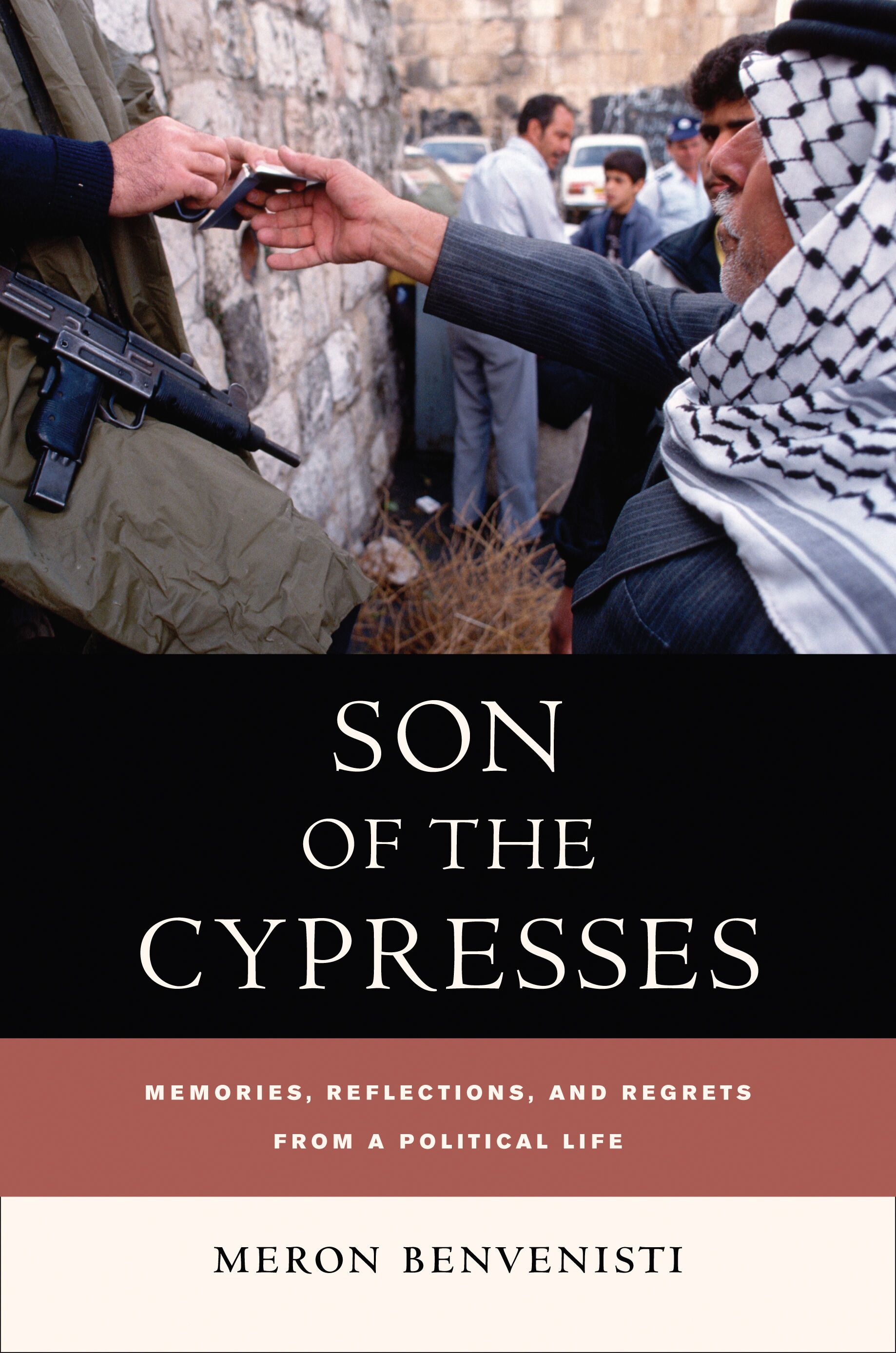
Son of the Cypresses
\"Now that I am seventy years of age, it is my prerogative to offer a summing up,\" says Meron Benvenisti, internationally known author and columnist, Jerusalem native, and scion of Israel's founders. Born in Palestine in 1934 to a Sephardic father and an Ashkenazi mother, Benvenisti has enjoyed an unusual vantage point from which to consider his homeland's conflicts and controversies. Throughout his long and provocative career as a scholar, an elected official, and a respected journalist, he has remained intimately involved with Israel's social and political development. Part memoir and part political polemic,Son of the Cypressesthreads Benvenisti's own story through the story of Israel. The result is a vivid, sharply drawn eyewitness account of pre-state Jerusalem and Israel's early years. He memorably sets the scene by recalling his father's emotional journey from Jewish Salonika in 1913 to Palestine, with all its attendant euphoria and frustration, and his father's pioneer dedication to inculcating Israeli youth with a \"native's\" attachment to the homeland. In describing the colorful and lively Jerusalem in which he grew up, Benvenisti recalls the many challenges faced by new Jewish immigrants, who found themselves not only in conflict with the Arab population but also with each other as Sephardim and Ashkenazim. He revisits his own public disagreements with both Zionists and Palestinians and shares indelible memories such as his boyhood experiences of the 1948 War. In remembering his life as an Israeli sabra, Benvenisti offers a vivid record of the historical roots of the conflict that persists today.
eBook