
Catalogue Search | MBRL


Are you sure you want to remove the book from the shelf?

{{itemTitle}}
2,425
result(s) for
"Refugees Germany."
Sort by:


Between national socialism and Soviet communism
In May of 1945, there were more than eight million \"displaced persons\" (or DPs) in Germany-recently liberated foreign workers, concentration camp prisoners, and prisoners of war from all of Nazi-occupied Europe, as well as eastern Europeans who had fled west before the advancing Red Army. Although most of them quickly returned home, it soon became clear that large numbers of eastern European DPs could or would not do so. Focusing on Bavaria, in the heart of the American occupation zone,Between National Socialism and Soviet Communismexamines the cultural and political worlds that four groups of displaced persons-Polish, Ukrainian, Russian, and Jewish-created in Germany during the late 1940s and early 1950s. The volume investigates the development of refugee communities and how divergent interpretations of National Socialism and Soviet Communism defined these displaced groups.
Combining German and eastern European history, Anna Holian draws on a rich array of sources in cultural and political history and engages the broader literature on displacement in the fields of anthropology, sociology, political theory, and cultural studies. Her book will interest students and scholars of German, eastern European, and Jewish history; migration and refugees; and human rights.
eBook


Refugees and Expellees in Post-War Germany
At the end of the Second World War, some 12 million German refugees and expellees fled or were expelled from their homelands in Eastern and Central Europe into what remained of the former Reich. This book examines their economic, social and political integration in Germany from 1945 up to the present day.
eBook

Nujeen : one girl's incredible journey from war-torn Syria in a wheelchair
Traces the inspiring story of Syrian refugee Nujeen Mustafa, who after being born with cerebral palsy and denied an education because of her disability made a harrowing journey by wheelchair from her war-ravaged home to safety in Germany.
BOOK
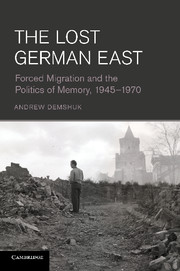
The Lost German East
A fifth of West Germany's post-1945 population consisted of ethnic German refugees expelled from Eastern Europe, a quarter of whom came from Silesia. As the richest territory lost inside Germany's interwar borders, Silesia was a leading objective for territorial revisionists, many of whom were themselves expellees. The Lost German East examines how and why millions of Silesian expellees came to terms with the loss of their homeland. Applying theories of memory and nostalgia, as well as recent studies on ethnic cleansing, Andrew Demshuk shows how, over time, most expellees came to recognize that the idealized world they mourned no longer existed. Revising the traditional view that most of those expelled sought a restoration of prewar borders so they could return to the east, Demshuk offers a new answer to the question of why, after decades of violent upheaval, peace and stability took root in West Germany during the tense early years of the Cold War.
eBook

Upheaval : the refugee trek through Europe
\"By foot, in buses, prison vans and trains, a steady stream of refugees traveled from the Greek island of Lesbos into Europe. In the autumn of 2015, award-winning writer Navid Kermani decided to accompany them on the \"Balkan route.\" In this perceptive account from the front line of the \"refugee crisis,\" Kermani shows how a seemingly distant world in which war and conflict rage has suddenly collided with our own. Kermani describes the situation on the Turkish west coast where thousands of refugees live in the most desperate conditions, waiting to take the perilous journey across the Mediterranean. Then, on Lesbos, he observes the culture shock amongst those who have survived the ordeal by sea. He speaks to aid workers and politicians, but most importantly of all to the refugees themselves, asking those who have come from Syria, Iraq, Afghanistan and elsewhere what has driven them to risk everything and embark on the long and treacherous journey to Europe. With great sensitivity Kermani reveals, often through small details, the cultural and political upheaval that has caused people to uproot their lives, and at the same time shining a light on Europe's inadequate and at times openly hostile response to the refugees. Interspersed with powerful images by the acclaimed photographer Moises Saman, Upheaval is a much-needed human account of a crisis we cannot ignore\"-- Provided by publisher.
Book

In the children's best interests
Among the hundreds of thousands of displaced persons in Germany at the end of World War II, approximately 40,000 were unaccompanied children. These children, of every age and nationality, were without parents or legal guardians and many were without clear identities. This situation posed serious practical, legal, ethical, and political problems for the agencies responsible for their care. In the Children’s Best Interests , by Lynne Taylor, is the first work to delve deeply into the records of the United Nations Relief and Rehabilitation Administration (UNRRA) and the International Refugee Organization (IRO) and reveal the heated battles that erupted amongst the various entities (military, governments, and NGOs) responsible for their care and disposition. The bitter debates focused on such issues as whether a child could be adopted, what to do with illegitimate and abandoned children, and who could assume the role of guardian. The inconclusive nationality of these children meant they became pawns in the battle between East and West during the Cold War. Taylor’s exploration and insight into the debates around national identity and the privilege of citizenship challenges our understanding of nationality in the postwar period.
eBook

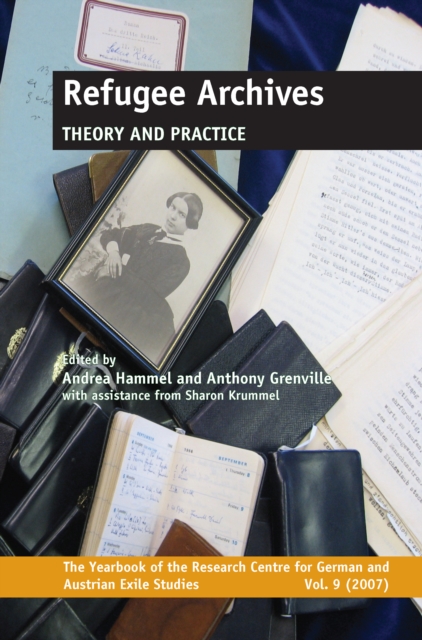
Refugee Archives
This volume gives an extensive overview of current developments in the field of archival collections relating to German-speaking refugees located in Germany, Austria, the USA, Ireland and the UK. The contributions illustrate the three interlinked areas of refugee archives, Exile and Migration Studies research and related databases and other resources. The articles investigate their interrelationship as well as the future challenges facing all three areas by focussing on larger archival holdings as well as collections relating to individuals and organisations and more recently established electronic and online resources and finding aids. The volume is aimed at researchers and archival practioners alike and should be especially useful for anyone starting out in the field.
eBook