
Catalogue Search | MBRL


Are you sure you want to remove the book from the shelf?

{{itemTitle}}
156
result(s) for
"Refugees History 21st century."
Sort by:

We are not refugees : true stories of the displaced
Never in history have so many people been displaced by political and military conflicts at home--more than 65 million globally ... [This book] tells the stories of many of these displaced, who have not been given asylum. For over a decade, human rights journalist Agus Morales has journeyed to the sites of the world's most brutal conflicts and spoken to the victims of violence and displacement. To Syria, Afghanistan, Pakistan, and the Central African Republic. To Central America, the Congo, and the refugee camps of Jordan. To the Tibetan Parliament in exile in northern India.
BOOK


Casualties of care
This book explores the unintended consequences of compassion in the world of immigration politics. Miriam Ticktin focuses on France and its humanitarian immigration practices to argue that a politics based on care and protection can lead the state to view issues of immigration and asylum through a medical lens. Examining two \"regimes of care\"—humanitarianism and the movement to stop violence against women—Ticktin asks what it means to permit the sick and sexually violated to cross borders while the impoverished cannot? She demonstrates how in an inhospitable immigration climate, unusual pathologies can become the means to residency papers, making conditions like HIV, cancer, and select experiences of sexual violence into distinct advantages for would-be migrants. Ticktin's analysis also indicts the inequalities forged by global capitalism that drive people to migrate, and the state practices that criminalize the majority of undocumented migrants at the expense of care for the exceptional few.
eBook

Upheaval : the refugee trek through Europe
\"By foot, in buses, prison vans and trains, a steady stream of refugees traveled from the Greek island of Lesbos into Europe. In the autumn of 2015, award-winning writer Navid Kermani decided to accompany them on the \"Balkan route.\" In this perceptive account from the front line of the \"refugee crisis,\" Kermani shows how a seemingly distant world in which war and conflict rage has suddenly collided with our own. Kermani describes the situation on the Turkish west coast where thousands of refugees live in the most desperate conditions, waiting to take the perilous journey across the Mediterranean. Then, on Lesbos, he observes the culture shock amongst those who have survived the ordeal by sea. He speaks to aid workers and politicians, but most importantly of all to the refugees themselves, asking those who have come from Syria, Iraq, Afghanistan and elsewhere what has driven them to risk everything and embark on the long and treacherous journey to Europe. With great sensitivity Kermani reveals, often through small details, the cultural and political upheaval that has caused people to uproot their lives, and at the same time shining a light on Europe's inadequate and at times openly hostile response to the refugees. Interspersed with powerful images by the acclaimed photographer Moises Saman, Upheaval is a much-needed human account of a crisis we cannot ignore\"-- Provided by publisher.
Book

Survival Migration
International treaties, conventions, and organizations to protect refugees were established in the aftermath of World War II to protect people escaping targeted persecution by their own governments. However, the nature of cross-border displacement has transformed dramatically since then. Such threats as environmental change, food insecurity, and generalized violence force massive numbers of people to flee states that are unable or unwilling to ensure their basic rights, as do conditions in failed and fragile states that make possible human rights deprivations. Because these reasons do not meet the legal understanding of persecution, the victims of these circumstances are not usually recognized as \"refugees,\" preventing current institutions from ensuring their protection. In this book, Alexander Betts develops the concept of \"survival migration\" to highlight the crisis in which these people find themselves.
Examining flight from three of the most fragile states in Africa-Zimbabwe, the Democratic Republic of Congo, and Somalia-Betts explains variation in institutional responses across the neighboring host states. There is massive inconsistency. Some survival migrants are offered asylum as refugees; others are rounded up, detained, and deported, often in brutal conditions. The inadequacies of the current refugee regime are a disaster for human rights and gravely threaten international security. InSurvival Migration, Betts outlines these failings, illustrates the enormous human suffering that results, and argues strongly for an expansion of protected categories.
eBook

Cast away : true stories of survival from Europe's refugee crisis
\"In one of the first works of narrative nonfiction on the ongoing refugee crisis ... [this book] describes the ... stories and the ... decisions that migrants have to make as they head toward what they believe is a better life: a pregnant Eritrean woman, four days overdue, chooses to board an obviously unsafe smugglers ship to Greece; a father, swimming from a sinking ship, has to decide whether to hold on to one child or let him go to save another\"--Amazon.com.
Book

The right to research : historical narratives by refugee and Global South researchers
Refugees and displaced people rarely figure as historical actors, and almost never as historical narrators and historians. The Right to Research offers a critical reflection on what history means, who narrates it, and what happens when those long excluded from authorship bring their knowledge and perspectives to bear.
eBook
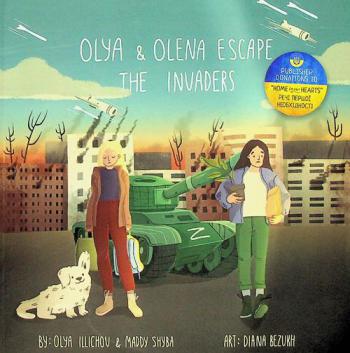
Olya & Olena escape the invaders
A story about two young Ukrainian ballet students who escape the Russian invasion of Mariupol and embark on a difficult journey to safety. Along the way they encounter helpers who aid them on their way, including an angelic grandmother and a dog named Rinnie. Although they know they will miss their homeland, they eventually make their way to Canada where they too become important helpers.

Crimes of Peace
Among the world's hotly contested, obsessively controlled, and often dangerous borders, none is deadlier than the Mediterranean Sea. Since 2000, at least 25,000 people have lost their lives attempting to reach Italy and the rest of Europe, most by drowning in the Mediterranean. Every day, unauthorized migrants and refugees bound for Europe put their lives in the hands of maritime smugglers, while fishermen, diplomats, priests, bureaucrats, armed forces sailors, and hesitant bystanders waver between indifference and intervention-with harrowing results.
InCrimes of Peace, Maurizio Albahari investigates why the Mediterranean Sea is the world's deadliest border, and what alternatives could improve this state of affairs. He also examines the dismal conditions of migrants in transit and the institutional framework in which they move or are physically confined. Drawing on his intimate knowledge of places, people, and European politics, Albahari supplements fieldwork in coastal southern Italy and neighboring Mediterranean locales with a meticulous documentary investigation, transforming abstract statistics into names and narratives that place the responsibility for the Mediterranean migration crisis in the very heart of liberal democracy. Global fault lines are scrutinized: between Europe, Africa, and the Middle East; military and humanitarian governance; detention and hospitality; transnational crime and statecraft; the universal law of the sea and the thresholds of a globalized yet parochial world.Crimes of Peaceilluminates crucial questions of sovereignty and rights: for migrants trying to enter Europe along the Mediterranean shore, the answers are a matter of life or death.
eBook