
Catalogue Search | MBRL


Are you sure you want to remove the book from the shelf?

{{itemTitle}}
2,396
result(s) for
"Refugees Public opinion."
Sort by:

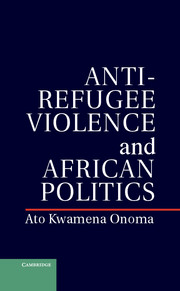
Anti-Refugee Violence and African Politics
Using comparative cases from Guinea, Uganda, and the Democratic Republic of Congo, this study explains why some refugee-hosting communities launch large-scale attacks on civilian refugees whereas others refrain from such attacks even when encouraged to do so by state officials. Ato Kwamena Onoma argues that such outbreaks only happen when states instigate them because of links between a few refugees and opposition groups. Locals embrace these attacks when refugees are settled in areas that privilege residence over indigeneity in the distribution of rights, ensuring that they live autonomously of local elites. The resulting opacity of their lives leads locals to buy into their demonization by the state. Locals do not buy into state denunciation of refugees in areas that privilege indigeneity over residence in the distribution of rights because refugees in such areas are subjugated to locals who come to know them very well. Onoma reorients the study of refugees back to a focus on the disempowered civilian refugees that constitute the majority of refugees even in cases of severe refugee militarization.
eBook


Blind Conscience
Reveals the untold story of the people who struggled to get assylum seekers out of detention and change government policy. Some like Petro Georgiou, Julian Burnside & Phillip Ruddock, are very well known. Others are not as famous but felt compelled to follow their consciences.
eBook


Aylan Kurdi, Twitter y la indignación efímera
La foto de Aylan Kurdi, tras haber naufragado con su familia, despertó la sensibilidad de la opinión pública internacional frente a una crisis europea que venía consolidándose tiempo atrás. El presente trabajo hace un acercamiento al comportamiento e interactividad presentes en Twitter alrededor de la crisis migratoria en Europa. Tomando las cuentas de los principales influenciadores en este tema y analizando sus publicaciones desde el 30 de agosto hasta el 3 de diciembre de 2015, se busca demostrar que la crisis solo generó ruido y fue invisible para la opinión pública. Sin embargo, se hizo visible a través del acontecimiento de la fotografía de Kurdi que luego desencadenó una shitstorm temporal, provocó una rápida anestésica colectiva y devolvió los hechos a su invisibilidad original.
The photo of Aylan Kurdi, the Syrian child who drowned after shipwrecking with his family, awakened international public concern in the face of a crisis that had already been established several months previously. This paper considers the behavior and interactivity taking place over Twitter with regards to the European migration crisis. Taking the accounts of the main influencers in this issue and analyzing their publications from August 30 to December 3 of 2015, the study seeks to demonstrate that the crisis was merely noise and was in fact invisible to public opinion. However, with the event of Kurdi’s photograph, setting off a temporary shitstorm that led to a rapid collective anesthetic, the events ultimately returned to their original invisibility.
Journal Article

The road before me weeps : on the refugee rout through Europe
\"Several million refugees and migrants set out for Europe from 2014 to 2018, spurred by war and chaos in Syria and Iraq, violence in Afghanistan, and hopelessness in countries bordering war zones. In 2015 and 2016 the western Balkans, from Turkey through Greece, Macedonia, Bulgaria, Serbia and Hungary, was their main entry point. As a BBC correspondent based in Budapest for more than three decades, Nick Thorpe was perfectly placed to cover the birth of the route, its heyday, and the attempts of numerous states to close it ever since. This is his intimate portrait of the daily lives of those stuck in razor-wire enclosures or on the move, along forest tracks, railway lines, motorways - and of the smugglers, border police and political leaders who help, exploit or obstruct them. In this eye-opening account, Thorpe challenges those who demonise or glorify migration, visits their arrivals in their new environment, and studies their impact on the countries that welcomed them with open arms or with hesitations\"--from inside cover.
Book

Contesting the Kindertransport as a ‘Model’ Refugee Response
Abstract The Kindertransport has long been interpreted as a heroic response to the refugee crisis of the 1930s and has recently re-entered the British national conversation as a model to be applied to the current Middle East refugee crisis. Kinder case files are utilized to argue that an unambiguously celebratory narrative is a misreading of the Kindertransport, especially when considering the plight of parents who had to make agonizing choices to send their children away. The majority of Kinder were never reunited with their families after the war, and even those who were suffered various traumas related to their long estrangement. An examination of the fate of parents and siblings who were not welcomed to Britain suggests that it is a mistake to call for the reimplementation of the Kindertransport on any scale to respond to the wave of religious and political refugees currently crossing into Europe in large numbers.
Journal Article


Co-memory and melancholia
The 1948 war that led to the creation of the State of Israel also resulted in the destruction of Palestinian society when some 80 per cent of the Palestinians who lived in the major part of Palestine upon which Israel was established became refugees. Israelis call the 1948 war their 'War of Independence' and the Palestinians their 'Nakba', or catastrophe. After many years of Nakba denial, land appropriation, political discrimination against the Palestinians within Israel and the denial of rights to Palestinian refugees, in recent years the Nakba is beginning to penetrate Israeli public discourse. This book explores the construction of collective memory in Israeli society, where the memory of the trauma of the Holocaust and of Israel's war dead competes with the memory claims of the dispossessed Palestinians. Taking an auto-ethnographic approach, Ronit Lentin makes a contribution to social memory studies through a critical evaluation of the co-memoration of the Palestinian Nakba by Israeli Jews. Against a background of the Israeli resistance movement, Lentin's central argument is that co-memorating the Nakba by Israeli Jews is motivated by an unresolved melancholia about the disappearance of Palestine and the dispossession of the Palestinians, a melancholia that shifts mourning from the lost object to the grieving subject. Lentin theorises Nakba co-memory as a politics of resistance, counterpoising co-memorative practices by internally displaced Israeli Palestinians with Israeli Jewish discourses of the Palestinian right of return, and questions whether return narratives by Israeli Jews, courageous as they may seem, are ultimately about Israeli Jewish self-healing rather than justice for Palestine.
eBook