
Catalogue Search | MBRL


Are you sure you want to remove the book from the shelf?

{{itemTitle}}
129,261
result(s) for
"Rehabilitation Medicine"
Sort by:


Enhancing Healthcare and Rehabilitation
Summary Description
This book is primarily a celebration of the qualitative work undertaken internationally by a number of experienced researchers. It also focuses on developing the use of qualitative research for health and rehabilitative practitioners by recognizing its value methodologically and empirically. We find that the very nature of qualitative research offers an array of opportunities for researchers in being able to understand the social world around us. Further, through experience and discussion, this book identifies the multifaceted use of qualitative methods in the healthcare and rehabilitative setting. This book touches on the role of the researcher, the participants involved, and the research environment. In short, we see how these three central elements can affect the nature of qualitative work in attempts to offer originality. This text speaks to a number of audiences. Students who are writing undergraduate dissertations and research proposals, they may find the myriad of examples stimulating and may support the rationale for methodological decisions in their own work. For academics, practitioners, and prospective qualitative researchers this book also aims to demonstrate an array of opportunism in the field of qualitative research and how they may resonate with arguments proffered. It is anticipated that readers will find this collection of qualitative examples not only useful for informing their own research, but we also hope to enlighten new discussions and arguments regarding both methodological and empirical use of qualitative work internationally.
Features
Encompasses the importance of qualitative research and how it can be used to facilitate healthcare and rehabilitation across a wide range of health conditions.
Evaluates empirical data whilst critically applying it to contemporary practices.
Provides readers with an overview with future directions and influence policy makers in order to develop practice.
Focuses on an array of health conditions that can affect groups of the population, coincided with life issues and the care and family support received.
Offers innovative methodological insights for prospective researchers in order to add to the existing evidence base.
1. Introduction. 2. Qualitative Research in Rehabilitation. 3. Children and Young Adults. 4. Life Issues. 5. Older People. 6. Caregivers and Family Support. 7. Policymakers.
'As an introduction to qualitative work in rehabilitation settings with a focus on the perspective of healthcare professionals, this book provides sufficient information and examples of qualitative research that has been conducted by experts in their respective fields. This book is worth reading and I recommend it. The qualitative examples are useful for helping to inform readers about their own research and for demonstrating the value of qualitative research both methodologically and empirically.' - Dominique Kinnett-Hopkins , Northwestern University Feinberg School of Medicine
Dr. Hayre is currently a lecturer in diagnostic radiography at the University of Suffolk. He has published both qualitative and quantitative refereed papers in the field of diagnostic radiography. He founded the Journal of Social Science & Allied Health Professions and remains Editor in Chief. He is currently writing a book chapter surrounding sustainable practices in medical imaging and is currently a visiting lecturer at the Odisee University in Brussels.
Professor Muller is currently Editor of the CRC series with Professor Marcia Scherer on Rehabilitation Science in Practice. He was founder Editor of the Journal Aphasiology and is currently Editor in Chief of the Journal Disability and Rehabilitation. He has published over forty refereed papers and has been involved either as Series Editor, Editor or Author of over fifty books. He is a visiting Professor at the University of Suffolk, United Kingdom.
eBook


Disorders of Movement due to Acquired and Traumatic Brain Injury
Purpose of Review
Both traumatic and acquired brain injury can result in diffuse multifocal injury affecting both the pyramidal and extrapyramidal tracts. Thus, these patients may exhibit signs of both upper motor neuron syndrome and movement disorder simultaneously which can further complicate diagnosis and management. We will be discussing movement disorders following acquired and traumatic brain injury.
Recent Findings
Multiple functions including speech, swallowing, posture, mobility, and activities of daily living can all be affected. Medical treatment and rehabilitation-based therapy can be especially challenging due to accompanying cognitive deficits and severity of the disorder which can involve multiple limbs in addition to muscles of the face and axial skeleton. Tremor and dystonia are the most reported movement disorders following traumatic brain injury. Dystonia and myoclonus are well documented following hypoxic ischemic brain injuries. Electrophysiological studies such as dynamic surface poly-electromyography can assist with identifying phenomenology, especially differentiating between jerk-like phenomenon and help guide further work up and management. Management with medications remains challenging due to potential adverse effects. Surgical interventions including stereotactic surgery, deep brain stimulation, and intrathecal baclofen pumps have been reported, but most of the evidence supporting them has been limited to primarily case reports except for post-traumatic tremor.
Summary
Brain injury can lead to motor disorders, movement disorders, visual (processing) deficits, and vestibular deficits which often coexist with cognitive deficits making it challenging to treat and rehabilitate these patients. Unfortunately, the evidence regarding the medical management and rehabilitation of brain injury patients with movement disorders is sparse and leaves much to be desired.
Journal Article

Rehabilitation Strategies for Cognitive and Neuropsychiatric Manifestations of COVID-19
Purpose of Review
Extrapulmonary manifestations of COVID-19 are abundant, including after recovery of acute SARS-CoV-2 infection. This review seeks to explore the cognitive and neuropsychiatric manifestations of COVID-19 and post-acute sequelae of SARS-CoV-2 (PASC), including Long COVID syndromes. Furthermore, the review will discuss rehabilitation strategies for the emerging neurological consequences of COVID-19 to help those experiencing long-term effects of COVID-19.
Recent Findings
There is emerging evidence depicting the neural involvement of COVID-19. Health priorities have shifted from understanding pathogenesis and treatment of pulmonary symptoms to targeting the acute and chronic sequelae of COVID-19, including cognitive and neuropsychiatric symptoms. The sequelae of COVID-19 often co-occur with other medical problems and is best managed by assessment and care across multiple disciplines. Symptoms following infection are similar to those found by other syndromes and disorders that disrupt the central nervous system.
Summary
The acute and chronic sequelae of COVID-19 have become major targets of current health care providers given its significant public health impact, inclusive of cognitive and neuropsychiatric sequelae. Assessment and referral to rehabilitation based on each individual’s needs and symptoms can decrease morbidity and improve quality of life.
Journal Article

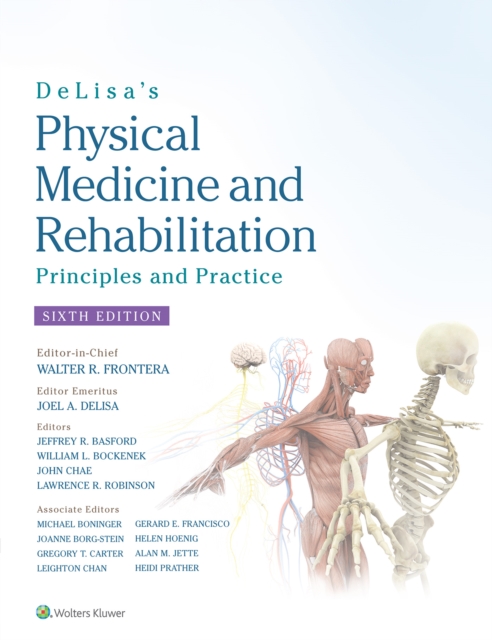
Delisa's Physical medicine and rehabilitation : principles and practice
DeLisa's Physical Medicine and Rehabilitation, Principles and Practice presents the most comprehensive review of the state of the art, evidence-based clinical recommendations for physiatric management of disorders affecting the brain, spinal cord, nerves, bones, joints, ligaments, muscles, and tendons.
eBook


What is the landscape of evidence about the safety of physical agents used in physical medicine and rehabilitation? A scoping review
BackgroundSeveral systematic reviews (SRs) assessing the effectiveness of superficial physical agents have been published, but the evidence about their safety remains controversial.ObjectiveTo identify areas where there is evidence of the safety of physical agents by a scoping review.DesignFour databases were systematically searched for including English SRs that explored and reported safety in terms of adverse events (AEs) related to the application of physical agents in outpatient and inpatient physical medicine and rehabilitation settings managed by healthcare professionals, published in January 2011–29 September 2021. The severity of AEs was classified according to the Common Terminology Criteria. Then, AE findings were summarised according to the SR syntheses. Finally, the reporting of the certainty of the evidence was mapped.ResultsOverall, 117 SRs were retrieved. Most of the SRs included randomised controlled trials (77%) and patients with musculoskeletal disorders (67%). The most investigated physical agents were extracorporeal shock wave therapy (ESWT) (15%), transcutaneous electrical nerve stimulation (13%) and electrical stimulation (12%). No AE (35%) was reported in one-third of the included primary studies in SRs, whereas few severe AEs occurred in less than 1% of the sample. Among physical agents, ESWT showed an increased risk of experiencing mild AEs compared with the control. Most SRs reported a qualitative AE synthesis (65.8%), and few reported the certainty of the evidence (17.9%), which was mainly low.ConclusionWe found evidence of safety on several physical agents coming mostly from qualitative synthesis. No significant harms of these interventions were found except for ESWT reporting mild AEs. More attention to the AEs reporting and their classification should be pursued to analyse them and assess the certainty of evidence quantitatively.Review registration https://osf.io/6vx5a/.
Journal Article