
Catalogue Search | MBRL


Are you sure you want to remove the book from the shelf?

{{itemTitle}}
18,770
result(s) for
"Reinforced concrete construction"
Sort by:

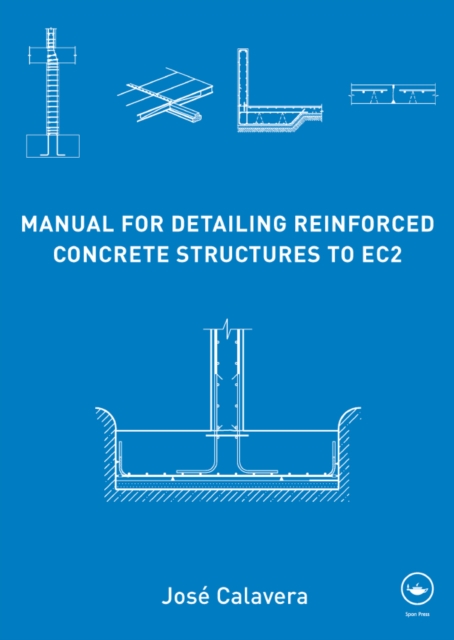
Manual for Detailing Reinforced Concrete Structures to EC2
Detailing is an essential part of the design process. This thorough reference guide for the design of reinforced concrete structures is largely based on Eurocode 2 (EC2), plus other European design standards such as Eurocode 8 (EC8), where appropriate.
With its large format, double-page spread layout, this book systematically details 213 structural elements. These have been carefully selected by José Calavera to cover relevant elements used in practice. Each element is presented with a whole-page annotated model along with commentary and recommendations for the element concerned, as well as a summary of the appropriate Eurocode legislation with reference to further standards and literature. The book's website provides AutoCAD files of all of the models, which can be directly developed and adapted for specific designs.
Its accessible and practical format makes the book an ideal handbook for professional engineers working with reinforced concrete, as well as for students who are training to become designers of concrete structures.
eBook

Reinforced Concrete Structures under Cyclic Loading
Experimental programs in laboratories give real results to identify nonlinear behavior of reinforced concrete (RC) structures but they are limited to knowledge of particular cases under restricted structural dimensions, sizes, shapes, loading and boundary conditions but the computational simulation approach has no limit to its application.
eBook

Infrastructure systems for nuclear energy
Developing sufficient energy resources to replace coal, oil and gas is a globally critical necessity. Alternatives to fossil fuels such as wind, solar, or geothermal energies are desirable, but the usable quantities are limited and each has inherent deterrents. The only virtually unlimited energy source is nuclear energy, where safety of infrastructure systems is the paramount concern.
Infrastructure Systems for Nuclear Energy addresses the analysis and design of infrastructures associated with nuclear energy. It provides an overview of the current and future nuclear power industry and the infrastructure systems from the perspectives of regulators, operators, practicing engineers and research academics. This book also provides details on investigations of containment structures, nuclear waste storage facilities and the applications of commercial/academic computer software.
Specific environments that challenge the behavior of nuclear power plants infrastructure systems such as earthquake, blast, high temperature, irradiation effects, soil-structure interaction effect, etc., are also discussed.
Key features:
* Includes contributions from global experts representing academia and industry
* Provides an overview of the nuclear power industry and nuclear infrastructure systems
* Presents the state-of-the-art as well as the future direction for nuclear civil infrastructure systems
Infrastructure Systems for Nuclear Energy is a comprehensive, up-to-date reference for researchers and practitioners working in this field and for graduate studies in civil and mechanical engineering.
eBook

Applications of Fracture Mechanics to Reinforced Concrete
This volume emphazises the most recent advances in fracture mechanics as specifically applied to steel bar reinforced concrete. Fracture mechanics has been applied to plain and fibre reinforced concrete with increasing success over recent years. This workshop extended these concepts to steel bar reinforced and pre-stressed concrete design. Particularly for high strength concrete, which is a very brittle material, and in the case of large structural members, the application of fracture mechanics appears to be very useful for improving the present design rules. The pre-eminent participants at the Turin workshop contributed extensive expert opinions in four selected areas for which a rational approach, using fracture mechanics, could introduce variations into the concrete design codes: size effects; anchorage and bond; minimum reinforcement for elements in flexure; and shear resistance. The 23 chapters logically address these themes and demonstrate the unique ability of fracture mechanics to capture all the experimentally observed characteristics. The book is primarily directed to the researchers in universities and institutions and will be of value to consultants and engineering companies.
Size effect in quasi-brittle micro-heterogeneous structures: deterministic and statistical theories. Size effects in concrete structures. Stress-crack opening relation and size effect in concrete. Size effects in two compact test specimen geometries. Scaling in tensile and compressive fracture of concrete. Prediction of fracture of concrete and fibre reinforced concrete by the R-curve approach. Size effect in concrete structures: an R-curve approach. Modelling crack toughness curves in fibre-reinforced cement composites. Fracture mechanics evaluation of anchorage bearing capacity in concrete. Anchor bolts modelled with fracture mechanics. Simulation of bond and anchorage: usefulness of softening fracture mechanics. Analysis of steel-concrete bond with damage mechanics: nonlinear behaviour and size effect. Splitting failure of a strain-softening material due to bond stress. Fracture mechanics evaluation of minimum reinforcement in concrete structures. Minimum reinforcement requirements for concrete flexural members. Fracture mechanics application to reinforced concrete members in flexure. Role of compressive fracture energy of concrete on the failure behaviour of reinforced beams. Shear crack stability along a precast reinforced concrete joint. Shear strength of reinforced concrete beams. Effect of fibre modified fracture properties on shear resistance of reinforced mortar and concrete beams. Failure modes of longitudinally reinforced beams. Reinforced concrete beam behaviour under cyclic loadings. An expert system approach to applying fracture mechanics to reinforced concrete. Index.
Alberto Carpinteri is Professor of Structural Mechanics at the Politecnico di Torino, Italy. Among his many awards he is Past President of the European Structural Integrity Society and of the International Association of Fracture Mechanics for Concrete and Concrete Structures; a Member of the American Association for the Advancement of Science, and of the Member of the American Academy of Mechanics; Recipient of RILEM‘s Robert l'Hermite Medal, and of the JSME Medal of the Japan Society of Mechanical Engineers.
eBook


Reinforced concrete and the modernization of American building, 1900-1930
Examining the proliferation of reinforced-concrete construction in the United States after 1900, historian Amy E. Slaton considers how scientific approaches and occupations displaced traditionally skilled labor. The technology of concrete buildings—little studied by historians of engineering, architecture, or industry—offers a remarkable case study in the modernization of American production.
The use of concrete brought to construction the new procedures and priorities of mass production. These included a comprehensive application of science to commercial enterprise and vast redistributions of skills, opportunities, credit, and risk in the workplace. Reinforced concrete also changed the American landscape as building buyers embraced the architectural uniformity and simplicity to which the technology was best suited.
Based on a wealth of data that includes university curricula, laboratory and company records, organizational proceedings, blueprints, and promotional materials as well as a rich body of physical evidence such as tools, instruments, building materials, and surviving reinforced-concrete buildings, this book tests the thesis that modern mass production in the United States came about not simply in answer to manufacturers' search for profits, but as a result of a complex of occupational and cultural agendas.
eBook