
Catalogue Search | MBRL


Are you sure you want to remove the book from the shelf?

{{itemTitle}}
4,606
result(s) for
"Reintroduction"
Sort by:

Reintroduction of fish and wildlife populations
\"Reintroduction of Fish and Wildlife Populations provides a practical step-by-step guide to planning, implementing, and evaluating the successful re-establishment of animal populations in former habitats or the introduction of them in new environments. In each chapter, experts in reintroduction biology outline a comprehensive synthesis of core concepts, issues, techniques, and perspectives. This manual and reference supports scientists and managers from fisheries and wildlife professions as they plan reintroductions, initiate releases of individuals, and manage restored populations over time. Focusing on a broad range of taxonomic groups, ecosystems, and global regions, this edited volume is an essential guide for academics, students, and professionals in natural resource management\"--Provided by publisher.
BOOK

Back from the Collapse
Back from the Collapse is a clarion call for restoring one
of North America's most underappreciated and overlooked ecosystems:
the grasslands of the Great Plains. This region has been called
America's Serengeti in recognition of its historically
extraordinary abundance of wildlife. Since Euro-American
colonization, however, populations of at least twenty-four species
of Great Plains wildlife have collapsed-from pallid sturgeon and
burrowing owls to all major mammals, including bison and grizzly
bears. In response to this incalculable loss, Curtis H. Freese and
other conservationists founded American Prairie, a nonprofit
organization with the mission of supporting the region's native
wildlife by establishing a 3.2-million-acre reserve on the plains
of eastern Montana, one of the most intact and highest-priority
areas for biodiversity conservation in the Great Plains. In
Back from the Collapse Freese explores the evolutionary
history of the region's ecosystem over millions of years, as it
transitioned from subtropical forests to the edge of an ice sheet
to today's prairies. He details the eventual species collapse and
American Prairie's work to restore the habitat and wildlife,
efforts described by National Geographic as \"one of the
most ambitious conservation projects in American history.\"
eBook


Socio-ecological drivers of public conservation voting
Understanding factors that influence real-world public conservation behaviors is critical for developing successful conservation policies and management actions. Citizens of Colorado, USA recently passed a ballot initiative to restore the gray wolf to its former range within the state. The >3 million votes offer an unprecedented opportunity to test factors that influenced decisions to support or oppose this conservation action. We created spatial linear regression models to assess the relationship between support for wolf restoration and (1) the presidential vote, (2) distance to conservation intervention (i.e., proposed wolf reintroduction and existing wolves), and measures of (3) livelihood and (4) demographics using precinct-level data. Our results demonstrate the strong relationship between support for wolf restoration and political support for the Democratic candidate for president in the 2020 election, and highlight how other factors, including increased age, participation in elk hunting, and proximity to the reintroduction region were associated with less support. Our findings underscore the critical role of politicization on public conservation action and the need to develop outreach and engagement strategies to mitigate polarization.
Journal Article
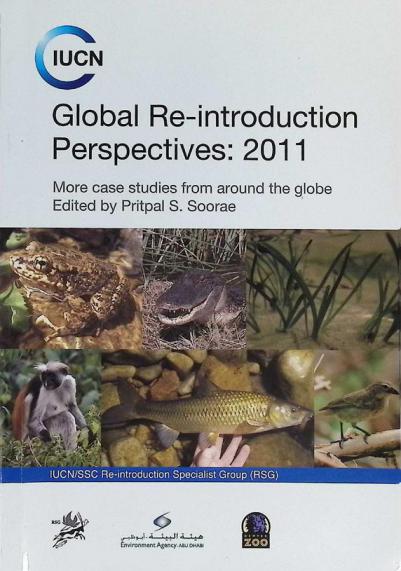
Global re-introduction perspectives, 2011 : more case studies from around the globe
\"Global Re-introduction Perspectives, 2011\" is the third installment in a landmark series of conservation case studies published by the IUCN/SSC Re-introduction Specialist Group in collaboration with the Environment Agency—Abu Dhabi (EAD). Edited by Pritpal S. Soorae, this edition provides 50 new peer-reviewed case studies that document the practical application of the IUCN Guidelines for Re-introductions. The work spans a diverse taxonomic range—including invertebrates, fish, amphibians, reptiles, birds, mammals, and plants—and serves as a global repository of \"lessons learned\" from the front lines of species restoration and biodiversity management
BOOK

Captivity and Animal Microbiomes: Potential Roles of Microbiota for Influencing Animal Conservation
During the ongoing biodiversity crisis, captive conservation and breeding programs offer a refuge for species to persist and provide source populations for reintroduction efforts. Unfortunately, captive animals are at a higher disease risk and reintroduction efforts remain largely unsuccessful. One potential factor in these outcomes is the host microbiota which includes a large diversity and abundance of bacteria, fungi, and viruses that play an essential role in host physiology. Relative to wild populations, the generalized pattern of gut and skin microbiomes in captivity are reduced alpha diversity and they exhibit a significant shift in community composition and/or structure which often correlates with various physiological maladies. Many conditions of captivity (antibiotic exposure, altered diet composition, homogenous environment, increased stress, and altered intraspecific interactions) likely lead to changes in the host-associated microbiome. To minimize the problems arising from captivity, efforts can be taken to manipulate microbial diversity and composition to be comparable with wild populations through methods such as increasing dietary diversity, exposure to natural environmental reservoirs, or probiotics. For individuals destined for reintroduction, these strategies can prime the microbiota to buffer against novel pathogens and changes in
diet
and improve reintroduction success. The microbiome is a critical component of animal physiology and its role in species conservation should be expanded and included in the repertoire of future management practices.
Journal Article


Baby panda goes wild
\"Readers will learn how one mother and her cub are being protected and raised in a Chinese panda reserve, which seeks to help this vulnerable species survive\"--Provided by publisher.
Book
