
Catalogue Search | MBRL


Are you sure you want to remove the book from the shelf?

{{itemTitle}}
63
result(s) for
"Relating to religious groups"
Sort by:

Judging 'Privileged' Jews : Holocaust Ethics, Representation, and the 'Grey Zone'
The Nazis’ persecution of the Jews during the Holocaust included the creation of prisoner hierarchies that forced victims to cooperate with their persecutors. Many in the camps and ghettos came to hold so-called “privileged” positions, and their behavior has often been judged as self-serving and harmful to fellow inmates. Such controversial figures constitute an intrinsically important, frequently misunderstood, and often taboo aspect of the Holocaust. Drawing on Primo Levi’s concept of the “grey zone,” this study analyzes the passing of moral judgment on “privileged” Jews as represented by writers, such as Raul Hilberg, and in films, including Claude Lanzmann’s Shoah and Steven Spielberg’s Schindler’s List. Negotiating the problems and potentialities of “representing the unrepresentable,” this book engages with issues that are fundamental to present-day attempts to understand the Holocaust and deeply relevant to reflections on human nature.
eBook

On the Strange Place of Religion in Contemporary Art
Can contemporary art say anything about spirituality? John Updike calls modern art \"a religion assembled from the fragments of our daily life,\" but does that mean that contemporary art is spiritual? What might it mean to say that the art you make expresses your spiritual belief?
On the Strange Place of Religion in Contemporary Art explores the curious disconnection between spirituality and current art. This book will enable you to walk into a museum and talk about the spirituality that is or is not visible in the art you see.
\"For those searching for a way to broach the intriguing and complicated topic of religion in relation to cintemporary art, this book provides much to talk about...\" -- The Journal of Religion
James Elkins is Professor of Art History, Theory and Criticism at the School of the Art Institute of Chicago, and Chair of Art History at University College, Cork, Ireland. Among his books are Pictures and Tears, Visual Studies: a Skeptical Introduction, What Painting Is, Stories of Art , and How to Use Your Eyes, all published by Routledge.
eBook

The Passion of Max von Oppenheim
Born into a prominent German Jewish banking family, Baron Max von Oppenheim (1860-1946) was a keen amateur archaeologist and ethnologist. His discovery and excavation of Tell Halaf in Syria marked an important contribution to knowledge of the ancient Middle East, while his massive study of the Bedouins is still consulted by scholars today. He was also an ardent German patriot, eager to support his country's pursuit of its \"place in the sun\". Excluded by his part-Jewish ancestry from the regular diplomatic service, Oppenheim earned a reputation as \"the Kaiser's spy\" because of his intriguing against the British in Cairo, as well as his plan, at the start of the First World War, to incite Muslims under British, French and Russian rule to a jihad against the colonial powers. After 1933, despite being half-Jewish according to the Nuremberg Laws, Oppenheim was not persecuted by the Nazis. In fact, he placed his knowledge of the Middle East and his connections with Muslim leaders at the service of the regime. Ranging widely over many fields—from war studies to archaeology and banking history—The Passion of Max von Oppenheim tells the gripping and at times unsettling story of one part-Jewish man's passion for his country in the face of persistent and, in his later years, genocidal anti-Semitism.
eBook
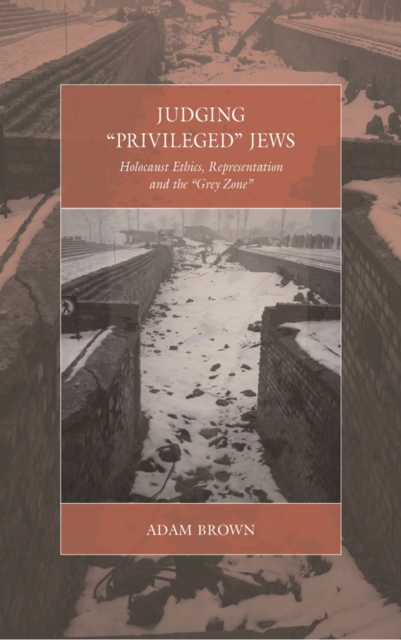
Judging 'Privileged' Jews
The Nazis’ persecution of the Jews during the Holocaust included the creation of prisoner hierarchies that forced victims to cooperate with their persecutors. Many in the camps and ghettos came to hold so-called “privileged” positions, and their behavior has often been judged as self-serving and harmful to fellow inmates. Such controversial figures constitute an intrinsically important, frequently misunderstood, and often taboo aspect of the Holocaust. Drawing on Primo Levi’s concept of the “grey zone,” this study analyzes the passing of moral judgment on “privileged” Jews as represented by writers, such as Raul Hilberg, and in films, including Claude Lanzmann’s Shoah and Steven Spielberg’s Schindler’s List. Negotiating the problems and potentialities of “representing the unrepresentable,” this book engages with issues that are fundamental to present-day attempts to understand the Holocaust and deeply relevant to reflections on human nature.
eBook
The Book of Job
The Book of Job has held a central role in defining the project of modernity from the age of Enlightenment until today. Why has Job`s response to disaster become a touchstone for modern reflections on catastrophic events? This volume engages this question and offers new perspectives on the tragic bent of the Book of Job, on its dramatic irony, on Job`s position as mourner, and the unique representation of the Joban body in pain.
eBook

German Rabbis in British Exile
The rich history of the German rabbinate came to an abrupt halt with the November Pogrom of 1938. The need to leave Germany became clear and many rabbis made use of the visas they had been offered. Their resettlement in Britain was hampered by additional obstacles such as internment, deportation, enlistment in the Pioneer Corps. But rabbis still attempted to support their fellow refugees with spiritual and pastoral care. The refugee rabbis replanted the seed of the once proud German Judaism into British soil. New synagogues were founded and institutions of Jewish learning sprung up, like rabbinic training and the continuation of \"Wissenschaft des Judentums.\" The arrival of Leo Baeck professionalized these efforts and resulted in the foundation of the Leo Baeck College in London. Refugee rabbis now settled and obtained pulpits in the many newly founded synagogues. Their arrival in Britain was the catalyst for much change in British Judaism, an influence that can still be felt today.
eBook

The Codification of Jewish Law and an Introduction to the Jurisprudence of the Mishna Berura
The Mishna Berura is, without a doubt, Rabbi Israel Meir Kagan's greatest and most complex contribution to the canon of Orthodox Jewish Law; it is a singular work that synthesizes Jewish traditions, laws, and mores into a practical halakhic guide to daily religious life. For all of his traditionalism, Rabbi Kagan was an iconoclast, and the Mishna Berura broke from many of the traditional approaches of deciding halakhic directives. Instead, he favored studying, engaging, and asserting decisions in a nuanced, almost natural approach to how ethical people should live their daily lives consistent with Jewish law. Today, the Mishna Berura has gained widespread recognition and is considered authoritative by essentially all of contemporary Orthodox Jewry, a measure of greatness that few works of Halakha have attained. Michael J. Broyde and Ira Bedzow here investigate this seminal text and explore its background and decision-making process.
eBook

Dialogue as a Trans-disciplinary Concept
This volume of essays takes as its point of departure Martin Buber`s principle of dialogue, which he applied as a comprehensive hermeneutic method for the study of various cultural phenomena. The volume critically evaluates the methodological purchase to be gained by the introduction of Buber`s conception of dialogue in political theory, psychology and psychiatry, and religious studies.
eBook
Ancient Jewish Prayers and Emotions
Given the recent interest in the emotions presupposed in early religious literature, it has been thought useful to examine in this volume how the Jews and early Christians expressed their feelings within the prayers recorded in some of their literature. Specialists in their fields from academic institutions around the world have analysed important texts relating to this overall theme and to what is revealed with regard to such diverse topics as relations with God, exegesis, education, prophecy, linguistic expression, feminism, happiness, grief, cult, suicide, non-Jews, Hellenism, Qumran and Jerusalem. The texts discussed are in Greek, Hebrew and Aramaic and are important for a scientific understanding of how Rabbinic Judaism and Early Christianity developed their approaches to worship, to the construction of their theology and to the feelings that lay behind their religious ideas and practices. The articles contribute significantly to an historical understanding of how Jews maintained
eBook
The Construct of Identity in Hellenistic Judaism
This volume assembles twenty-three essays by Erich S. Gruen, who has written extensively on the literature and history of early Judaism and the experience of the Jews in the Greco-Roman world. Twenty-two of the articles have previously been published, and one new one was composed for the volume.
eBook