
Catalogue Search | MBRL


Are you sure you want to remove the book from the shelf?

{{itemTitle}}
213,505
result(s) for
"Religion and Science."
Sort by:


Prophets and Protons
By the twentieth century, science had become so important that religious traditions had to respond to it. Emerging religions, still led by a living founder to guide them, responded with a clarity and focus that illuminates other larger, more established religions' understandings of science. The Hare Krishnas, the Unification Church, and Heaven's Gate each found distinct ways to incorporate major findings of modern American science, understanding it as central to their wider theological and social agendas. In tracing the development of these new religious movements' viewpoints on science during each movement's founding period, we can discern how their views on science were crafted over time. These NRMs shed light on how religious groups - new, old, alternative, or mainstream - could respond to the tremendous growth of power and prestige of science in late twentieth-century America.In this engrossing book, Zeller carefully shows that religious groups had several methods of creatively responding to science, and that the often-assumed conflict-based model of science vs. religion must be replaced by a more nuanced understanding of how religions operate in our modern scientific world.
eBook

The Cambridge companion to science and religion
\"In recent years, the relations between science and religion have been the object of renewed attention. Developments in physics, biology and the neurosciences have reinvigorated discussions about the nature of life and ultimate reality. At the same time, the growth of anti-evolutionary and intelligent design movements has led many to the view that science and religion are necessarily in conflict. This book provides a comprehensive introduction to the relations between science and religion, with contributions from historians, philosophers, scientists and theologians. It explores the impact of religion on the origins and development of science, religious reactions to Darwinism, and the link between science and secularization. It also offers in-depth discussions of contemporary issues, with perspectives from cosmology, evolutionary biology, psychology, and bioethics. The volume is rounded out with philosophical reflections on the connections between atheism and science, the nature of scientific and religious knowledge, and divine action and human freedom\"-- Provided by publisher.
Book

Disknowledge
\"Disknowledge\": knowing something isn't true, but believing it anyway. InDisknowledge: Literature, Alchemy, and the End of Humanism in Renaissance England, Katherine Eggert explores the crumbling state of learning in the sixteenth and seventeenth centuries. Even as the shortcomings of Renaissance humanism became plain to see, many intellectuals of the age had little choice but to treat their familiar knowledge systems as though they still held. Humanism thus came to share the status of alchemy: a way of thinking simultaneously productive and suspect, reasonable and wrongheaded.
Eggert argues that English writers used alchemy to signal how to avoid or camouflage pressing but discomfiting topics in an age of rapid intellectual change.Disknowledgedescribes how John Donne, George Herbert, Henry Vaughan, John Dee, Christopher Marlowe, William Harvey, Helkiah Crooke, Edmund Spenser, and William Shakespeare used alchemical imagery, rhetoric, and habits of thought to shunt aside three difficult questions: how theories of matter shared their physics with Roman Catholic transubstantiation; how Christian Hermeticism depended on Jewish Kabbalah; and how new anatomical learning acknowledged women's role in human reproduction.Disknowledgefurther shows how Shakespeare, Ben Jonson, and Margaret Cavendish used the language of alchemy to castigate humanism for its blind spots and to invent a new, posthumanist mode of knowledge: writing fiction.
Covering a wide range of authors and topics,Disknowledgeis the first book to analyze how English Renaissance literature employed alchemy to probe the nature and limits of learning. The concept of disknowledge-willfully adhering to something we know is wrong-resonates across literary and cultural studies as an urgent issue of our own era.
eBook

Protestant Modernist Pamphlets
A critical edition of ten rare pamphlets on science and religion published from 1922–1931 by the University of Chicago Divinity School.
In the years surrounding the Scopes trial in 1925, liberal Protestant scientists, theologians, and clergy sought to diminish opposition to evolution and to persuade American Christians to adopt more positive attitudes toward modern science. With funding from the Rockefeller Foundation and many leading scientists, the University of Chicago Divinity School published a series of ten pamphlets on science and religion to counter William Jennings Bryan's efforts to ban evolution in public schools.
In Protestant Modernist Pamphlets, historian Edward B. Davis, who discovered these pamphlets, reprints them with extensive editorial comments, annotations, and introductions to each. Based on unpublished correspondence and internal Divinity School documents, these introductions narrate the origin of the pamphlets, as well as their funding sources and how readers reacted to them. Letters from dozens of top scientists at the time reveal their previously unknown views on God and the relationship between science and religion. Viewed together, the pamphlets and Davis's critical assessment of their historical importance provide an intriguing perspective on Protestant modernist encounters with science in the early twentieth century.
eBook

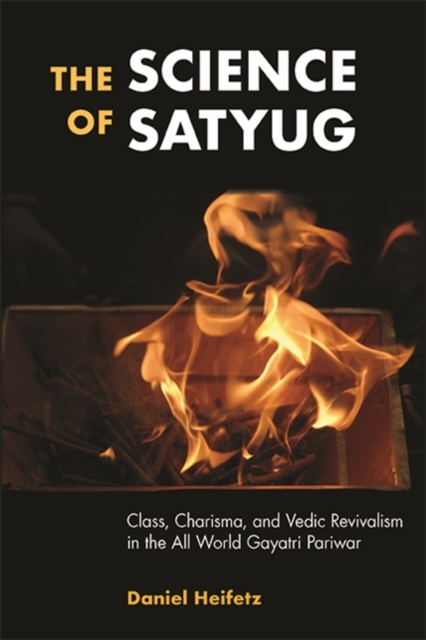
The Science of Satyug
The All World Gayatri Pariwar is a modern religious movement that
enjoys wide popularity in North India, particularly among the many
STEM workers who joined after becoming disillusioned with their
lucrative but unfulfilling private-sector careers. Founded in the
mid-twentieth century, the Gayatri Pariwar works to popularize
practices inspired by ancient religious texts and breaks with
convention by framing these practices as the foundation of a
universal spirituality. The movement appeals to science in its
advocacy of these practices, claiming that they have medical
benefits that constitute proof that rational people around the
world should find persuasive. Should these practices become
sufficiently widespread, the belief is that humanity will enter a
new satyug , or \"golden age.\" In The Science of
Satyug , Daniel Heifetz focuses on how religion and science are
objects of intense emotion that help to constitute identities.
Weaving engaging ethnographic anecdotes together with readings of
Gayatri Pariwar literature, Heifetz interprets this material in
light of classic and contemporary theory. The result is a
significant contribution to current conversations about the
globalized middle classes and the entanglement of religion and
science that will appeal to anyone interested in understanding
these aspects of life in modern India.
eBook


Making Truth in Early Modern Catholicism
Scholarship has come to value the uncertainties haunting early modern knowledge cultures; indeed, the awareness of the fragility and plurality of knowledge is now offered as a key element of Baroque Science. Yet early modern actors never questioned the possibility of certainty itself; including the notion that truth is out there, universal, and therefore situated at one remove from human manipulations. This book addresses the central question of how early modern actors managed not to succumb to postmodern relativism, amidst uncertainties and blatant disagreements about the nature of God, Man, and the Universe. An international and interdisciplinary team of experts in fields ranging from Astronomy to Business Administration to Theology investigate a number of practices that are central to maintaining and functionalizing the notion of absolute truth, the certainty that could be achieved about it, and of the credibility of a wide plethora of actors in differentiating fields of knowledge.
eBook