
Catalogue Search | MBRL


Are you sure you want to remove the book from the shelf?

{{itemTitle}}
136,514
result(s) for
"Religion and Theology"
Sort by:


Isaac Newton and the Study of Chronology
Isaac Newton (1642-1727) is best known for his natural philosophical and mathematical works. Yet he devoted ample time to the study of ancient chronology, resulting in the posthumously published The Chronology of Ancient Kingdoms Amended (1728). Here, Newton attempted to show how the antiquity of Greece, Egypt, Assyria, Persia, and other Mediterranean nations could be reinterpreted to fit the timespan allowed for by Scripture. As the hundreds of books from his library and the thousands of manuscript pages devoted to the topic show, the Chronology was long in the making. This volume provides the first comprehensive analysis of the genesis and evolution of Newton's studies of ancient history and demonstrates how these emerged from that other major scholarly project of his, the interpretation of the apocalyptic prophecies in Scripture. A careful study of Newton's reading, note-taking, writing, and ordering practices provides the key to unravelling and reconstructing the chronology of Newton's chronological studies, bringing to light writings hitherto hidden in the archives.
eBook

Making Truth in Early Modern Catholicism
Scholarship has come to value the uncertainties haunting early modern knowledge cultures; indeed, the awareness of the fragility and plurality of knowledge is now offered as a key element of Baroque Science. Yet early modern actors never questioned the possibility of certainty itself; including the notion that truth is out there, universal, and therefore situated at one remove from human manipulations. This book addresses the central question of how early modern actors managed not to succumb to postmodern relativism, amidst uncertainties and blatant disagreements about the nature of God, Man, and the Universe. An international and interdisciplinary team of experts in fields ranging from Astronomy to Business Administration to Theology investigate a number of practices that are central to maintaining and functionalizing the notion of absolute truth, the certainty that could be achieved about it, and of the credibility of a wide plethora of actors in differentiating fields of knowledge.
eBook


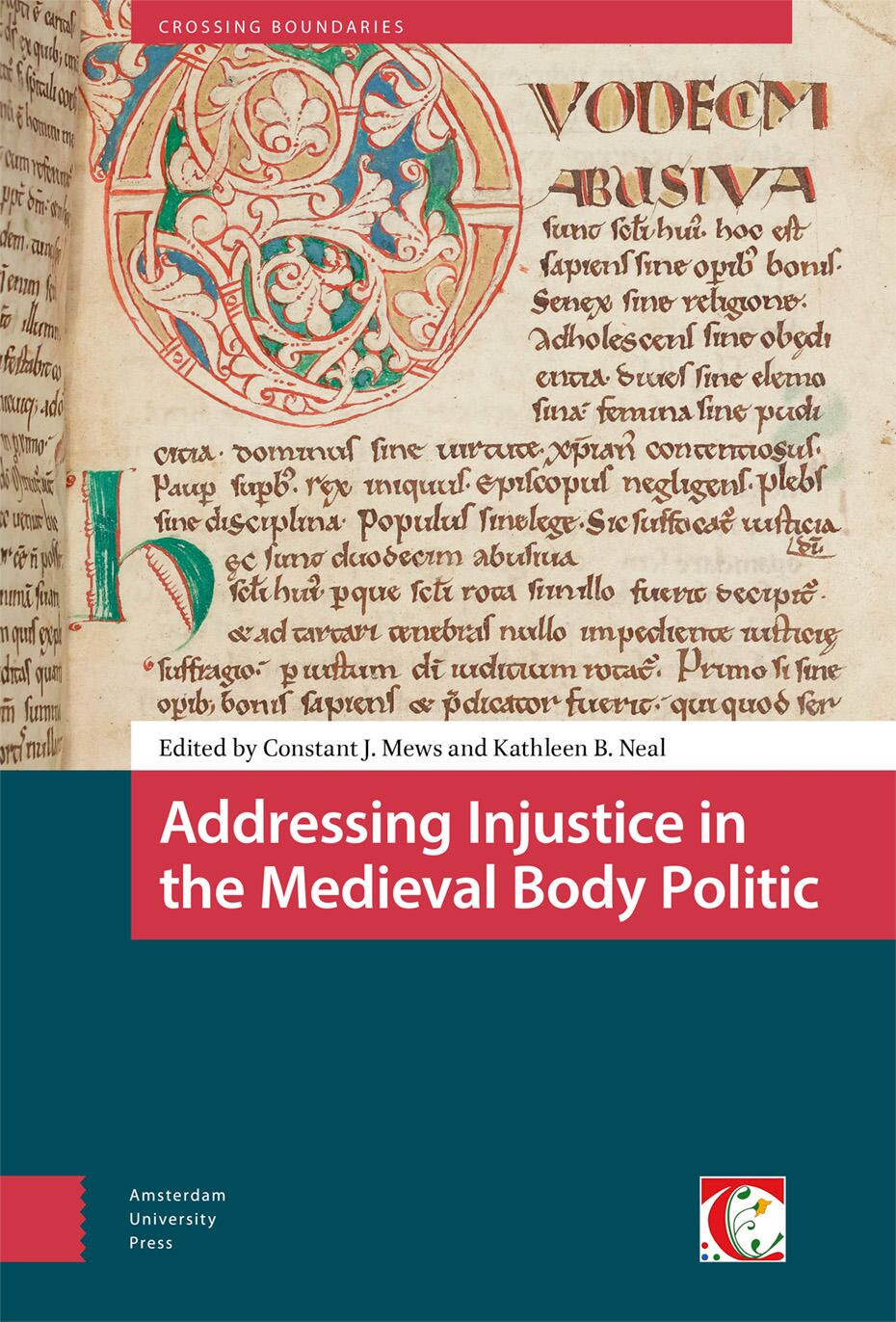
Addressing Injustice in the Medieval Body Politic
Justice and injustice were subjects of ongoing debate in medieval Europe. Received classical and biblical models both influenced how these qualities of moral and political life were perceived, discussed and acted upon. Important among these influences was the anonymous seventh-century Irish text, On The Twelve Abuses of the Age, a biblically-inspired discussion of the moral duties particular to each sector of society. This volume probes its long influence, and its interaction with the revival of classical ideas. By bringing together scholars of political thought and practice, in lay and religious contexts spanning the seventh to fourteenth centuries, this volume crosses boundaries of periodisation, discipline and approach to reflect upon the medieval evolution of concepts of injustice and means of redress. Contributions address how ideas about justice and injustice were discussed among scholars and theologians, and how those ideas were translated into action through complaint and advice throughout the medieval period.
eBook


Cormac McCarthy and the signs of sacrament : literature, theology, and the moral of stories
\"Although scholars have widely acknowledged the prevalence of religious reference in the work of Cormac McCarthy, this is the first book on the most pervasive religious trope in all his works: the image of sacrament, and in particular, of eucharist. Informed by postmodern theories of narrative and Christian theologies of sacrament, Matthew Potts reads the major novels of Cormac McCarthy in a new and insightful way, arguing that their dark moral significance coheres with the Christian theological tradition in difficult, demanding ways. Potts develops this account through an argument that integrates McCarthy's fiction with both postmodern theory and contemporary fundamental and sacramental theology. In McCarthy's novels, the human self is always dispossessed of itself, given over to harm, fate, and narrative. But this fundamental dispossession, this vulnerability to violence and signs, is also one uniquely expressed in and articulated by the Christian sacramental tradition. By reading McCarthy and this theology alongside postmodern accounts of action, identity, subjectivity, and narration, Potts demonstrates how McCarthy exploits Christian theology in order to locate the value of human acts and relations in a way that mimics the dispossessing movement of sacramental signs. This is not to claim McCarthy for theology, necessarily, but it is to assert that McCarthy generates his account of what human goodness might look like in the wake of metaphysical collapse through the explicit use of Christian theology\"-- Provided by publisher.
BOOK

Lebanese Salafis between the Gulf and Europe
Salafism is becoming increasingly important in the post-Arab Spring Middle East, yet there is a marked scarcity of serious academic studies of its rise. This essential volume examines the rise of Salafi networks in Lebanon and their transnational reach in Northern Africa, the Arabian Gulf and Europe. Drawing on his extensive fieldwork in Lebanon, Kuwait, Qatar and Europe, the author sheds new light on the expansion of Salafism to become one of the most important religious movements in Lebanon's Sunni Muslim community. Offering new insight into the structure of Salafism and its networking techniques at the local and transnational level, Pall links the interconnectedness of the Lebanese groups with networks and charity organisations in the Gulf and in Europe. This timely volume is an invaluable addition to the broad international debates on transnational Islamic movements.
eBook