
Catalogue Search | MBRL


Are you sure you want to remove the book from the shelf?

{{itemTitle}}
111,201
result(s) for
"Religious Studies"
Sort by:


Foreigners and their food
Foreigners and Their Food explores how Jews, Christians, and Muslims conceptualize \"us\" and \"them\" through rules about the preparation of food by adherents of other religions and the act of eating with such outsiders. David M. Freidenreich analyzes the significance of food to religious formation, elucidating the ways ancient and medieval scholars use food restrictions to think about the \"other.\" Freidenreich illuminates the subtly different ways Jews, Christians, and Muslims perceive themselves, and he demonstrates how these distinctive self-conceptions shape ideas about religious foreigners and communal boundaries. This work, the first to analyze change over time across the legal literatures of Judaism, Christianity, and Islam, makes pathbreaking contributions to the history of interreligious intolerance and to the comparative study of religion.
eBook

Learning love from a tiger : religious experiences with nature
\"Learning Love from a Tiger explores the vibrancy and variety of humans' sacred encounters with the natural world, gathering a range of stories culled from Christian, Muslim, Hindu, Mayan, Himalayan, Buddhist, and Chinese shamanic traditions. Readers will delight in tales of house cats who teach monks how to meditate, rivers that grant salvation, shamans who shape-shift into jaguars, crickets who perform Catholic mass, and many others. More than a collection of wonderful stories, this book introduces important concepts and approaches that underlie much recent work in environmental ethics, religion, and ecology. Capper's light touch prompts readers to engage their own views of humanity's place in the natural world and in particular question longstanding assumptions of human superiority\"--Provided by publisher.
Book

Global Visions of Violence
In Global Visions of Violence , the editors and contributors argue that violence creates a lens, bridge, and method for interdisciplinary collaboration that examines Christianity worldwide in the twentieth and twenty-first centuries. By analyzing the myriad ways violence, persecution, and suffering impact Christians and the imagination of Christian identity globally, this interdisciplinary volume integrates the perspectives of ethicists, historians, anthropologists, and ethnographers to generate new conversations. Taken together, the chapters in this book challenge scholarship on Christian growth that has not accounted for violence while analyzing persecution narratives that can wield data toward partisan ends. This allows Global Visions of Violence to push urgent conversations forward, giving voice to projects that illuminate wide and often hidden landscapes that have been shaped by global visions of violence, and seeking solutions that end violence and turn toward the pursuit of justice, peace, and human rights among suffering Christians.
eBook


Demonic Desires
InDemonic Desires, Ishay Rosen-Zvi examines the concept ofyetzer hara, or evil inclination, and its evolution in biblical and rabbinic literature. Contrary to existing scholarship, which reads the term under the rubric of destructive sexual desire, Rosen-Zvi contends that in late antiquity theyetzerrepresents a general tendency toward evil. Rather than the lower bodily part of a human, the rabbinicyetzeris a wicked, sophisticated inciter, attempting to snare humans to sin. The rabbinicyetzershould therefore not be read in the tradition of the Hellenistic quest for control over the lower parts of the psyche, writes Rosen-Zvi, but rather in the tradition of ancient Jewish and Christian demonology.
Rosen-Zvi conducts a systematic and comprehensive analysis of the some one hundred and fifty appearances of the evilyetzerin classical rabbinic literature to explore the biblical and postbiblical search for the sources of human sinfulness. By examining theyetzerwithin a specific demonological tradition,Demonic Desiresplaces theyetzerdiscourse in the larger context of a move toward psychologization in late antiquity, in which evil-and even demons-became internalized within the human psyche. The book discusses various manifestations of this move in patristic and monastic material, from Clement and Origin to Antony, Athanasius, and Evagrius. It concludes with a consideration of the broader implications of theyetzerdiscourse in rabbinic anthropology.
eBook

Healing racial trauma : the road to resilience
\"People of color have endured traumatic histories and almost daily assaults on their dignity. Professional counselor Sheila Wise Rowe exposes the symptoms of racial trauma to lead readers to a place of freedom from the past and new life for the future. With Rowe as a reliable guide who has both been on the journey and shown others the way forward, you will find a safe pathway to resilience\"-- Provided by publisher.
Book

Sisters and Brothers of the Common Life
The Devotio Moderna, or Modern Devout, puzzled their contemporaries. Beginning in the 1380s in market towns along the Ijssel River of the east-central Netherlands and in the county of Holland, they formed households organized as communes and forged lives centered on private devotion. They lived on city streets alongside their neighbors, managed properties and rents in common, and worked in the textile and book trades, all the while refusing to profess vows as members of any religious order or to acquire spouses and personal property as lay citizens. They defended their self-designed style of life as exemplary and sustained it in the face of opposition, their women labeled \"beguines\" and their men \"lollards,\" both meant as derogatory terms. Yet the movement grew, drawing in women and schoolboys, priests and laymen, and spreading outward toward Münster, Flanders, and Cologne.
The Devout were arguably more culturally significant than the Lollards and Beguines, yet they have commanded far less scholarly attention in English. John Van Engen's magisterial book keeps the Modern Devout at its center and thinks through their story anew. Few interpreters have read the Devout so insistently within their own time and space by looking to the social and religious conditions that marked towns and parishes in northern Europe during the fifteenth century and examining the widespread upheavals in cultural and religious life between the 1370s and the 1440s. InSisters and Brothers of the Common Life, Van Engen grasps the Devout in their humanity, communities, and beliefs, and places them firmly within the urban societies of the Low Countries and the cultures we call late medieval.
eBook

Foreigners and their food : constructing otherness in Jewish, Christian, and Islamic law
Foreigners and Their Food explores how Jews, Christians, and Muslims conceptualize \"us\" and \"them\" through rules about the preparation of food by adherents of other religions and the act of eating with such outsiders. David M. Freidenreich analyzes the significance of food to religious formation, elucidating the ways ancient and medieval scholars use food restrictions to think about the \"other.\" Freidenreich illuminates the subtly different ways Jews, Christians, and Muslims perceive themselves, and he demonstrates how these distinctive self-conceptions shape ideas about religious foreigners and communal boundaries. This work, the first to analyze change over time across the legal literatures of Judaism, Christianity, and Islam, makes pathbreaking contributions to the history of interreligious intolerance and to the comparative study of religion.
Book
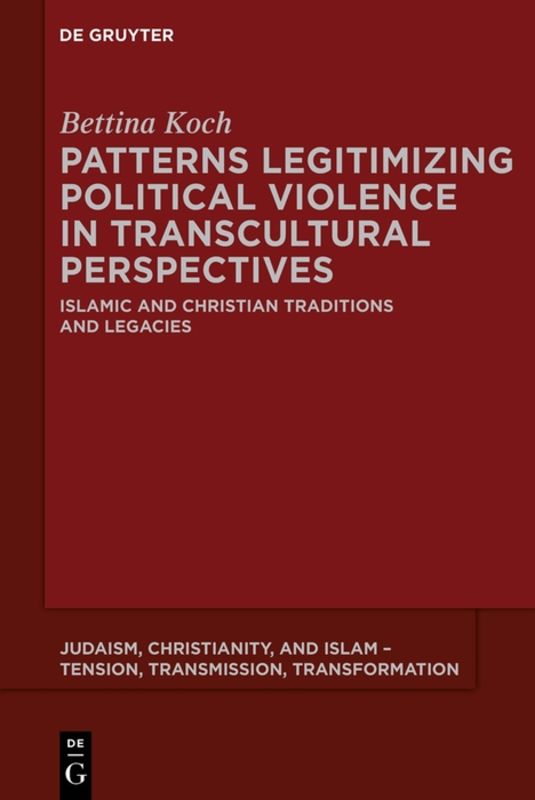
Patterns Legitimizing Political Violence in Transcultural Perspectives
This volume explores theoretical discourses in which religion is used to legitimize political violence. It examines the ways in which Christianity and Islam are utilized for political ends, in particular how violence is used (or abused) as an expedient to justify political action. This research focuses on premodern as well as contemporary discourses in the Middle East and Latin America, identifying patterns frequently used to justify the deployment of violence in both hegemonic and anti-hegemonic discourses. In addition, it explores how premodern arguments and authorities are utilized and transformed in order to legitimize contemporary violence as well as the ways in which the use of religion as a means to justify violence alters the nature of conflicts that are not otherwise explicitly religious. It argues that most past and present conflicts, even if the discourses about them are conducted in religious terms, have origins other than religion and/or blend religion with other causes, namely socio-economic and political injustice and inequality. Understanding the use and abuse of religion to justify violence is a prerequisite to discerning the nature of a conflict and might thus contribute to conflict resolution.
eBook