
Catalogue Search | MBRL


Are you sure you want to remove the book from the shelf?

{{itemTitle}}
302
result(s) for
"Religious awakening."
Sort by:


Islam's Predicament with Modernity
Islam's Predicament with Modernity presents an in-depth cultural and political analysis of the issue of political Islam as a potential source of tensions and conflict, and how this might be peacefully resolved.
Looking at the issue of modernity from an Islamic point of view, the author examines the role of culture and religion in Muslim society under conditions of globalisation, and analyses issues such as law, knowledge and human rights. He engages a number of significant studies on political Islam and draws on detailed case studies, rejecting the approaches of both Orientalists and apologists and calling instead for a genuine Islamic pluralism that accepts the equality of others. Situating modernity as a Western product at the crux of his argument, he argues that a separation of religion and politics is required, which presents a challenge to the Islamic worldview.
This critical analysis of value conflicts, tensions and change in the Islamic world will be of interest to scholars and advanced students of international relations, social theory, political science, religion, Islamic studies and Middle Eastern studies.
'Bassam Tibi has written the rarest of books: a book of learning and a daring one as well. One of the most formidable books to appear on modern Islam in a very long time. Arguable the leading singular authority on European Islam, Professor Tibi has looked, unsentimentally, at the modern dilemma of Islam and come forth with a book of startling originality. This is scholarship of the highest level: Professor Tibi neither apologizes for Islam's troubles nor hacks away at the Islamist utopia. In this \"cool\" and authoritative book, we have an unflinching depiction of Islam's modern predicament. An exemplary work.' - Fouad Ajami, Director of Middle East Studies, the Johns Hopkins University
\"[A] wide-ranging and thought-provoking book.\" - Richard Bonney, University of Leicester; The Muslim World Book Review, Volume 31, Number 1, 2010
Bassam Tibi is Professor of International Relations at the University of Goettingen and A.D. White Professor-at-Large at Cornell University
Introduction: Cultural Tensions, Modernity, Globalization, and Conflict 1. The Predicament: The Exposure to Cultural Modernity, and the Need for an Accommodation. Religious Reform and Cultural Change in Islamic Civilization 2. Issue Areas of the Predicament I: Modernity and Knowledge. Torn Between Reason and Islamization 3. Issue Areas of the Predicament II: Cultural Modernity and Law. The Contemporary Reinvention of Shari’a for the Shari’atization of Islam 4. Issue Areas of the Predicament III: Islam, the Principle of Subjectivity and Individual Human Rights 5. Islam’s Predicament as a Source of Conflict. Cultural-Religious Tensions and Identity Politics 6. Cultural Change and Religious Reform I: The Challenge of Secularization in the Shadow of De-Secularization 7. Cultural Change and Religious Reform II: Pluralism of Religions vs. Islamic Supremacism 8. Authenticity and Cultural Legacy. The Revival of the Heritage of Islamic Rationalism: Falsafa/Rational Philosophy vs. Fiqh-Orthodoxy 9. Case Studies I. The Failed Cultural Transformation in Egypt: A Model for the World of Islam? 10. Case Studies II. The Gulf Beyond the Age of Oil: The Envisioned Cultural Project for the Future 11. Conclusions and Future Prospects. Cultural Modernity and the Islamic Dream of Semi-Modernity. Conclusions
eBook

Reform of Islam : forty theses for an Islamic ethics in the 21st century
Abdel-Hakim Ourghi's 'Reform of Islam' is an open indictment of prevailing conservative Islam which insists on the absolute subjugation of the body and mind of all Muslims. The author seeks a humanist understanding of Islam and aims to interpret Islam in today's terms. He argues against the historical alienation and transfiguration that still shape the collective consciousness of Muslims in the 21st Century. Using critical analysis and logic, the author aims to reveal the true core of Islam.
Book

Islamism and Islam
Despite the intense media focus on Muslims and their religion since the tragedy of 9/11, few Western scholars or policymakers today have a clear idea of the distinctions between Islam and the politically based fundamentalist movement known as Islamism. In this important and illuminating book, Bassam Tibi, a senior scholar of Islamic politics, provides a corrective to this dangerous gap in our understanding. He explores the true nature of contemporary Islamism and the essential ways in which it differs from the religious faith of Islam.
Drawing on research in twenty Islamic countries over three decades, Tibi describes Islamism as a political ideology based on a reinvented version of Islamic law. In separate chapters devoted to the major features of Islamism, he discusses the Islamist vision of state order, the centrality of antisemitism in Islamist ideology, Islamism's incompatibility with democracy, the reinvention of jihadism as terrorism, the invented tradition of shari'a law as constitutional order, and the Islamists' confusion of the concepts of authenticity and cultural purity. Tibi's concluding chapter applies elements of Hannah Arendt's theory to identify Islamism as a totalitarian ideology.
eBook


Preaching to Convert
Preaching to Convertoffers an intriguing new perspective on the outreach strategies of U.S. evangelicals, framing them as examples of activist performance, broadly defined as acts performed before an audience in the hopes of changing hearts and minds. Most writing about activist performance has focused on left-progressive causes, events, and actors.Preaching to Convertargues against such a constricted view of activism and for a more nuanced understanding of U.S. evangelicalism as a movement defined by its desire to win converts and spread the gospel.The book positions evangelicals as a diverse, complicated group confronting the loss of conservative Christianity's default status in 21st-century U.S. culture. In the face of an increasingly secular age, evangelicals have been reassessing models of outreach. In acts like handing out Bible tracts to strangers on the street or going door-to-door with a Bible in hand, in elaborately staged horror-themed morality plays or multimillion-dollar creationist discovery centers, in megachurch services beamed to dozens of satellite campuses, and in controversial \"ex-gay\" ministries striving to return gays and lesbians to the straight and narrow, evangelicals are redefining what it means to be deeply committed in a pluralist world. The book's engaging style and careful argumentation make it accessible and appealing to scholars and students across a range of fields.
eBook
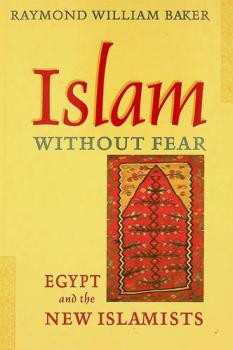
Islam without fear : Egypt and the new Islamists
\"For the last several decades an influential group of Egyptian scholars and public intellectuals has been having a profound effect in the Islamic world. Raymond Baker offers a portrait of these New Islamists - Islamic scholars, lawyers, judges, and journalists who provide the moral and intellectual foundations for a more fully realized Islamic community, open to the world and with full rights of active citizenship for women and non-Muslims.\" \"The New Islamists have a record of constructive engagement in Egyptian public life, balanced by an unequivocal critique of the excesses of Islamist extremists. Baker shows how the New Islamists are translating their thinking into action in education and the arts, economics and social life, and politics and foreign relations despite an authoritarian political environment.\" \"For the first time, Baker allows us to hear in context the most important New Islamist voices, including Muhammad al Ghazzaly, Kamal Abul Magd, Muhammad Selim al Awa, Fahmy Huwaidy, Tareq al Bishry, and Yusuf al Qaradawy - regarded by some as the most influential Islamic scholar in the world today.\"--Jacket.
Book

The first great awakening
The First Great Awakening, an unprecedented surge in Protestant Christian revivalism in the Eighteenth Century, sparked enormous of controversy at the time and has been a source of scholarly debate ever since. Few historians have sought to write a synthetic history of the First Great Awakening, and in recent decades it has been challenged as having happened at all, being either an exaggeration or an \"invention.\" The First Great Awakening expands the movement's geographical, theological, and sociopolitical scope. Rather than focus exclusively on the clerical elites, as earlier studies have done, it deals with them alongside ordinary people, and includes the experiences of women, African Americans, and Indians as the observers and participants they were. It challenges prevailing scholarly opinion concerning what the revivals were and what they meant to the formation of American religious identity and culture.
Cover image: NPG 131, George Whitefield by John Wollaston, oil on canvas, circa 1742. © National Portrait Gallery, London
eBook


Living Shi Ism: Instances of Ritualisation Among Islamist Men in Contemporary Iran
This book is about Iranian Islamism on grass-roots level. It provides a vivid, near-life portrait of young activist men who uphold this movement through their zealous support of revolutionary ideals and the present regime. It is based on interviews with a group of volunteers in the Iranian home guard movement known as basij during a period of four years. By focusing on beliefs and rituals of individual persons, it gives a unique picture of the shifting motifs behind Islamist engagement in today's Iran. The book contextualises the interviewed individuals within the wider framework of Iranian society and relates their stories to a discussion on ritual, emotion, embodiment and authority. It is of interest to anyone who seeks to understand the multifaceted driving forces behind Shi'ite Islamism today.
eBook