
Catalogue Search | MBRL


Are you sure you want to remove the book from the shelf?

{{itemTitle}}
4,858
result(s) for
"Religious dances"
Sort by:

Tantra, Ritual Performance, and Politics in Nepal and Kerala
For the first time, Tantra, Ritual Performance and Politics in Nepal and Kerala offers a comparative approach to Tantric mediumship as observed in two locales: Navadurgā rituals in Bhaktapur, Nepal, and Teyyāṭṭam in North Kerala.
eBook
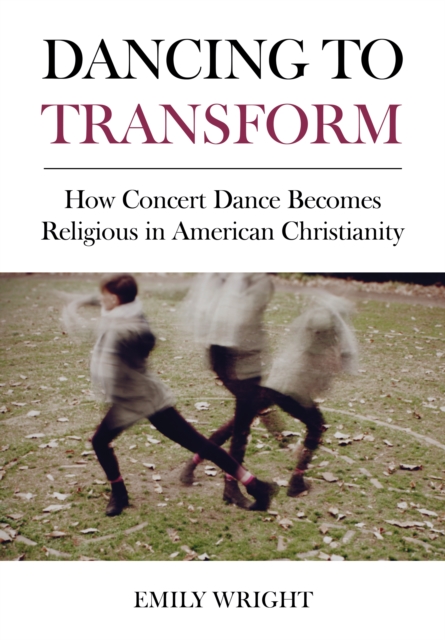
Dancing to Transform
Uses original studies of four dance companies to examine the religious lives of American Christians who are also professional dancers. Explores how practices of dancing and Christianity, and experience and performance contexts influence and shape approaches to creating, transforming and performing dance. 10 b/w illus.
eBook

Carrying the Word
In Carrying the Word: The Concheros Dance in Mexico City, the first full length study of the Concheros dancers, Susanna Rostas explores the experience of this unique group, whose use of dance links rural religious practices with urban post-modern innovation in distinctive ways even within Mexican culture, which is rife with ritual dances. The Concheros blend Catholic and indigenous traditions in their performances, but are not governed by a predetermined set of beliefs; rather they are bound together by long standing interpersonal connections framed by the discipline of their tradition. The Concheros manifest their spirituality by means of the dance. Rostas traces how they construct their identity and beliefs, both individual and communal, by its means. The book offers new insights into the experience of dancing as a Conchero while also exploring their history, organization and practices. Carrying the Word provides a new way for audiences to understand the Conchero's dance tradition, and will be of interest to students and scholars of contemporary Mesoamerica. Those studying identity, religion, and tradition will find this social-anthropological work particularly enlightening.
eBook

Synchrony and Cooperation
Armies, churches, organizations, and communities often engage in activities--for example, marching, singing, and dancing--that lead group members to act in synchrony with each other. Anthropologists and sociologists have speculated that rituals involving synchronous activity may produce positive emotions that weaken the psychological boundaries between the self and the group. This article explores whether synchronous activity may serve as a partial solution to the free-rider problem facing groups that need to motivate their members to contribute toward the collective good. Across three experiments, people acting in synchrony with others cooperated more in subsequent group economic exercises, even in situations requiring personal sacrifice. Our results also showed that positive emotions need not be generated for synchrony to foster cooperation. In total, the results suggest that acting in synchrony with others can increase cooperation by strengthening social attachment among group members.
Journal Article
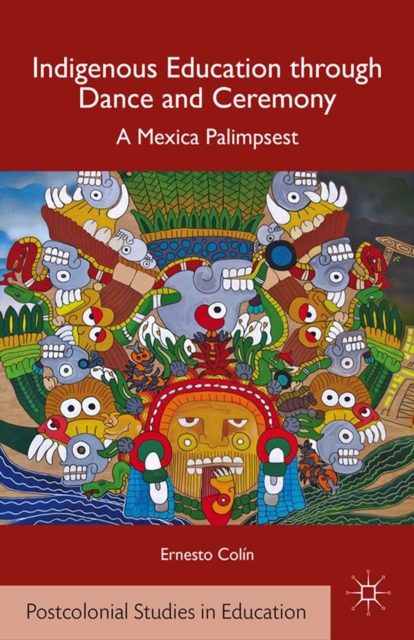
Indigenous Education through Dance and Ceremony
In the first book on Aztec dance in the United States, Ernesto Colín combines cultural anthropology, educational theory, and postcolonial theory to create an innovative, interdisciplinary, long-term ethnography of an Aztec dance circle and makes a case for the use of the metaphor of palimpsest as an ethnographic research tool.
eBook
Dancing Bodies of Devotion
Dancing Bodies of Devotion: Fluid Gestures in Bharata Natyam examines how Bharata Natyam, a traditionally Hindu storytelling dance form, moves across religious boundaries through both incorporating choreography on Buddhist, Christian, Muslim, and Jain themes and the pluralistic identities of participants. Dancers traverse religious boundaries by reformulating an aesthetic foundation based on performative rather than solely textual understandings of rasa, conventionally defined as a formula for how to physically craft emotion on stage. Through the ethnographic case studies of this volume, dancers of Bharata Natyam innovatively demonstrate how the rasa of devotion (bhakti rasa), surprisingly absent from classic dance-related texts, serves as the pivotal framework for expanding on their own interreligious thematic and interpretive possibilities. In contemporary Bharata Natyam, bhakti rasa is not just about enhancing religious experience; instead, these dancers choreographically adapt various religious identities and ideas in order to emphasize pluralistic cultural and ethical dimensions in their work. Through the dancing body, multiple religious and secular interpretations fluidly co-exist.
eBook
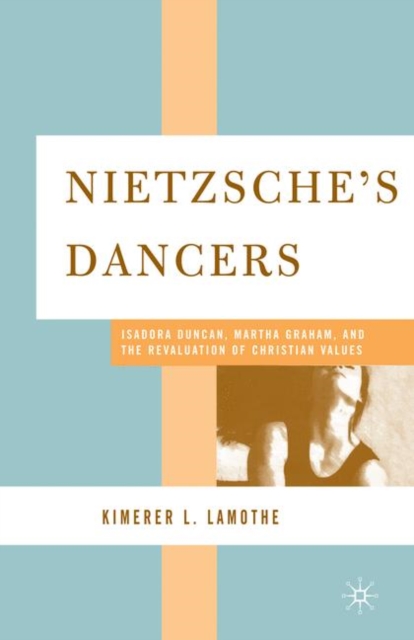
Nietzsche's dancers : Isadora Duncan, Martha Graham, and the revaluation of Christian values
This book investigates the role Nietzsche's dance images play in his project of \"revaluing all values\" alongside the religious rhetoric and subject matter evident in the work of Isadora Duncan and Martha Graham, who found justification and guidance in Nietzsche's texts for developing dance as a medium of religious expression.
eBook

Between Dancing and Writing
This book provides philosophical grounds for an emerging area of scholarship: the study of religion and dance. In the first part, LaMothe investigates why scholars in religious studies have tended to overlook dance, or rhythmic bodily movement, in favor of textual expressions of religious life. In close readings of Descartes, Kant, Schleiermacher, Hegel, and Kierkegaard, LaMothe traces this attitude to formative moments of the field in which philosophers relied upon the practice of writing to mediate between the study of religion,on the one hand, and theology,on the other.In the second part, LaMothe revives the work of theologian, phenomenologist, and historian of religion Gerardus van der Leeuw for help in interpreting how dancing can serve as a medium of religious experience and expression. In so doing, LaMothe opens new perspectives on the role of bodily being in religious life, and on the place of theology in the study of religion.
eBook

Carrying the Word
In Carrying the Word: The Concheros Dance in Mexico City, the first full length study of the Concheros dancers, Susanna Rostas explores the experience of this unique group, whose use of dance links rural religious practices with urban post-modern innovation in distinctive ways even within Mexican culture, which is rife with ritual dances. The Concheros blend Catholic and indigenous traditions in their performances, but are not governed by a predetermined set of beliefs; rather they are bound together by long standing interpersonal connections framed by the discipline of their tradition. The Concheros manifest their spirituality by means of the dance. Rostas traces how they construct their identity and beliefs, both individual and communal, by its means. The book offers new insights into the experience of dancing as a Conchero while also exploring their history, organization and practices. Carrying the Word provides a new way for audiences to understand the Conchero's dance tradition, and will be of interest to students and scholars of contemporary Mesoamerica. Those studying identity, religion, and tradition will find this social-anthropological work particularly enlightening.
eBook

Dancing Faith, Reproducing Identity: The Lord of Miracles Devotion Among Barcelona’s Migrants
The procession of El Señor de los Milagros is a multitudinous religious manifestation originally from Peru that tours numerous cities around the world each year in October. In Barcelona (Spain), the procession centers the diverse dances performed in honor of the “Cristo Moreno”, especially La Marinera, which is considered the cultural heritage of the Peruvian nation and is performed mainly by dance groups formed by new generations of Peruvian migrants’ children. This article analyzes the relationship between new generations and the practice of dancing La Marinera in honor of El Señor de los Milagros in Barcelona. Our main methodological strategy was an ethnography focused on the processions held in Barcelona (Spain) in 2016, 2017, 2018, and 2022. We also conducted in-depth interviews with key informants and focus groups and a review of documents and historical information. In this article, we will show that the performance of the Marinera dance in the procession can foster a connection between young dancers and the worship of the Lord of Miracles. Its performance promotes the appreciation and safeguarding of this practice as a distinctive cultural and national element of Peru, also allowing for a public staging oriented toward spectacle, framed in a transnational and globalized context.
Journal Article