
Catalogue Search | MBRL


Are you sure you want to remove the book from the shelf?

{{itemTitle}}
17,088
result(s) for
"Religious institutions"
Sort by:

Accounting and auditing standards for Islamic financial institutions
\"While accounting and audit functions are significantly regulated and standardized in conventional financial industries and activities, through the implementation of International Accounting Standards, and International Financial Reporting Standards, as well as other international, regional, and local regulations, this is not the case for Islamic financial organizations. Rather than having their own set of comprehensive accounting or auditing standards or policies, these are based, in some cases, on the Accounting and Auditing Organization for Islamic Financial Institutions (AAIOFI), the Islamic Financial Services Board (IFSB)'s standards and Shari'ah based local policies. This book is a timely and comprehensive overview of accounting and auditing standards within the doctrine of Shari'ah. It offers a significant contribution to the field and a wealth of technical know-how. It analyzes Islamic accounting and auditing both in theory and practice and from a distinctly international perspective. The chapters are arranged in a systematic and logical way making it easily accessible and engaging. The book evaluates the existing standards and widens the scope of the discourse to include Maqasid al-Shari'ah, Islamic accounting and audit models and standards, as well as, offering practical policy recommendations. The author presents a Shari'ah justified solution to Islamic Accounting and Audit and offers guidance on overcoming the challenges to implementing Islamic Accounting and Auditing Standards. The book is a unique and exhaustive guide and, as such, will be an invaluable resource for academics, researchers, students, policymakers, as well as, practitioners in accounting and auditing firms and financial institutions\"-- Provided by publisher.
Book

Islamic finance in the global economy
Islamic finance is growing at an astonishing rate and is now a 1200 billion industry, with operations in over 100 countries. This book explains the paradox of a system rooted in the medieval era thriving in the global economy. Coverage is exhaustively comprehensive, defining Islamic finance in its broadest sense to include banks, mutual funds, securities firms and insurance (or takaful) companies. The author places Islamic finance in the context of the global political and economic system and covers a wide variety of issues such as the underlying principles of Islamic finance, the range of Islamic financial products, and country differences. He also discusses a number of economic, political, regulatory and religious concerns and challenges. This second edition has been completely revised and updated to take into account the great changes and developments in the field in recent times. It includes the impact of the 9/11 and 7/7 terrorist attacks on the industry, the new forms of interaction with Western financial institutions, the emergence of innovative products such as sukuk, attempts by a broad range of financial centres - including Kuala Lumpur, London, Singapore, Bahrain and Dubai - to become global hubs of Islamic finance, and the repercussions of the 2008 global financial meltdown on Islamic institutions.
eBook

Against All Odds
Religious institutions are among the most segregated
organizations in American society. This segregation has long been a
troubling issue among scholars and religious leaders alike. Despite
attempts to address this racial divide, integrated churches are
very difficult to maintain over time. Why is this so? How can
organizations incorporate separate racial, ethnic, and cultural
groups? Should they? And what are the costs and rewards for people
and groups in such organizations? Following up on Michael O.
Emerson and Christian Smith's award-winning Divided by Faith,
Against All Odds breaks new ground by exploring
the beliefs, practices, and structures which allow integrated
religious organizations to survive and thrive despite their
difficulties. Based on six in-depth ethnographies of churches and
other Christian organizations, this engaging work draws on numerous
interviews, so that readers can hear first-hand the joys and
frustrations which arise from actually experiencing racial
integration. The book gives an inside, visceral sense of what it is
like to be part of a multiracial religious organization as well as
a theoretical understanding of these experiences.
eBook

Women's Work
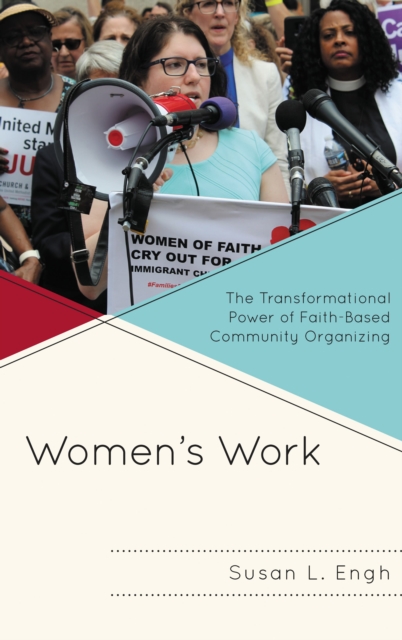
In Women's Work: The Transformational Power of Faith-Based Community Organizing, Susan L.Engh draws on her own experiences and those of twenty-one other women who work in the field of faith-based community organizing to describe how women have been transformed by their participation in organizing, and how they have been agents of transformation.
eBook


The Pacifying Effects of Local Religious Institutions: An Analysis of Communal Violence in Indonesia
This paper tests whether local religious institutions have a dampening effect on the probability of communal violence. It argues that a dense layer of institutions strengthens horizontal and vertical contacts and networks within religious communities. Horizontal linkages help to bridge social, economic, and ethnic divisions. Vertical contacts enable religious leaders to stay informed about communal grievances among their followers and to coordinate conflict resolution attempts. In our analysis of more than 60,000 villages in Indonesia, we are able to document a statistically significant and substantively meaningful negative effect of the density of local religious institutions on the probability of mass fighting. This effect is robust to the inclusion of an exhaustive list of confounding variables and alternative measures of violence. We present additional evidence that this pacifying effect of religious institutions is weaker or absent in conflicts that evolve along explicitly religious cleavages.
Journal Article

Islamic capital markets and products
Ensure Basel III compliance with expert analysis specific to Islamic Finance Islamic Capital Markets and Products provides a thorough examination of Islamic capital markets (ICM), with particular attention to the products that they offer and the legal and regulatory infrastructure within which they operate. Since Islamic banks act as asset managers, attention is paid to the regulatory challenges which they face in the light of Basel III, as regards both eligible capital and liquidity risk management. The authors of the chapters are professionals and practitioners, and write from experience. The editors also contributed to some of the chapters. The markets and products covered include Islamic equities, Islamic investment certificates (Sukūk) which are Shari'ah compliant alternatives to conventional bonds, and Islamic Collective Investment Schemes. The coverage of legal and regulatory issues includes an examination of the implications for ICM of securities laws and regulations and of Basel III, as well as collateralisation issues. Shari'ah compliance aspects, in terms both of the selection criteria for Islamic equities and of the 'purification' of impermissible components of income, are also examined in some detail, as are the implications of Basel III for eligible capital in general and for Shari'ah compliant capital instruments in particular. A similar analysis is also made of the implications of the Basel III requirements for liquidity risk management and high quality liquid assets (HQLA), including Shari'ah compliant HQLA. The book concludes with three case studies, two describing the ICM in Malaysia and Bahrain and a third which describes Sukūk issued as Shari'ah compliant capital instruments, followed by brief concluding remarks by the editors.
eBook