
Catalogue Search | MBRL


Are you sure you want to remove the book from the shelf?

{{itemTitle}}
21,213
result(s) for
"Religious movements"
Sort by:
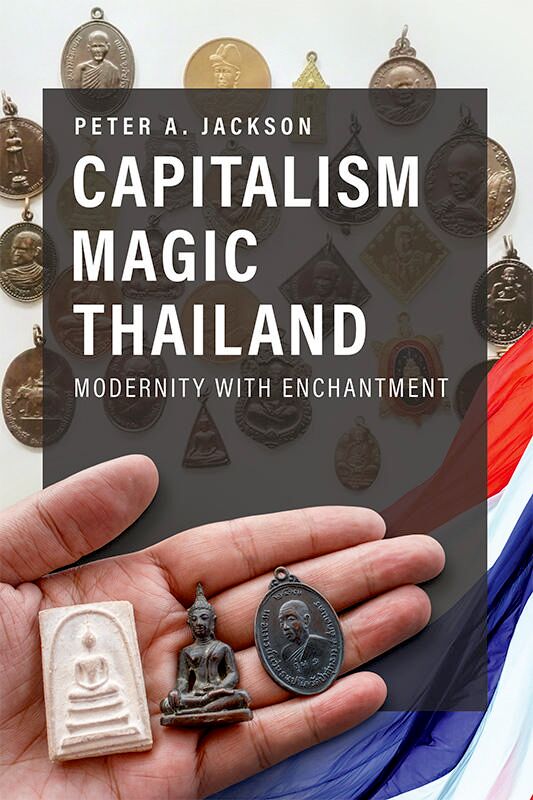
Capitalism magic Thailand : modernity with enchantment
By studying intersections among new cults of wealth, ritually empowered amulets and professional spirit mediumship—which have emerged together in Thailand's dynamic religious field in recent decades—Capitalism Magic Thailand explores the conditions under which global modernity produces new varieties of enchantment. Bruno Latour's account of modernity as a condition fractured between rationalizing ideology and hybridizing practice is expanded to explain the apparent paradox of new forms of magical ritual emerging alongside religious fundamentalism across a wide range of Asian societies. In Thailand, novel and increasingly popular varieties of ritual now form a symbolic complex in which originally distinct cults centred on Indian deities, Chinese gods and Thai religious and royal figures have merged in commercial spaces and media sites to sacralize the market and wealth production. Emerging within popular culture, this complex of cults of wealth, amulets and spirit mediumship is supported by all levels of Thai society, including those at the acme of economic and political power. New theoretical frameworks are presented in analyses that challenge the view that magic is a residue of premodernity, placing the dramatic transformations of cultic ritual centre stage in modern Thai history. It is concluded that modern enchantment arises at the confluence of three processes: neoliberal capitalism's production of occult economies, the auraticizing effects of technologies of mass mediatization, and the performative force of ritual in religious fields where practice takes precedence over doctrine.
eBook


Wild religion
Wild Religion is a wild ride through recent South African history from the advent of democracy in 1994 to the euphoria of the football World Cup in 2010. In the context of South Africa's political journey and religious diversity, David Chidester explores African indigenous religious heritage with a difference. As the spiritual dimension of an African Renaissance, indigenous religion has been recovered in South Africa as a national resource. Wild Religion analyzes indigenous rituals of purification on Robben Island, rituals of healing and reconciliation at the new national shrine, Freedom Park, and rituals of animal sacrifice at the World Cup. Not always in the national interest, indigenous religion also appears in the wild religious creativity of prison gangs, the global spirituality of neo-shamans, the ceremonial display of Zulu virgins, the ancient Egyptian theosophy in South Africa's Parliament, and the new traditionalism of South Africa's President Jacob Zuma. Arguing that the sacred is produced through the religious work of intensive interpretation, formal ritualization, and intense contestation, Chidester develops innovative insights for understanding the meaning and power of religion in a changing society. For anyone interested in religion, Wild Religion uncovers surprising dynamics of sacred space, violence, fundamentalism, heritage, media, sex, sovereignty, and the political economy of the sacred.
eBook

Becoming Freud : the making of a psychoanalyst
\"Becoming Freud is the story of the young Freud-Freud up until the age of fifty-that incorporates all of Freud's many misgivings about the art of biography. Freud invented a psychological treatment that involved the telling and revising of life stories, but he was himself skeptical of the writing of such stories. In this biography, Adam Phillips, whom the New Yorker calls \"Britain's foremost psychoanalytical writer,\" emphasizes the largely and inevitably undocumented story of Freud's earliest years as the oldest-and favored-son of Jewish immigrants from Eastern Europe and suggests that the psychoanalysis Freud invented was, among many other things, a psychology of the immigrant-increasingly, of course, everybody's status in the modern world. Psychoanalysis was also Freud's way of coming to terms with the fate of the Jews in Europe in the late nineteenth and early twentieth centuries. So as well as incorporating the writings of Freud and his contemporaries, Becoming Freud also uses the work of historians of the Jews in Europe in this significant period in their lives, a period of unprecedented political freedom and mounting persecution. Phillips concludes by speculating what psychoanalysis might have become if Freud had died in 1906, before the emergence of a psychoanalytic movement over which he had to preside\"-- Provided by publisher.
Book

Turning away from terrorism: Lessons from psychology, sociology, and criminology
Although research on violent extremism traditionally focuses on why individuals become involved in terrorism, recent efforts have started to tackle the question of why individuals leave terrorist groups. Research on terrorist disengagement, however, remains conceptually and theoretically underdeveloped. In an effort to enhance our understanding of disengagement from terrorism and pave the way for future empirical work, this article provides a multidisciplinary review of related research from psychology, sociology, and criminology. Significant promise for moving beyond the existing push/pull framework is found in Rusbult and colleagues' investment model from psychology and Ebaugh's research on voluntary role exit from sociology. Rusbult's investment model offers insight into when and why individuals disengage from terrorism, while accounting for individual, group, and macro-level differences in the satisfaction one derives from involvement, the investments incurred, and the alternatives available. Ebaugh's research on voluntary role exit provides a deeper understanding of how people leave, including the emotions and cuing behavior likely to be involved. The article highlights the strengths and limitations of these frameworks in explaining exit and exit processes across a variety of social roles, including potentially the terrorist role, and lends additional insights into terrorist disengagement through a review of related research on desistance from crime, disaffiliation from new religious movements, and turnover in traditional work organizations.
Journal Article

Unsettling truths : the ongoing, dehumanizing legacy of the Doctrine of Discovery
\"You cannot discover lands already inhabited. In this prophetic blend of history, theology, and cultural commentary, Mark Charles and Soong-Chan Rah reveal the damaging effects of the \"Doctrine of Discovery,\" which institutionalized American triumphalism and white supremacy. This book calls our nation and churches to a truth-telling that will expose past injustices and open the door to conciliation and true community\"-- Provided by publisher.
Book

Handbook of Conspiracy Theory and Contemporary Religion
The Handbook of Conspiracy Theories and Contemporary Religion is the first collection to offer a comprehensive overview of conspiracy theories and their relationship with religion(s), taking a global and interdisciplinary perspective.
eBook


Religious Transhumanism as a New Religious Movement: Sketching a Model of the Development of Religious Transhumanism
This essay proposes a new model for understanding religious transhumanism by extending existing frameworks that have been useful for predicting the success of new religious movements (NRMs). This paper focuses on the Mormon Transhumanist Association as a case of religious transhumanism that is incongruent with existing models of NRMs, thereby highlighting the limitations of these models. First, I demonstrate how the Morman Transhumanist Association challenges religious scholars’ conventional concepts for understanding NRMs, particularly within anthropology, cosmology, and eschatology. Then, I present a model that effectively accounts for the unique characteristics of religious transhumanist groups, thereby demonstrating and addressing the field’s current lack of an explanatory framework.
Journal Article