
Catalogue Search | MBRL


Are you sure you want to remove the book from the shelf?

{{itemTitle}}
29,319
result(s) for
"Religious orders"
Sort by:


The Destruction and Recovery of Monte Cassino, 529-1964
Between the sixth and twentieth centuries, the Benedictine Abbey of Monte Cassino (est. 529) experienced a cycle of atrocities which forever transformed its identity. This book examines how such a tumultuous history has been constructed, remembered, and represented from the Middle Ages to the present day. It uses this singular and pivotal case to analyse the historical process of remembering and its impact on modern representations of the past. Exactly how Monte Cassino is remembered is distinctive and diagnostic. The abbey is recognizable today as a beacon of western civilization, culture, and learning precisely because of its 'destruction tradition' over fourteen centuries. The Destruction and Recovery of Monte Cassino, 529.1964 asks how the abbey's fragmented past has been ideologically, politically, and culturally constituted and preserved; how its experience with destruction and suffering . and recovery and rebirth . has become incorporated into a modern narrative of progress and triumph.
eBook


Men of God
A broadly researched cultural history,
Men of God offers a path to understanding the concept of
religious masculinity through an intimate approach to the study
of friars and lay brothers in colonial Mexico. Though other
scholars have focused on the missionary work of the Augustinian,
Franciscan, and Dominican friars, few have addressed their
everyday lives and how the internal discipline of their orders
shaped them. In
Men of God Asunción Lavrin offers a sweeping yet
intimate history of the mendicant friars in New Spain from the
late sixteenth through the eighteenth centuries. Focusing on
these individuals' lives from childhood through death, Lavrin
explores contemporaneous ideas, from how to raise a boy to the
friars' training as novices, and the similarities and differences
in the life experiences of lay brothers and ordained members. She
discusses their sexuality to reveal the challenges and failures
of religious manhood, as well as the drive behind their
missionary duties, especially in the late seventeenth through the
eighteenth centuries.
Men of God also explores the concepts and realities of
martyrdom and death, significant elements in the spirituality of
the mendicant friars of colonial Mexico.
eBook

The wandering mind : what medieval monks tell us about distraction
\"A revelatory account of how Christian monks identified distraction as a fundamental challenge, and how their efforts to defeat it can inform ours, more than a millennium later\"-- Provided by publisher.
BOOK

Discipline and debate
The Dalai Lama has represented Buddhism as a religion of non-violence, compassion, and world peace, but this does not reflect how monks learn their vocation. This book shows how monasteries use harsh methods to make monks of men, and how this tradition is changing as modernist reformers—like the Dalai Lama—adopt liberal and democratic ideals, such as natural rights and individual autonomy. In the first in-depth account of disciplinary practices at a Tibetan monastery in India, Michael Lempert looks closely at everyday education rites—from debate to reprimand and corporal punishment. His analysis explores how the idioms of violence inscribed in these socialization rites help produce educated, moral persons but in ways that trouble Tibetans who aspire to modernity. Bringing the study of language and social interaction to our understanding of Buddhism for the first time, Lempert shows and why liberal ideals are being acted out by monks in India, offering a provocative alternative view of liberalism as a globalizing discourse.
eBook

Jonas of Bobbio and the legacy of Columbanus : sanctity and community in the seventh century
\"Jonas of Bobbio's life mirrored many of the transformations of the seventh century, while his three saints' Lives provide a window into the early medieval Age of Saints and the monastic and political worlds of Merovingian Gaul and Lombard Italy\"-- Provided by publisher.
Book

Monastic Reform as Process
The history of monastic institutions in the Middle Ages may at first appear remarkably uniform and predictable. Medieval commentators and modern scholars have observed how monasteries of the tenth to early twelfth centuries experienced long periods of stasis alternating with bursts of rapid development known as reforms. Charismatic leaders by sheer force of will, and by assiduously recruiting the support of the ecclesiastical and lay elites, pushed monasticism forward toward reform, remediating the inevitable decline of discipline and government in these institutions. A lack of concrete information on what happened at individual monasteries is not regarded as a significant problem, as long as there is the possibility to reconstruct the reformers' ''program.'' While this general picture makes for a compelling narrative, it doesn't necessarily hold up when one looks closely at the history of specific institutions.
InMonastic Reform as Process, Steven Vanderputten puts the history of monastic reform to the test by examining the evidence from seven monasteries in Flanders, one of the wealthiest principalities of northwestern Europe, between 900 and 1100. He finds that the reform of a monastery should be studied not as an \"exogenous shock\" but as an intentional blending of reformist ideals with existing structures and traditions. He also shows that reformist government was cumulative in nature, and many of the individual achievements and initiatives of reformist abbots were only possible because they built upon previous achievements. Rather than looking at reforms as \"flashpoint events,\" we need to view them as processes worthy of study in their own right. Deeply researched and carefully argued,Monastic Reform as Processwill be essential reading for scholars working on the history of monasteries more broadly as well as those studying the phenomenon of reform throughout history.
eBook

The monastic landscape of late antique Egypt : an archaeological reconstruction
Darlene L. Brooks Hedstrom offers a new history of the field of Egyptian monastic archaeology. It is the first study in English to trace how scholars identified a space or site as monastic within the Egyptian landscape and how such identifications impacted perceptions of monasticism. Brooks Hedstrom then provides an ecohistory of Egypt's tripartite landscape to offer a reorientation of the perception of the physical landscape. She analyzes late-antique documentary evidence, early monastic literature, and ecclesiastical history before turning to the extensive archaeological evidence of Christian monastic settlements. In doing so, she illustrates the stark differences between idealized monastic landscape and the actual monastic landscape that was urbanized through monastic constructions. Drawing upon critical theories in landscape studies, materiality and phenomenology, Brooks Hedstrom looks at domestic settlements of non-monastic and monastic settlements to posit what features makes monastic settlements unique, thus offering a new history of monasticism in Egypt.
Book
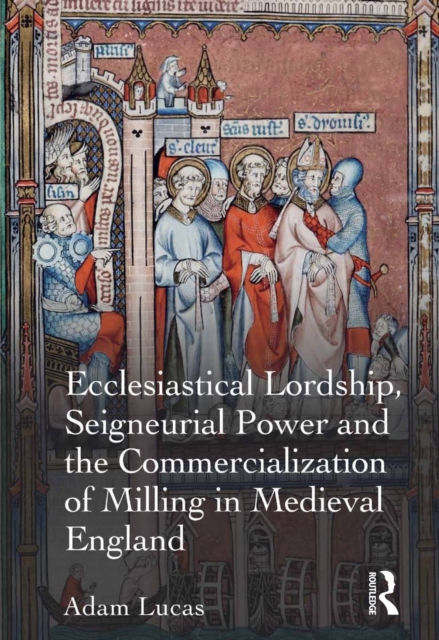
Ecclesiastical Lordship, Seigneurial Power and the Commercialization of Milling in Medieval England
This is the first detailed study of the role of the Church in the commercialization of milling in medieval England. Focusing on the period from the late eleventh to the mid sixteenth centuries, it examines the estate management practices of more than thirty English religious houses founded by the Benedictines, Cistercians, Augustinians and other minor orders, with an emphasis on the role played by mills and milling in the establishment and development of a range of different sized episcopal and conventual foundations. Contrary to the views espoused by a number of prominent historians of technology since the 1930s, the book demonstrates that patterns of mill acquisition, innovation and exploitation were shaped not only by the size, wealth and distribution of a house's estates, but also by environmental and demographic factors, changing cultural attitudes and legal conventions, prevailing and emergent technical traditions, the personal relations of a house with its patrons, tenants, servants and neighbours, and the entrepreneurial and administrative flair of bishops, abbots, priors and other ecclesiastical officials.
eBook