
Catalogue Search | MBRL


Are you sure you want to remove the book from the shelf?

{{itemTitle}}
28,851
result(s) for
"Religious war"
Sort by:


American Crusade
When is a war a holy crusade? And when does
theology cause Christians to condemn violence? In American
Crusade , Benjamin Wetzel argues that the Civil War, the
Spanish-American War, and World War I shared a cultural meaning for
white Protestant ministers in the United States, who considered
each conflict to be a modern-day crusade. American Crusade
examines the \"holy war\" mentality prevalent between 1860 and 1920,
juxtaposing mainline Protestant support for these wars with more
hesitant religious voices: Catholics, German-speaking Lutherans,
and African American Methodists. The specific theologies and social
locations of these more marginal denominations made their
ministries highly critical of the crusading mentality. Religious
understandings of the nation, both in support of and opposed to
armed conflict, played a major role in such ideological
contestation. Wetzel's book questions traditional periodizations
and suggests that these three wars should be understood as a unit.
Grappling with the views of America's religious leaders,
supplemented by those of ordinary people, American Crusade
provides a fresh way of understanding the three major American wars
of the late nineteenth and early twentieth centuries.
eBook


God's Almost Chosen Peoples
Throughout the Civil War, soldiers and civilians on both sides of the conflict saw the hand of God in the terrible events of the day, but the standard narratives of the period pay scant attention to religion. Now, inGod's Almost Chosen Peoples, Lincoln Prize-winning historian George C. Rable offers a groundbreaking account of how Americans of all political and religious persuasions used faith to interpret the course of the war.Examining a wide range of published and unpublished documents--including sermons, official statements from various churches, denominational papers and periodicals, and letters, diaries, and newspaper articles--Rable illuminates the broad role of religion during the Civil War, giving attention to often-neglected groups such as Mormons, Catholics, blacks, and people from the Trans-Mississippi region. The book underscores religion's presence in the everyday lives of Americans north and south struggling to understand the meaning of the conflict, from the tragedy of individual death to victory and defeat in battle and even the ultimate outcome of the war. Rable shows that themes of providence, sin, and judgment pervaded both public and private writings about the conflict. Perhaps most important, this volume--the only comprehensive religious history of the war--highlights the resilience of religious faith in the face of political and military storms the likes of which Americans had never before endured.
eBook


Marcus Aurelius' Rain Miracle and the Marcomannic Wars
The rain and lightning miracles are the best-known events of Marcus Aurelius' northern wars. Several pagan and Christian versions existed in Antiquity. The author studies and publishes for the first time all the sources and the development of the legend from Antiquity to the 14th century.
eBook

The Babylon Complex: Theopolitical Fantasies of War, Sex, and Sovereignty
Babylon is a surprisingly multivalent symbol in U.S. culture and politics. Political citations of Babylon range widely, from torture at Abu Ghraib to depictions of Hollywood glamour and decadence. In political discourse, Babylon appears in conservative ruminations on democratic law, liberal appeals to unity, Tea Party warnings about equality, and religious advocacy for family values. A composite biblical figure, Babylon is used to celebrate diversity and also to condemn it, to sell sexuality and to regulate it, to galvanize war and to worry about imperialism. Erin Runions explores the significance of these shifts and contradictions, arguing that together they reveal a theopolitics that tries to balance the drive for U.S. dominance with the countervailing ideals and subjectivities of economic globalization. Examining the confluence of cultural formations, biblical interpretations, and (bio)political philosophies, The Babylon Complex shows how theopolitical arguments for war, sexual regulation, and political control both assuage and contribute to anxieties about waning national sovereignty. Theoretically sophisticated and engaging, this remarkable book complicates our understanding of how the Bible affects U.S. political ideals and subjectivities.
eBook
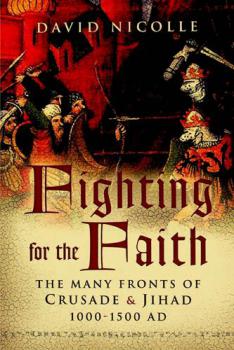
Fighting for the faith : the many fronts of medieval crusade and Jihad, 1000-1500 AD
\"Fighting between Christians and Muslims in the medieval period is often seen in the narrow context of the battle for the Holy Land. Other points of conflict tend to be ignored. But, as David Nicolle's thought provoking survey shows, religions clashed across the medieval world - in the Mediterranean and the Therian peninsula, in the Near East, in Central Asia, India, the Balkans, Anatolia, Russia, the Baltic and Africa. Over 500 years, the struggle in reach theatre of conflict had its own character - methods of warfare differed and developed in different ways and were influenced by local traditions and circumstances. And these campaigns were not waged solely against Christian or Islamic enemies, but against pagan, non-Christian or non-Islamic peoples. As he tells the story of Crusade and Jihad, and describes the organization and tactics of the armies involved, David Nicolle opens up a new understanding of the phenomenon of holy war.\"--Jacket.
Book

Just wars, holy wars, and jihads : Christian, Jewish, and Muslim encounters and exchanges
This book explores the development of ideas of morally justified or legitimate war in Western and Islamic civilizations. Historically, these ideas have been grouped under three labels: just war, holy war, and jihad. The twenty chapters of this book explore two broad questions: What historical evidence exists that Christian and Jewish writers on just war and holy war and Muslim writers on jihad knew of the other tradition? What is the evidence in treatises, chronicles, speeches, ballads, and other historical records, or in practice, that either tradition influenced the other? The book surveys the period from the rise of Islam in the early seventh century to the present day. Part One surveys the impact of the early Islamic conquests upon Byzantine, Syriac, and Muslim thinking on justified war. Part Two probes developments during the Crusades. Part Three focuses on the early modern period in Europe and the Ottoman Empire, followed by analysis of the era of European imperialism in Part Four. Part Five brings the discussion into the present period, with chapters analyzing the impact of international law and terrorism on conceptions of just war and jihad.
eBook