
Catalogue Search | MBRL


Are you sure you want to remove the book from the shelf?

{{itemTitle}}
464
result(s) for
"Renaissance Sources."
Sort by:


The Renaissance and Reformation in Northern Europe
This updated version of Humanism and the Northern Renaissance now includes over 60 documents exploring humanist and Renaissance ideals, the zeal of religion, and the wealth of the new world. Together, the sources illuminate the chaos and brilliance of the historical period—as well as its failures and inconsistencies.
The reader has been thoroughly revised to meet the needs of the undergraduate classroom. Over 30 historical documents have been added, including material by Martin Luther, John Calvin, John Knox, William Shakespeare, Christopher Columbus, Miguel de Cervantes, and Galileo Galilei. In the introduction, Bartlett and McGlynn identify humanism as the central expression of the European Renaissance and explain how this idea migrated from Italy to northern Europe. The editors also emphasize the role of the church and Christianity in northern Europe and detail the events leading up to the Reformation. A short essay on how to read historical documents is included. Each reading is preceded by a short introduction and ancillary materials can be found on UTP's History Matters website (www.utphistorymatters.com).
eBook


Love & death in Renaissance Italy
Gratuitous sex. Graphic violence. Lies, revenge, and murder. Before there was digital cable or reality television, there was Renaissance Italy and the courts in which Italian magistrates meted justice to the vicious and the villainous, the scabrous and the scandalous. Love and Death in Renaissance Italy retells six piquant episodes from the Italian court just after 1550, as the Renaissance gave way to an era of Catholic reformation. Each of the chapters in this history chronicles a domestic drama around which the lives of ordinary Romans are suddenly and violently altered. You might read the gruesome murder that opens the book—when an Italian noble takes revenge on his wife and her bastard lover as he catches them in delicto flagrante—as straight from the pages of Boccaccio. But this tale, like the other stories Cohen recalls here, is true, and its recounting in this scintillating work is based on assiduous research in court proceedings kept in the state archives in Rome. Love and Death in Renaissance Italy contains stories of a forbidden love for an orphan nun, of brothers who cruelly exact a will from their dying teenage sister, and of a malicious papal prosecutor who not only rapes a band of sisters, but turns their shambling father into a pimp! Cohen retells each cruel episode with a blend of sly wit and warm sympathy and then wraps his tales in ruminations on their lessons, both for the history of their own time and for historians writing today. What results is a book at once poignant and painfully human as well as deliciously entertaining.
eBook

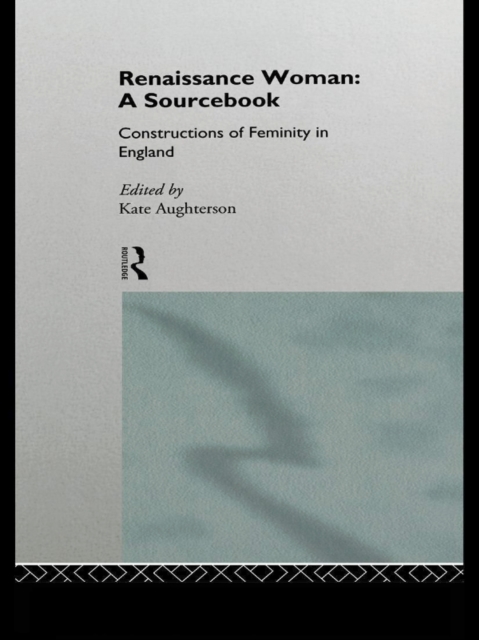
Renaissance Woman: A Sourcebook
Renaissance Woman: A Sourcebook is an invaluable collection of accounts of women and femininity in early modern England. The volume is divided thematically into nine sections, each with an accessible introduction, notes on sources and an annotated bibliography. The sections are: * Theology * Biology * Conduct * Sexuality and Motherhood * Politics and Law * Education * Work * Writing and Speaking * Feminism Renaissance Woman: A Sourcebook brings together sources ranging from medical documents and political pamphlets to sermons and the Bible, as well as literary sources. Providing a historical context to issues of gender in the Renasissance, it will be essential reading for students of the period, gender studies and cultural history.
eBook

The Ideas of Man and Woman in Renaissance France
The Ideas of Man and Woman in Renaissance France provides the first comprehensive comparison of the printed debates in the 1500s over the superiority or inferiority of woman - the Querelle des femmes - and the dignity and misery of man. Analysing these writings side by side, Lyndan Warner reveals the extent to which Renaissance authors borrowed commonplaces from both traditions as they praised or blamed man or woman and habitually considered opposite and contrary points of view. In the law courts reflections on the virtues and vices of man and woman had a practical application-to win cases-and as Warner demonstrates, Parisian lawyers employed this developing rhetoric in family disputes over inheritance and marriage, and amplified it in the published versions of their pleadings. Tracing these ideas and modes of thinking from the writer's quill to the workshops and boutiques of printers and booksellers, Warner uses probate inventories to follow the books to the households of their potential male and female readers. Warner reveals the shifts in printed discussions of human nature from the 1500s to the early 1600s and shows how booksellers adapted the ways they marketed and sold new genres such as essays and lawyers' pleadings.
eBook

Scholars and Poets Talk About Queens
\"Scholars and Poets Talk About Queens is a lively and erudite collection, unusual in an especially appealing way: not only are there essays about a range of queens and how they were represented in the Middle Ages and Renaissance through primary accounts, chronicles, and literary representations, but the book also contains modern poetry and short plays about these same queens, allowing readers to understand and appreciate them both intellectually and emotionally. Queens include such famous and fascinating women as Hecuba, Cleopatra, the Empress Matilda, Margaret of Anjou, Catherine of Aragon, Mary Stuart, and Queen Elizabeth I, and Grace O'Malley, a pirate queen. One can find, for example, an essay on Mary Stuart's responses to her widowhoods paired with Mary's lamentation from the afterlife. After reading the analysis of the Empress Matilda's efforts to gain the throne of England, one can also see the character of the much older Matilda playing chess with her daughter-in-law Eleanor of Aquitaine\"-- Provided by publisher.
Book

Collected Letters of a Renaissance Feminist
Renaissance writer Laura Cereta (1469–1499) presents feminist issues in a predominantly male venue—the humanist autobiography in the form of personal letters. Cereta's works circulated widely in Italy during the early modern era, but her complete letters have never before been published in English. In her public lectures and essays, Cereta explores the history of women's contributions to the intellectual and political life of Europe. She argues against the slavery of women in marriage and for the rights of women to higher education, the same issues that have occupied feminist thinkers of later centuries. Yet these letters also furnish a detailed portrait of an early modern woman's private experience, for Cereta addressed many letters to a close circle of family and friends, discussing highly personal concerns such as her difficult relationships with her mother and her husband. Taken together, these letters are a testament both to an individual woman and to enduring feminist concerns.
eBook