
Catalogue Search | MBRL


Are you sure you want to remove the book from the shelf?

{{itemTitle}}
3,223
result(s) for
"Renaissance humanism"
Sort by:


Cultural Transformation in Samuel Whitings Harvard Oration of 1649
Samuel Whiting (1597-1679), a graduate of Emmanuel College, Cambridge (BA, 1616; MA, 1620) and pastor at Lynn, Massachusetts, from 1636 to his death, delivered the Harvard commencement oration in 1649, and in his address he quotes three Arabic proverbs from Kitab al-amthal sev proverbiorvm Arabicorvm centuria duae (first published in Leiden in 1614), a book of two hundred Arabic proverbs, printed in Arabic with Latin translations and commentary on the proverbs by the foremost European Arabist of the period, Thomas Erpenius (Thomas van Erpe) and the great humanist scholar Joseph Scaliger. A comparison of Kitab al-amthal with the text of the proverbs as presented by Whiting shows that he extensively edited the Leiden text. These textual changes reveal how and why an early seventeenth-century European imprint with multiple interpretive layers and rich with philological commentary was transformed into a very different text in response to the cultural dynamics of mid-seventeenth-century New England.
Journal Article

On the Image of Jews in Latin Humanist Poetry
This study is devoted to the depiction of Jews, Jewishness and the stereotypes connected therewith in Latin humanist poetry (from approximately the first third of the 16th century to the beginning of the 17th century). An analysis of the texts of ‘occasional poetry’ confirmed the predominant antiJewish discourse which pervaded the intellectual circles to whom the authors of this poetry mostly belonged during the time of Renaissance humanism.
Journal Article


Animating the Past: History-Making, Memory-Making, Law-Making
This paper examines certain history-making and memory-making practices that allow us to see how the past may be animated. These practices are: first, the Ancient Greek sophistic arts, as exemplified by Gorgias’s Encomium of Helen, and as revived, in dialogue form, in Renaissance humanism; and second, Ancient Greek, Ancient Roman, and medieval memory arts, with particular attention to the composite generative imagery of those arts. Animating the past – as these practices of history-making and memory-making do – is of great epistemic and political value to communities: it enables acts of argument and judgement, and, more generally, it is vital for vibrant democracies. The paper signals, albeit only briefly, how these practices are also intertwined with legal history, and in particular the history of legal reasoning, suggesting some ways forward, in future work, for investigating the entangled histories of history-making, memory-making, and law-making.
Journal Article


Writing History in Renaissance Sicily: The Formation of Sicilian National Identity in the Work of Tommaso Fazello
This study illuminates the process of writing history in Renaissance Sicily. While Italian historians have offered revisionist histories of Sicily in the Medieval period, the same cannot be said for the Sicilian Renaissance. The existing gap in our understanding of Renaissance historiography with regard to Sicily is the result of a much more expansive tradition that can be traced from Dante and Petrarch to later Italian national histories such as those of Francesco DeSanctis and Benedetto Croce, not to mention Jacob Burckhardt. Anglophone historiography of the Renaissance also reflects this trend of overlooking Sicilian historians of this period. We are left with an incomplete understanding of Sicilian history and culture. I offer a different picture of culture in Sicily during this period by examining how humanists of the time wrote Sicilian history and, as a result, constructed Sicilianità, a term I have chosen to discuss the construction of a unique Sicilian national identity. The work of the Dominican friar Tommaso Fazello (1498–1570) is particularly helpful in teasing out the broader pattern in Sicilian intellectual thought of a selective use of history, philosophy, and literature in order to construct Sicilianità.
Journal Article

A short history of the Renaissance in Europe
\"A Short History of the Renaissance is a new edition of The Renaissance in Europe previously published by Laurence King Press and McGraw Hill. Readers will learn not only about the Renaissance that unfolded in Europe between 1300 and 1700, but also about the problem of cultural renewal: why it happens; why its energies are momentous, and how it changes everything all around it. This illustrated overview is a social history of the Renaissance in Europe. There are over 100 colour images. Key terms are defined in the Introduction. There are 25 Focus questions that expand on a specific topic such as Florence, prostitutes, and women and love. The 22 Voices features offer students the opportunity to read primary sources. 18 miniboxes contain statistical information. The book included timelines, a glossary, and Suggested Readings.\"-- Provided by publisher.
Book
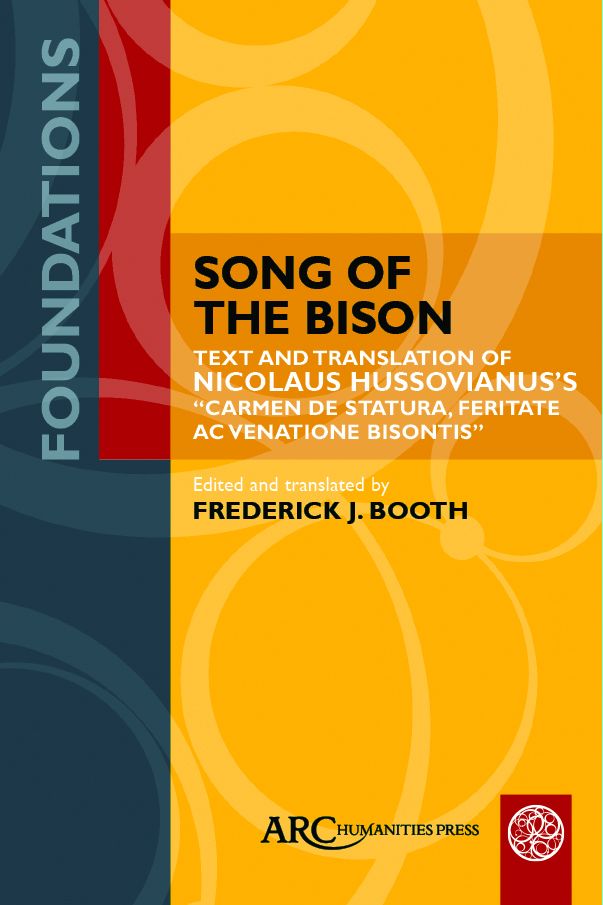
Song of the bison
In 1521, the young Polish diplomat Nicolaus Hussovianus was watching the bullfights at a papal celebration in Rome. He remarked that the spectacle reminded him of the bison hunts he had witnessed as a young man in the Polish-Lithuanian woods, and his employer then asked Hussovianus to write a poem about the bison hunts, to accompany the gift of a stuffed bison for Pope Leo X, an avid hunter. Song of the Bison is the first complete English translation of Hussovianus’s Latin poem, which is claimed as a national epic by Lithuania, Belarus, and Poland. The exciting poem discusses not only Hussovianus’s own experience in hunting and observing the European bison, but also the political, social, religious, and aesthetic developments of sixteenth-century Europe, and ends with an urgent plea for unity among European states threatened by foreign invasions.
eBook