
Catalogue Search | MBRL


Are you sure you want to remove the book from the shelf?

{{itemTitle}}
20,303
result(s) for
"Renaissance literature"
Sort by:

Art and culture of the Renaissance world
Introduces the reader to the Renaissance through its art and culture.
Book

The Burley manuscript
The Burley manuscript is a miscellany compiled in the late sixteenth and early seventeenth century, unique in size and variety. In this study, annotated transcriptions are given of all of the private letters in English and all the English verse. Incipit transcriptions and identification are provided for each of the other items, including those in foreign languages. The history and provenance of the collection are described in detail, with lengthy notes on memorial transcription of verse and prose, and the clandestine interception of letters. The book makes available texts, annotations and commentary that will have an impact on a wide range of scholarship. It will be found useful to literary scholars, editors, and social historians, illuminating such diverse subjects as the circulation of verse, the correspondence of John Donne, the self-fashioning of English gentlemen after the classical Romans of their class and the government's paranoiac spying on its own citizens.
eBook

The Renaissance
\"'Renaissance' means 'rebirth' in French. The Renaissance period of European history is aptly named because people had a rebirth, or renewed, interest in the ideas of ancient Greeks and Romans. This led to a new age of science and art. Readers will learn about the many aspects of the Renaissance as well as the prominent figures of this era, including Nicolaus Copernicus, Leonardo da Vinci, and others. A timeline helps summarize the crucial dates of the Renaissance while stunning images bring the period to life.\"--Provided by publisher.
Book

Widow City
Widow City: Gender, Emotion, and Community in the Italian Renaissance investigates the ever-evolving role of the widow in medieval and early modern Italian literature, from canonical authors such as Dante, Petrarch, and Boccaccio, to the numerous widowed writers who rose to prominence in the sixteenth century—including Vittoria Colonna, Veronica Gambara, and Francesca Turina—and radically changed the conversation on public mourning. Engaging with broader intellectual discussions around gender, the history of emotions, the politics of mourning, and the construction of community, Widow City argues that widows served as key models demonstrating to readers not just how to mourn, but how to live well after devastating loss. At the same time, widows were figures of great anxiety: their status as unattached women, and the public performance of their grief, were viewed as very real threats to the stability of the social order. They are thus key to broader intellectual understandings of community and civic life in the Italian Middle Ages and Renaissance.
eBook

Timeline of the Renaissance
Chronicles the important events, people, and places in Europe during the Renaissance, including the invention of the printing press, and advances in art, science, and religion.
Book

Discourses and Representations of Friendship in Early Modern Europe, 1500-1700
Interdisciplinary in scope, this collection examines the varied and complex ways in which early modern Europeans imagined, discussed and enacted friendship, a fundamentally elective relationship between individuals otherwise bound in prescribed familial, religious and political associations. The volume is carefully designed to reflect the complexity and multi-faceted nature of early modern friendship, and each chapter comprises a case study of specific contexts, narratives and/or lived friendships. Contributors include scholars of British, French, Italian and Spanish culture, offering literary, historical, religious, and political perspectives. Discourses and Representations of Friendship in Early Modern Europe, 1500-1700 lays the groundwork for a taxonomy of the transformations of friendship discourse in Western Europe and its overlap with emergent views of the psyche and the body, as well as of the relationship of the self to others, classes, social institutions and the state.
eBook

The Renaissance artists : with history projects for kids
Who were the artists of the Renaissance? Why do we still learn from Renaissance art? Using an inquiry-based approach, readers are introduced to the Italian Renaissance as it was experienced by five of the world's most renowned artists: Sandro Botticelli, Leonardo da Vinci, Michelangelo, Raphael, and Titian. Readers will learn about the biographies of these Renaissance artists through the perspective of three to four major works of art that not only defined that artist's career but created a cultural legacy that still resonates in the world today.
Book

Food Culture and Literary Imagination in Early Modern Italy
As the long sixteenth century came to a close, new positive ideas of gusto/ taste opened a rich counter vision of food and taste where material practice, sensory perceptions and imagination contended with traditional social values, morality, and dietetic/medical discourse. Exploring the complex and evocative ways the early modern Italian culture of food was imagined in the literature of the time, Food Culture and the Literary Imagination in Early Modern Italy reveals that while a moral and disciplinary vision tried to control the discourse on food and eating in medical and dietetic treatises of the sixteenth century and prescriptive literature, a wide range of literary works contributed to a revolution in eating and taste. In the process long held visions of food and eating, as related to social order and hierarchy, medicine, sexuality and gender, religion and morality, pleasure and the senses, were questioned, tested and overturned, and eating and its pleasures would never be the same.
eBook

Women in the Renaissance
This book investigates how women struggled for identity, influence, power, and recognition in a society dominated by men.
Book
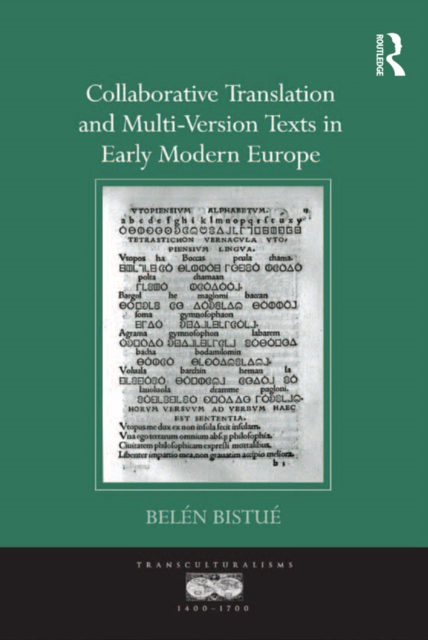
Collaborative Translation and Multi-Version Texts in Early Modern Europe
Focusing on team translation and the production of multilingual editions, and on the difficulties these techniques created for Renaissance translation theory, this book interrogates textual practices that were widespread in medieval and Renaissance Europe but have been excluded from translation and literary history. Comparing actual translation texts and strategies with the forceful theoretical demands for unity that characterize the reflections of early modern translators, the author challenges assumptions frequently made in translation and literary analysis.
eBook