
Catalogue Search | MBRL


Are you sure you want to remove the book from the shelf?

{{itemTitle}}
4,706
result(s) for
"Renewable energy sources -- Environmental aspects"
Sort by:


Renewable Energy Sources and Climate Change Mitigation
This Intergovernmental Panel on Climate Change Special Report (IPCC-SRREN) assesses the potential role of renewable energy in the mitigation of climate change. It covers the six most important renewable energy sources – bioenergy, solar, geothermal, hydropower, ocean and wind energy – as well as their integration into present and future energy systems. It considers the environmental and social consequences associated with the deployment of these technologies and presents strategies to overcome technical as well as non-technical obstacles to their application and diffusion. SRREN brings a broad spectrum of technology-specific experts together with scientists studying energy systems as a whole. Prepared following strict IPCC procedures, it presents an impartial assessment of the current state of knowledge: it is policy relevant but not policy prescriptive. SRREN is an invaluable assessment of the potential role of renewable energy for the mitigation of climate change for policymakers, the private sector and academic researchers.
eBook

Sustainable energy and environment : an earth system approach
\"Sustainable Energy and Environment: An Earth System Approach provides a holistic understanding of Earth, energy, and the environment through a careful selection of invited chapters. The book looks at Earth from the perspective of a livable planet and elaborates the surface and subsurface processes and the various energy cycles where energy is transformed and stored in the planet's various spheres. The chapters discuss the interactions between the different parts of Earth-how energy is exchanged between the atmosphere, hydrosphere, biosphere, and geosphere, and how they impact the environment in which we live. Beginning with an introduction that highlights the strong nexus between Earth, energy, and environment through connectivity and interactivity of natural processes that influence the sustainability of life, the book goes on to discuss Earth in particular-its origin and evolution, its surfaces and rock-forming processes, in the context of past climates, climate changes, and influencing planetary cycles. The volume then focuses on energy-its fundamentals and its various forms. The authors cover conventional and unconventional fossil fuels and renewables and the aspects of energy availability and economics. The fact that energy is central to life and its activities is elaborated in the included chapters. This section reinforces the connection between different energy forms with Earth's surface and subsurface processes. The final section examines the environment- its impact on human health and well-being, climate change and resulting environmental impacts, environmental disasters from exploration, production and usage of energy, and balancing energy usage and its environmental impacts. This holistic approach to the integrated science of earth, energy and environment provides a comprehensive and all-around understanding of the complex planet that is home to mankind. The book is particularly intended for those studying introductory earth sciences, energy fundamentals, and environmental studies. At the same time students in related disciplines, such as ecology, agriculture, petroleum and gas-and indeed all those are interested in Earth, environment, and energy-should find this book as an inviting basic introduction to the interconnectedness of Earth, energy, and the environment. Some of the concepts that are introduced go beyond the general scope of basic courses, making the volume also suitable for more advanced studies. Key features: Presents the fundamentals of Earth as a system along with its processes and evolutionary history Explores perspectives of energy mineral resources and their present and future potential Describes environmental impacts of anthropogenic energy harvesting and its uses through examples and case studies\"-- Provided by publisher.
Book
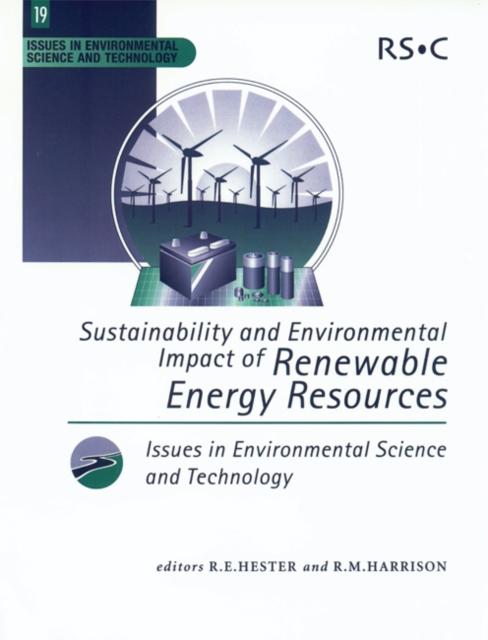
Sustainability and Environmental Impact of Renewable Energy Sources
The world's dependence on fossil fuels is widely acknowledged to be a major cause of rising levels of carbon dioxide in the atmosphere. Thus there is an urgent need to develop energy sources with lower environmental impact, with attention focusing on renewable energy sources. Concise, authoritative, up-to-date and readable, this book reviews various energy technologies, as well as taking a critical look at the political, social and economic aspects. Throughout, the emphasis is on renewable energy sources (wind, wave, solar, biomass, etc), but a discussion of fossil fuels and nuclear power is also presented. This timely book, written by recognised experts, will be welcomed by those in the energy industries as well as by policy-makers, consultants and engineers. Students and lecturers will also find the material invaluable.
eBook

The renaissance of renewable energy
\"This book provides detailed yet easily understandable information about sustainable energy alternatives in the context of growing public concern about climate change, the impending fuel crisis and environmental degradation. It deals with the history of energy use and the factors that have led to the current interest in energy alternatives and assesses the chance of renewable energy replacing fossil fuels in the future. The authors manage to make a highly complex and often intimidating subject not only accessible but also engaging and entertaining. This book unpacks but never simplifies the science of energy, leavening the more technical passages with anecdotes, metaphors, examples and imagery. By also dealing with the history, politics and economics of energy use, it offers both scientific and non-scientific readers a deeper understanding of the most important issue of our age\"-- Provided by publisher.
Book
Green energy and technology
The E-book is a convergence point for state-of-the-art research with preliminary but confirmed results. Topics covered in this e-book include transport, electricity generation, bio-fuels, Homogenous Charge Combustion Ignition research, kinetics, thermodynamics, combustion, (photovoltaic) solar energy, biomass, hydrogen combustion, hydrogen stocking, wind power, wind energy, hydro-electric power plants and fuel cells.
eBook

The Development of Renewable Energy Sources and Its Significance for the Environment
This book analyzes the effects of power generated by renewable energy sources, renewable energy production technologies, energy efficiency, and market regulation of carbon emissions. It elaborates on how these parameters have direct and indirect effects on carbon emission reduction, such as the results of an environmental tax that could directly reduce carbon emissions by decreasing fossil fuel consumption or by stimulating energy savings through technological innovation, as well as how renewable energy sources can affect both economic growth and the environment. In addition to a detailed analysis of the interrelationships between renewable energy consumption, production technology, and market regulation, The Development of Renewable Energy Sources and its Significance for the Environment proposes a model for measuring the effectiveness and results of the interaction between these links. Furthermore, a structure for a marketplace of renewable energy sources is put forward, as well as an outline of the requirements that must be met in order for this market to function. Suitable policy recommendations to enhance the market for renewable energies are also provided
eBook

Solar power : innovation, sustainability, and environmental justice
\"Drawing on case studies and information collected over the past decade, Solar Power tells a story about the social and environmental considerations for scaling solar power. The book articulates a vision for a more sustainable and just solar industry. While decarbonizing electricity systems with clean, solar power will have tremendous social and environmental benefits, scaling solar industries for electricity will have impacts from global supply chains to land use, through end-of-life that need attention to avoid environmental justice, land use, and waste impacts associated with manufacturing, deployment, and disposal of these clean technologies\"--Provided by publisher.
Book
Innovative Energy Strategies for CO2 Stabilization
The vast majority of the world's climate scientists believe that the build-up of heat-trapping CO2 in the atmosphere will lead to global warming unless we burn less fossil fuels. At the same time, energy must be supplied in increasing amounts for the developing world to continue its growth. This book discusses the feasibility of increasingly efficient energy use and the potential for supplying energy from sources that do not introduce CO2. The book analyses the prospects for Earth-based renewables: solar, wind, biomass, hydroelectricity, geothermal and ocean energy. It then discusses nuclear fission and fusion, and the relatively new idea of harvesting solar energy on satellites or lunar bases. It will be essential reading for all those interested in energy issues, including engineers and physicists (electrical, mechanical, chemical, industrial, environmental, nuclear), and industrial leaders and politicians. It will also be used as a supplementary textbook on advanced courses on energy.
eBook